


 Liz Brown
In Lynne Tillman’s latest collection of art writing, meaning may not arrive, but attention persists.
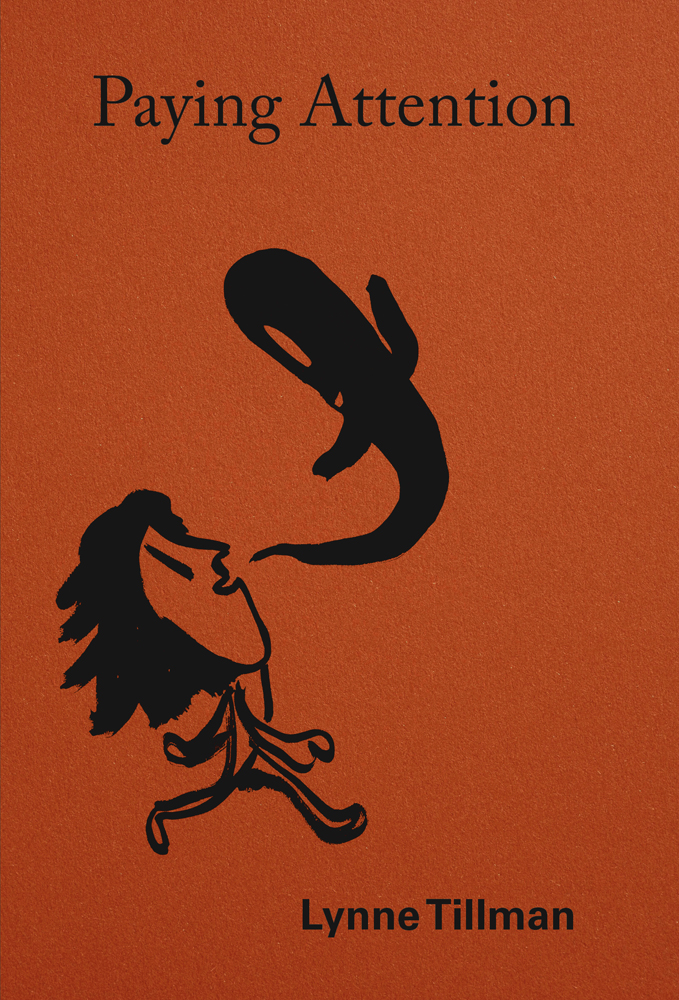
Paying Attention: Essays on Art and Culture, by Lynne Tillman, edited and with an introduction by Elizabeth Schambelan,
David Zwirner Books, 469 pages, $45
• • •
Years ago, in a class at the New School, the painter John Zinsser outlined the following sequence when writing about art. First, he said, write down everything you observe: material, composition, color, light, shadow, size, shape, texture, etc. Make no judgments. Simply record. Then, once you have exhausted your powers of perception, and only then, should you begin to analyze, evaluate, or interpret. In other words, pay attention first, make meaning later.
In Lynne Tillman’s latest collection of art writing, culled over the past thirtysome years from catalog essays, her column for frieze, and pieces for other publications, meaning may not arrive, but attention persists. She trains it on paintings, drawings, novels, movies, plays, and dance. Twice, Tillman invokes Wittgenstein’s dictum—“don’t explain, only describe”—though I prefer the affirming simplicity of her reformulation, which she delivers in an essay on Laurie Simmons’s photographs: “Stop, focus, look. Look again.”
These could be dance steps. The Hokey Pokey? The Electric Slide? Maybe a series of pas de deux—in which Tillman duets with the likes of Jane Bowles, Andy Warhol, Meret Oppenheim, and Clint Eastwood. Tillman is always trying to probe the limits of language, to expose the paradox of using words for art, since “words can only approximate” objects. “Words do what a painting can’t, a painting does what words can’t,” she muses in a piece on Etel Adnan, which originally appeared in 4Columns.
What Tillman does with words is circle, riff, wonder, and expound. In her account of Charles Henri Ford’s diaries, she traces a twentieth-century history of friendships among artists in exile while rhapsodizing about the pleasures of dailiness and gossip. In a consideration of Raymond Pettibon, she opens with a-guy-walks-into-a-bar joke, delivers an ardent tribute to “the B-side of art” (Antonin Artaud, Samuel Fuller, Weegee), and tries to picture Henry James at a Hollywood party. In a companion essay to Highway Kind, Justine Kurland’s book of photographs of American road culture, Tillman distills hope, despair, and love into eight short, sharp-edged vignettes of people in transit.
In the 1980s, Tillman created a fictional character, Madame Realism, who drifts through museums, galleries, dinner parties, and other microcosms, dispensing mordant capsules of insight with femme-fatale assurance: “She didn't feel like talking, the telephone demanded like an infant not yet weaned. Anything can be a transitional object. No one spoke of limits, they spoke of boundaries.”
The narrator in Paying Attention is a different woman. For one thing, she is real. “[L]ooking at art requires specific brain work, and the entire body,” Tillman writes; she tells us hers is sixty-two-inches high. She has the same concerns as Madame Realism—the constraints of language, the passage of time, the instability of identity. She, too, has a tendency to pronounce: "A little solipsism goes a long, long way.” But her edges are softer, her eye gentler, her grip looser. “I don’t trust experience, even if it has shaped me; I don’t fervently trust what I think or believe, while I believe it still. A pox on absolutes!”
To be clear, this is not a writer who doesn’t know her own mind. As these essays reveal, she knows her mind so well—“More and more, I trust my imagination to pull me through”—that she’s content to let it wander. The reader gets to come along for the ramble.
The book’s author bio identifies Tillman as a novelist, short-story writer, and cultural critic, but, in her own writing, she sidesteps this last label, referring to her “guise as a critic, who writes alongside art.” “Critic” is a costume for the real person underneath, who is, in her words, a fiction writer, one grown wary of storytelling. “I suppose I want to find a coherent narrative,” she writes of Kaitlin Maxwell’s photographs, “and know I will not.”
“Criticism” isn’t a dirty word, but it’s not adequate to what Tillman does with art, which, as she has put it, “can be a form of consciousness, of consciousness of process.” Her writing, then, is an act of communing with that consciousness, like rain falling into a river. I’m veering into the wooo here, and I’m not about to help the matter when I say that she is after the ineffable. But so was Flannery O’Connor, whom Tillman invokes in a meditation on Joan Jonas’s work, and no one will ever accuse that fiction writer of subsisting on vibes alone. Nor Tillman.
She does not anoint. She does not rank, does not shake her finger and declare, “This is good, this is bad,” which it not to say she doesn’t opine (Thanksgiving is “an ignorant and disturbing holiday”) or proclaim (“Any writer who believes in her or his literary immortality is delusional”) or speak the plainest of truths (”If men didn’t violate women, they wouldn’t have to protect them”).
She produces assiduously close readings of artwork. This is the first sentence in her account of Dana Schutz’s painting Boatman: “There is a disproportionately large head at the top, with one open eye, one closed or vacant.” This could be any kind of head, any kind of eye. The description continues in this vein for two pages, with words that describe but don’t necessarily evoke. In her essay about the artist Jim Hodges, she writes, “I know I want to leave space for readers, so they can put their imaginations to work and make a story theirs.”
Here’s my story: Lynne Tillman is a detective, investigating not art crimes but mysteries, trailing them through literary readings, exhibitions, screenings, and studio visits. Shades of Jessica Fletcher—kind, unflappable, relentlessly curious. Shades of Philip Marlowe—melancholy, sly, poetic. In The Big Sleep, Raymond Chandler’s fictional creation sums up a dodgy storyline with Tillmanian discernment: “It had the austere simplicity of fiction rather than the tangled woof of fact.” Our gumshoe, our girl detective, our private dick, she’s on the case.
Liz Brown is the author of Twilight Man: Love and Ruin in the Shadows of Hollywood and the Clark Empire. Her writing has appeared in Bookforum, frieze, London Review of Books, the Los Angeles Times, the New York Times Book Review, Slate, and elsewhere.