


 Aruna D’Souza
In his first comprehensive US retrospective, a demonstration of the Cuban artist’s practice as an act of decolonization.
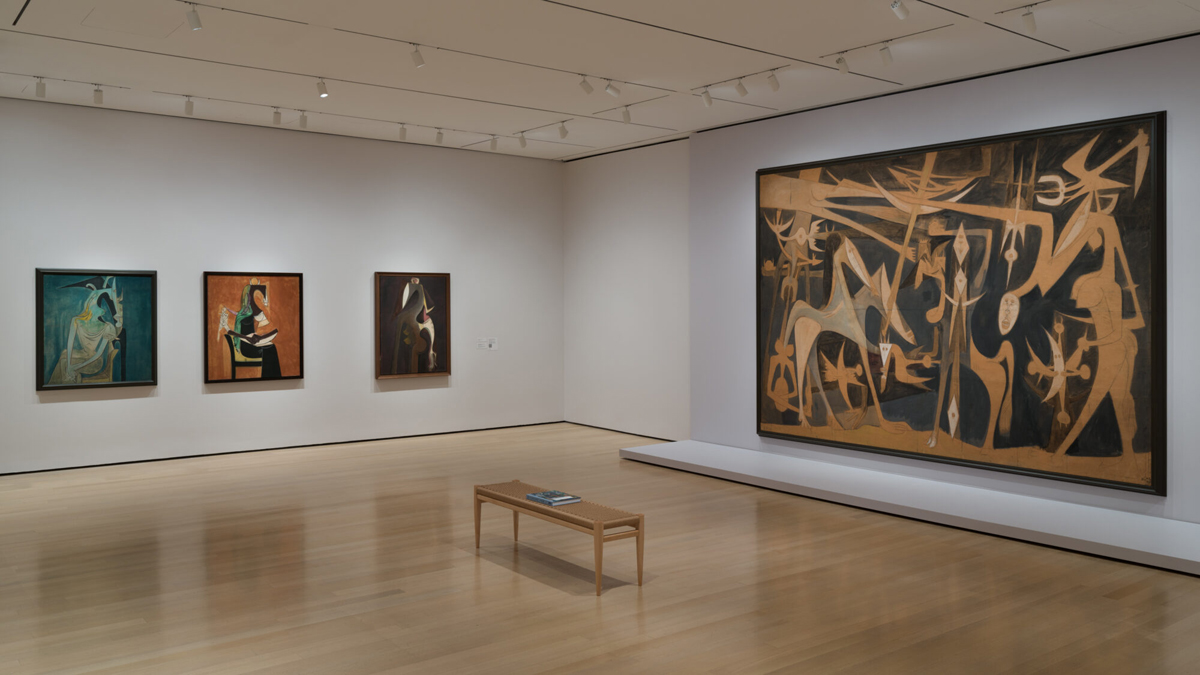
Wifredo Lam: When I Don’t Sleep, I Dream, installation view. Courtesy the Museum of Modern Art. Photo: Jonathan Dorado. Pictured, far right: Grande Composition, 1949.
Wifredo Lam: When I Don’t Sleep, I Dream, curated by Beverly Adams and Christophe Cherix with Damasia Lacroze and Eva Caston, Museum of Modern Art, 11 West Fifty-Third Street, New York City,
through April 11, 2026
• • •
Wifredo Lam: When I Don’t Sleep, I Dream is the first comprehensive retrospective of the artist in the United States, consisting of more than 130 paintings, works on paper, illustrated books, and ceramics realized over a span of five decades. It is less what museums like to call an “art historical corrective”—a show that addresses a scholarly lacuna—and more an “institutional corrective” that seeks to redress the Museum of Modern Art’s very specific past curatorial lapses. Lam (1902–82) became the first Cuban artist represented in the collection when Alfred Barr purchased one of his paintings in 1939; the museum acquired two more in the years following, including Lam’s best-known work, La jungla (The Jungle, 1942–43). And then . . . nada. Not for years. It would be as if MoMA bought Picasso’s Demoiselles d’Avignon and then said, nah, we’re good. Worse yet, La jungla was almost never shown with the rest of MoMA’s collection; it was famously isolated in the lobby near the coat check. When the poet and critic John Yau called the museum out for its belittling treatment of the artist and his masterpiece in a 1988 Arts Magazine essay, MoMA responded not by changing its placement or rewriting its label, but by putting it in storage.
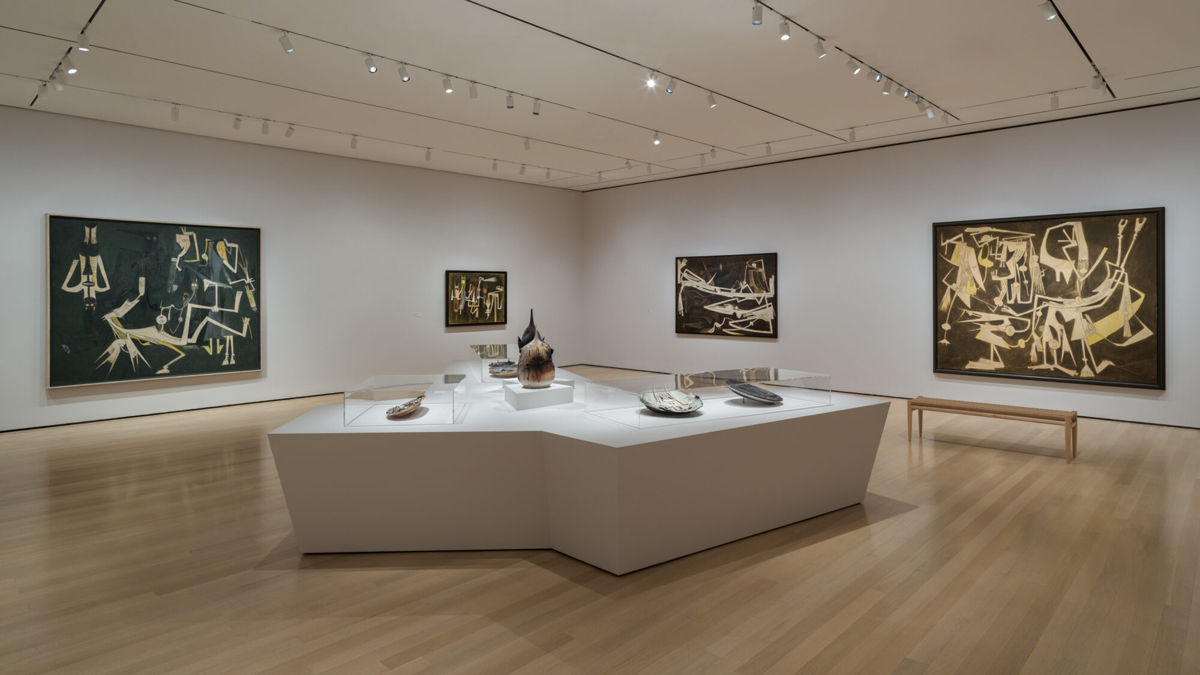
Wifredo Lam: When I Don’t Sleep, I Dream, installation view. Courtesy the Museum of Modern Art. Photo: Jonathan Dorado.
These facts are laid out in the first few pages of the show’s catalog, a sign that MoMA has moved on from its chronic defensive posture in the face of critique and is ready to change course. Building on long-standing scholarly research and past exhibitions, the organizers—Beverly Adams, curator of Latin American art, and Christophe Cherix, the institution’s new director—offer up the story of an artist whose engagement with modern art was framed and determined not only by the créolité of Cuban society and his own complex background, but by the larger context of an emerging idea of Négritude—a diasporic Black consciousness—being developed by people like Aimé Césaire, Lam’s longtime friend and collaborator. Lam considered his practice an “act of decolonization”—the exhibition shows us why.
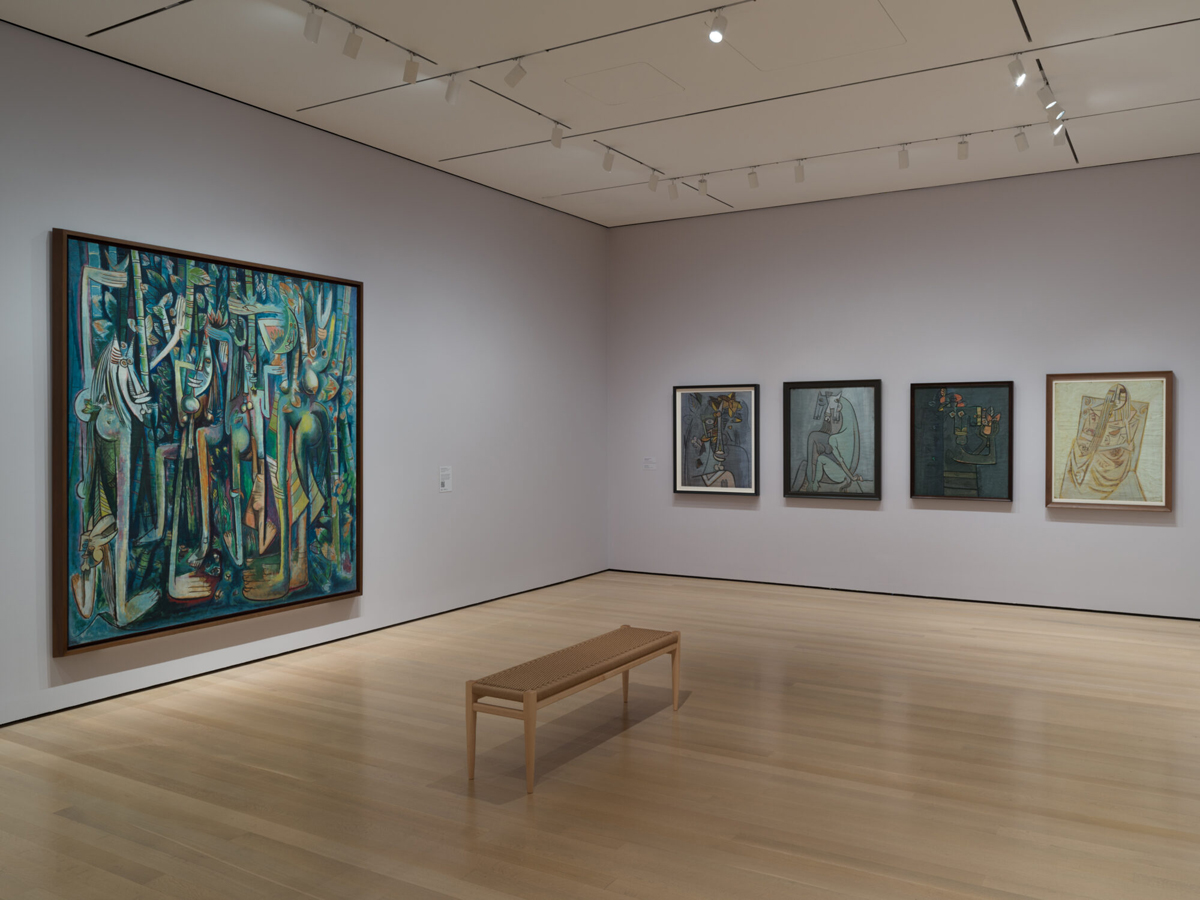
Wifredo Lam: When I Don’t Sleep, I Dream, installation view. Courtesy the Museum of Modern Art. Photo: Jonathan Dorado. Pictured, far left: La jungla (The Jungle), 1942–43.
Though the curators do an admirable job of demonstrating that Lam’s significance went far beyond La jungla—it appears in the second gallery, well into the show—the painting loses none of its power in the process. It has long been one of my favorite artworks, and I’ve spent years puzzling out its densely packed, shadow-box composition, clearly influenced by the artist’s study of Cubism, Surrealism, and other European avant-garde styles. Figures—all legs and hands and feet and an occasional buttock and coconut-like breast, with faces like African masks—merge with sugarcane stalks and foliage, everything suffused with tropical blues, greens, oranges, pinks, and purples. I always fixate on one detail: in the upper right corner, a paw-like hand clutching a pair of oversize shears. To my eye, that feature was what separated Lam’s picture from the modern art that filled the galleries upstairs, work which likewise drew upon African culture but placed that culture definitively out of time, and therefore untethered to histories of colonialism, violence, capitalism, exploitation. But Lam’s shears: they were a sign of labor. A reminder that, whatever the otherworldliness of this jungle, it was very much also a plantation.
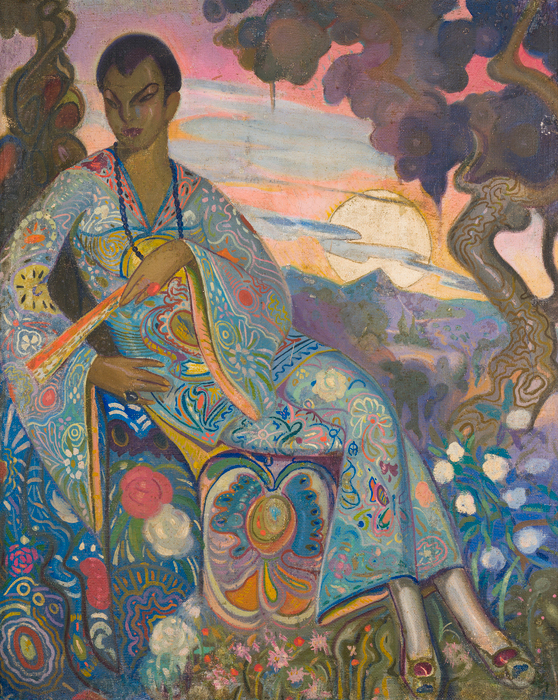
Wifredo Lam, Sol (Sun), 1925. Oil on burlap, 44 1/2 × 36 inches. © Succession Wifredo Lam, ADAGP/ARS.
Lam was born to a father of Chinese origin and a mother of mixed African and European descent—his ancestors had arrived in Cuba because of slavery and, later, the market in indentured laborers brought there to cultivate sugar, first for European colonizers and then American companies. They brought with them spiritual and cultural practices from their respective homes, which survived through a process of both hiding from and melding with the Christianity imposed by their overseers. There are hints in the show that, after moving to Spain in 1923 to continue his studies, the artist began to plumb his personal identity—as with the intriguing oil-on-burlap Sol (Sun) from 1925, likely a self-portrait. It depicts a man in a gloriously embroidered robe posing languidly, fan in hand and beads around neck, against a setting sun. (This work is so clearly homoerotic, and yet no mention of that fact is made in the wall label or catalog. What gives?) But such pictures are rare in Lam’s oeuvre, suggesting that exploring his own background was less important to him than taking part in a greater project of defining Afro-Caribbean creativity to plant seeds of political liberation; Césaire wrote in 1946 that his friend was a central figure in leveraging painting “against the sordidness of history.”
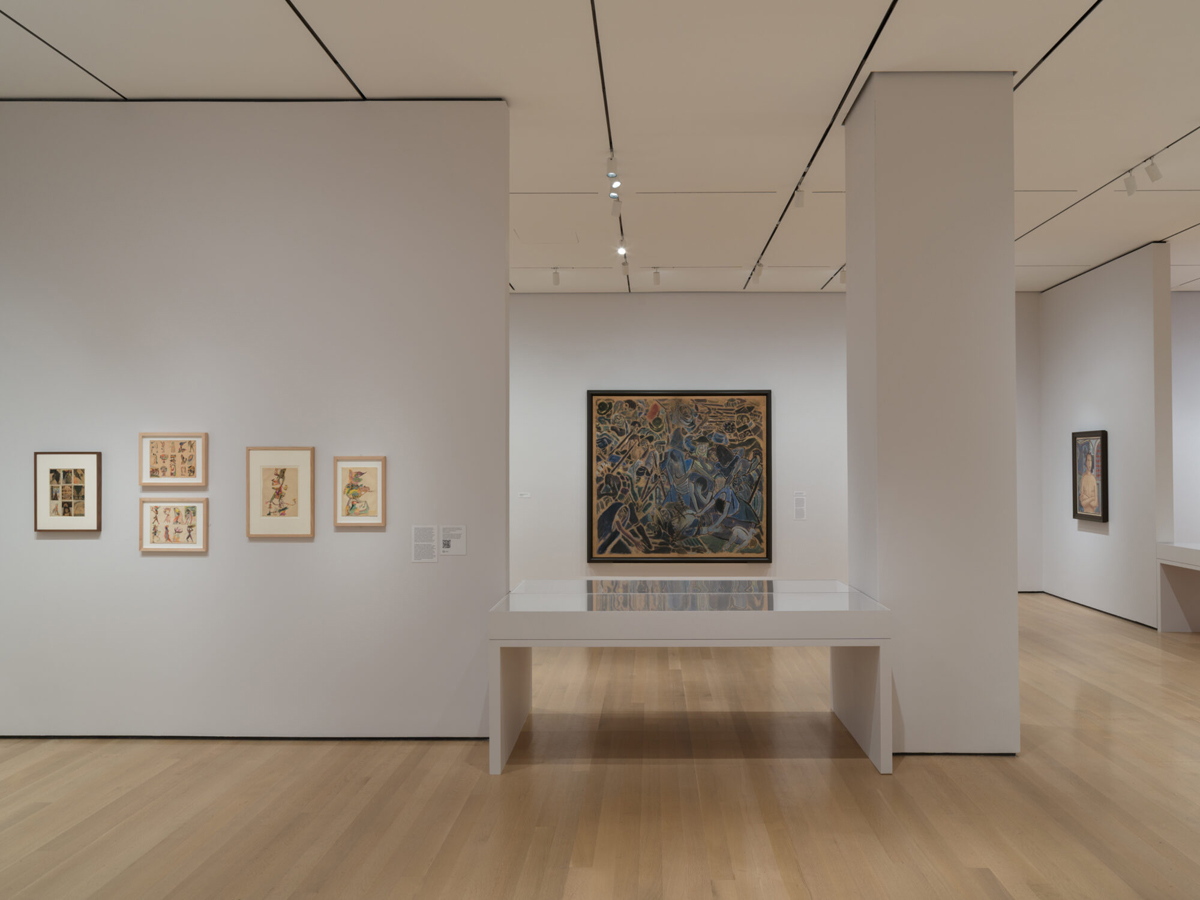
Wifredo Lam: When I Don’t Sleep, I Dream, installation view. Courtesy the Museum of Modern Art. Photo: Jonathan Dorado. Pictured, center right, on back wall: La guerra civil (The Spanish Civil War), 1937.
While pieces like La jungla intimate Lam’s deep connection to Cuba, he spent a mere decade of his adult life there. After completing his studies in Spain, he stayed on to take part in the resistance against Franco’s fascist onslaught, producing a major painting on the subject in 1937 (La guerra civil, The Spanish Civil War). In 1938, he fled to the French capital, where he was introduced to Picasso and the Surrealist ringleader André Breton, as well as other artists of the School of Paris. When the Nazis showed up in 1940, he took refuge in Marseille, immersing himself in Surrealist drawing techniques alongside Breton, Jacqueline Lamba, Victor Brauner, Óscar Domínguez, and others. (A number of the group’s collective drawings are in the show.) A year later, he secured passage back to the Caribbean, first to Martinique and then to Cuba. In 1952, in response to both political upheaval and the exhaustion of living in a country so steeped in anti-Blackness, he returned to Paris, where he lived until his death.
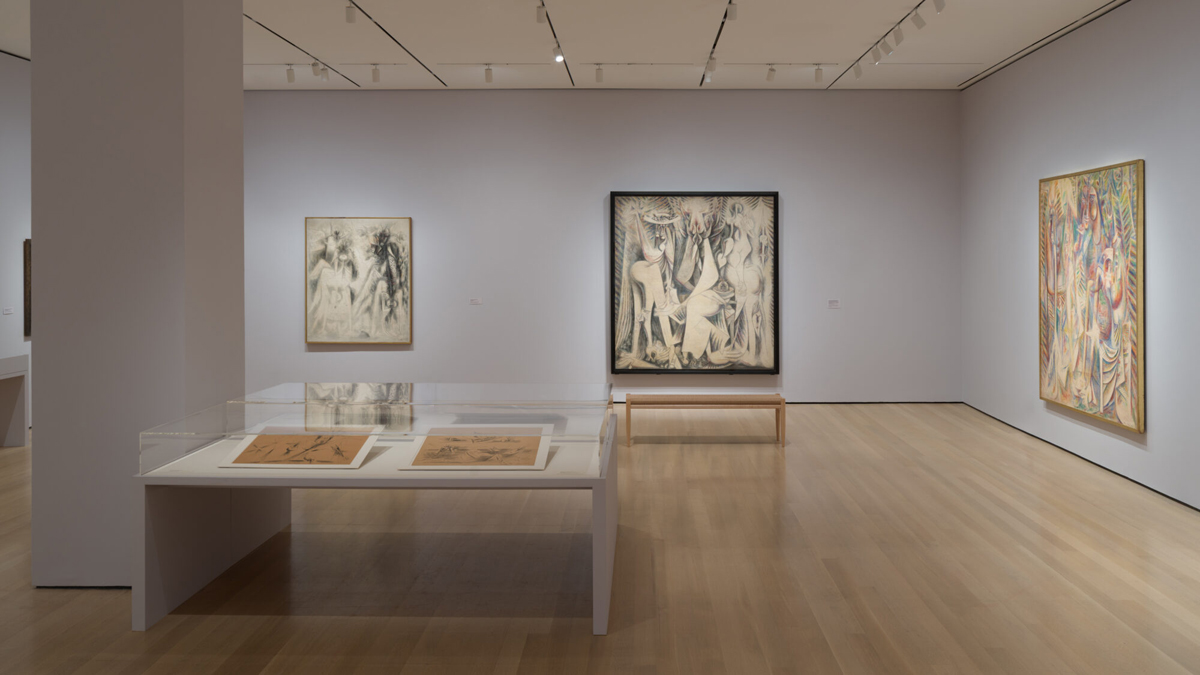
Wifredo Lam: When I Don’t Sleep, I Dream, installation view. Courtesy the Museum of Modern Art. Photo: Jonathan Dorado. Pictured, far right: Harpe astrale (Astral Harp), 1944.
In other words, even as his work has much to say about Afro-Cuban culture, the political consciousness that drove it developed mostly outside Cuba. It was when he arrived in Paris, for example, that he noticed how African and Oceanic art had been embalmed in European museums and appropriated by European modernists, aligning both phenomena with the violence of slavery: “Yesterday they sold Black flesh, today they monopolize the Black spirit, Black dreams, as objects of curiosity.”
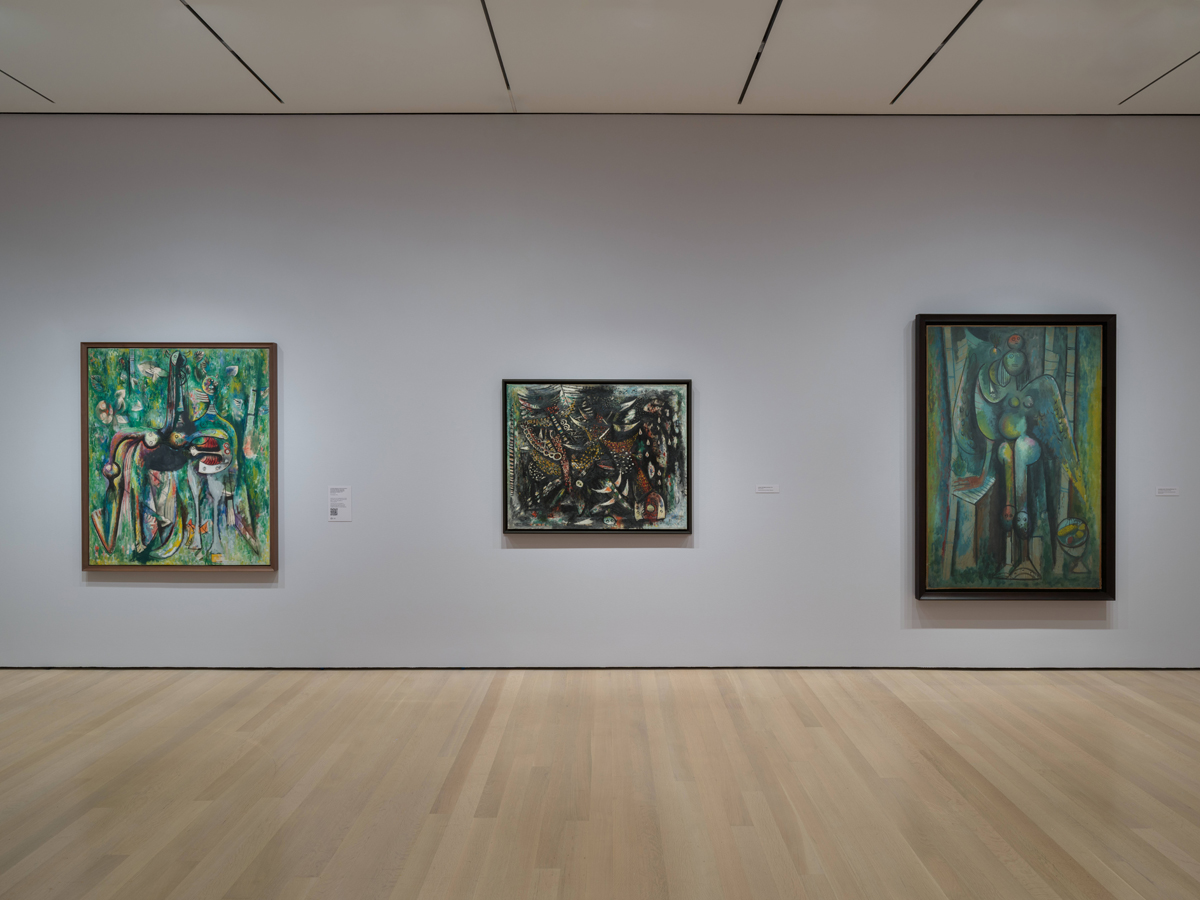
Wifredo Lam: When I Don’t Sleep, I Dream, installation view. Courtesy the Museum of Modern Art. Photo: Jonathan Dorado. Pictured, far left: Le sombre Malembo, dieu du carrefour (The Somber Malembo, God of the Crossroads), 1943.
His decade in Cuba was spent making works like Le sombre Malembo, dieu du carrefour (The Somber Malembo, God of the Crossroads, 1943), Harpe astral (Astral Harp, 1944), and the monumental Grande composition (1949). They all drew on various elements of Afro-Cuban spirituality, which he learned about largely thanks to his friend, the ethnographer and writer Lydia Cabrera, and his godmother, a priestess of Lucumí (also known as Santería). The Somber Malembo depicts a number of orishas, or deities, including one—Eleguá—who represents the idea of crossroads. Curiously, Lam calls another of his figures Malembo—the name derived from that of a major slave port in Kongo. Here, again, is a detail that signals that no matter what his personal connection to his chosen motifs—Lam himself was not a practitioner of Lucumí, in fact—he refused to simply adopt them in the manner of European modernists. When orishas appear in his work, they are firmly located in the historical conditions that brought them from West Africa to the Caribbean, and that continued, and continue, to shape life there. It was a process, he said, of taking Cubism, Surrealism, and other European movements back to their origins in African culture, reintegrating them with “all the transculturation that had taken place in Cuba among the Indigenous, Spaniards, Africans, Chinese, French immigrants, pirates, and all the elements that formed the Caribbean.” Seen in this light, Lam’s achievement wasn’t simply a variation of modernist art, but its apotheosis.
Aruna D’Souza is a writer and critic based in New York. She contributes to the New York Times, 4Columns, and Hyperallergic. Her new book, Imperfect Solidarities, was published by Floating Opera Press in 2024.