


 Moyra Davey
Lovers, friends, rivals, antagonists: Andrew Durbin’s revelatory biography of Peter Hujar and Paul Thek.
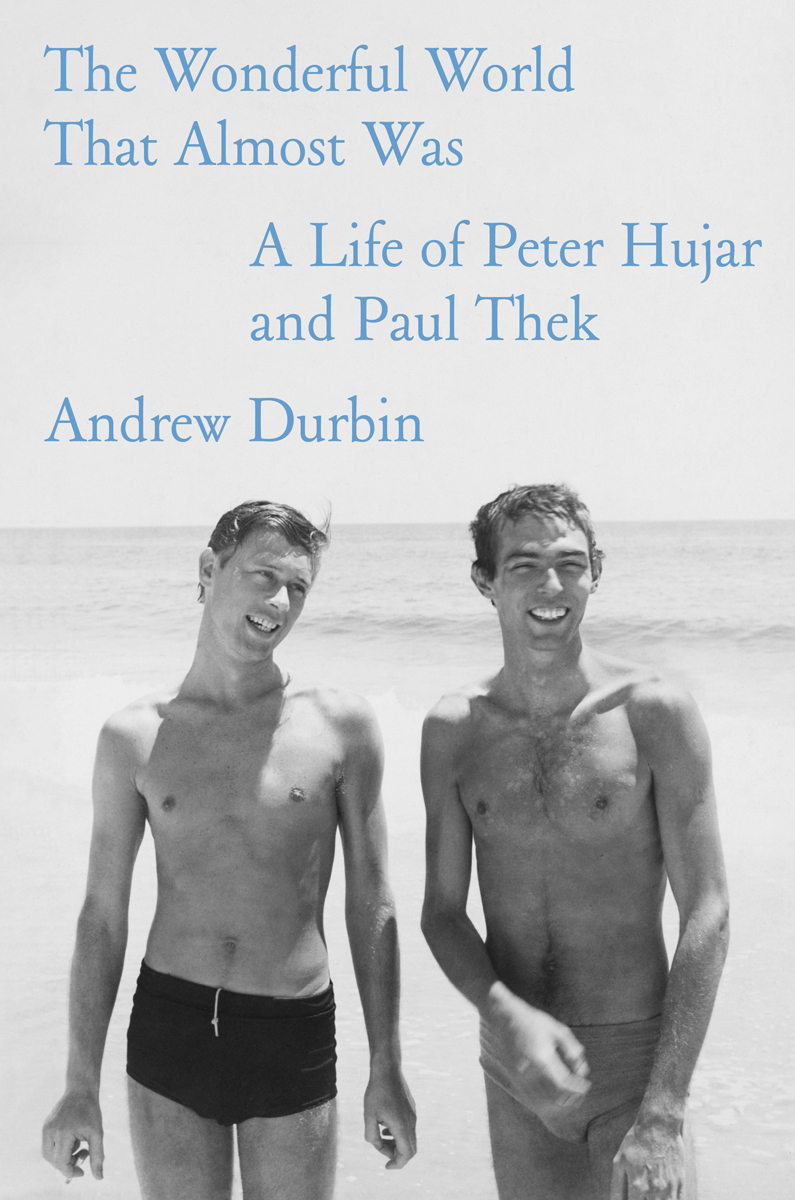
The Wonderful World That Almost Was: A Life of Peter Hujar and Paul Thek, by Andrew Durbin, Farrar, Straus and Giroux, 480 pages, $36
• • •
The Wonderful World That Almost Was is a timely narrative account of the thirty-one overlapping years in the lives of enigmatic, outsize personalities Peter Hujar and Paul Thek, during which they were lovers, friends, rivals, and ultimately antagonists. In alternating chapters, we encounter the subjects (born eleven months apart, Thek in 1933 and Hujar in ’34) first as youths, then as precocious young men trying to establish themselves as artists and professionals in New York City in the early 1950s. Unable to afford the metropolis, Thek, a recent graduate of Cooper Union, decamps to Coral Gables in Florida; Hujar begins working at a commercial photography studio in midtown Manhattan.
Their lives first converge in 1956, when Hujar and his then-lover, a former classmate of Thek’s, plan a road trip south to visit him, and Hujar makes his first dreamy portraits of his new acquaintance, in the woods and at home. In fact, they trade off the camera, and it is possible to see both young men (though not in this volume) in reverse shots among the trees. They will become lovers in 1960, after Peter returned to NYC from Italy, and will enjoy a few years of harmony at the center of a vibrant downtown art and literary scene. They are pictured on the cover of Andrew Durbin’s book in 1961, lean, handsome, and boyish in swimsuits, with wide smiles. Gradually, over the course of the next two decades, things between them will begin to sour and unravel.
Described as “saturnine” and “childlike,” respectively, Hujar and Thek, in other ways, have similar, uncompromising temperaments—both could be rageful, and both famously disdained the art world and sabotaged their own careers; neither ever sold much work, and both endured ongoing financial precarity. But, of the two, Hujar was by far the more grounded—he lived most of his life in NYC, whereas Thek spread himself across two continents and multiple cities. He also spent many years on the road, when his career was at its height and he was in demand, staging massive, unruly installations in European museums and galleries. Mike Kelley would later refer to these ephemeral artworks as “cosmic junk piles.”
Juicy and fast-paced, The Wonderful World is studded with anecdotes of all the people we enjoy reading about, with Susan Sontag, a friend and confidante (to both) and occasional lover to Thek, topping the list. Born the same year as Thek, and already a mother at age nineteen, Sontag is glimpsed here as a young woman, not yet famous, dating women, teaching at Columbia University, and partying with Thek in the Village. Writing of Sontag’s attraction to Thek and Hujar, Durbin boldly states: “What Susan most admired in artists . . . she never possessed herself: raw, unreconstructed talent.”
Diane Arbus famously snubbed Hujar and called his work derivative, but, interestingly, her photographs are now installed, as in the recent Constellations show at the Gropius Bau, in a style remarkably similar to the one pioneered by Hujar: i.e., radically mixing up the genres of portraits, architecture, landscape, and animals. No longer a parade of “freaks,” Arbus’s images have a freshness and spontaneity akin to what Hujar always envisaged for his gallery hangings. My first thought upon encountering the Arbus show in Berlin was: this looks a lot like Hujar.
Some of the stories in the bio are from the annals, but much is new and revelatory. We learn, in particular, about the time both artists spent in Italy—Hujar flirting with the neorealist film crowd in Rome, and Thek’s solitary sojourns in remote villages on the island of Ponza, where he made some of his best paintings. This writing is memorable for its lush description of the landscape and architecture, and for its account of postwar Italian culture and mores and the communities that embraced the young men. In Palermo, they famously visited the catacombs, an encounter with mortality that would mark both of them and inform some of their most significant accomplishments.
The Wonderful World is slightly weighted toward Thek, a wordsmith, whose copious illustrated notebooks (which he claimed to be his best works) have been conserved. His many letters to Hujar, who was hyper-organized and a careful archivist, were also safeguarded. Hujar was not a voluble correspondent, nor does it matter in this case, as none of his letters to Thek survived. One could say, as per Elizabeth Bishop, that Thek perfected the art of shedding his earthly belongings. Nonetheless, he left a plentiful written record for biographers to draw on, whereas taciturn Hujar must be interpreted largely via his photographs and 5,783 contact sheets.
There is a long, engaging description of Thek’s process and materials; he admittedly was the more diverse and complex of the two artists. Hujar’s photographs are carefully contextualized and fleshed out, and there is an account of his darkroom method, the manipulation of light and shadow he used to “make the picture tell a story.” We know from many witnesses that Hujar was markedly attuned to natural light, and his portraits were often described as “incandescent,” but we never learn how he lit his subjects in the studio. I would have loved to know about Hujar’s studio lighting technique, a holdover from his training in fashion in the storied tradition of Alexey Brodovitch and Richard Avedon.
There is a (tacit) companion volume to Durbin’s, just published by Primary Information, containing facsimiles of Thek’s letters to Hujar, and nineteen years of contact sheets and photographs of Hujar documenting Thek. It is highly gratifying to cross-check some of Durbin’s description by consulting this second book, titled Stay Away from Nothing, edited by archivist/artist Francis Schichtel, with an excellent afterword by Durbin himself. It made me wonder to what extent Durbin assumes a reader’s familiarity with Hujar’s oeuvre, as only a handful of his photographs appear in an insert.
The Wonderful World is luscious and absorbing, if sometimes a bit giddy. But it doesn’t matter—Durbin’s writing is passionate, and novelistic in scope; it is also scholarly and precise where it needs to be about the art practices of both men.
Over the course of the 1970s and ’80s, Hujar and Thek would grow mistrustful and estranged from one another. Their mercurial temperaments would become more entrenched, and would trip them up more often. Peter Hujar died of AIDS-related causes in 1987, Paul Thek died of the same the following year. They were prodigiously gifted artists, but it would take decades for their work to gain wider recognition.
There has been much anticipation around the publication of Durbin’s book, stemming in part from the efflorescence and coincidence of recent and forthcoming scholarship on Peter Hujar (Linda Rosenkrantz: Peter Hujar’s Day, 2021; Gary Schneider: Peter Hujar Behind the Camera and in the Darkroom, 2024; the reissue of Hujar’s Portraits in Life and Death, 2024; Joel Smith: Hujar: Contact, 2026; John Douglas Millar: Nude Opera, 2029), as well as the superb Raven Row exhibition in London, and Ira Sachs’s 2025 film Peter Hujar’s Day. Paul Thek’s fame has been growing since the mid-1990s, as have the prices of both men’s work. This is a point of consternation for Hujar’s survivors, and likely for Thek’s, those who witnessed the lives of hardship, when almost nothing sold. Perhaps this critical mass raises questions about yet another posthumous aspirant to the canon, but I for one welcome the new publications. Durbin’s astute joint-biography is a generous addition to the expanding bibliography, and will regale the swelling fan base of these legendary “good strong brother[s].”
Moyra Davey is an artist and writer. Her most recent book is Portrait Mode, 2025.