


 Brian Dillon
Plathies and Swifties unite: Maggie Nelson’s latest explores the overlap between the star poet and the pop star.
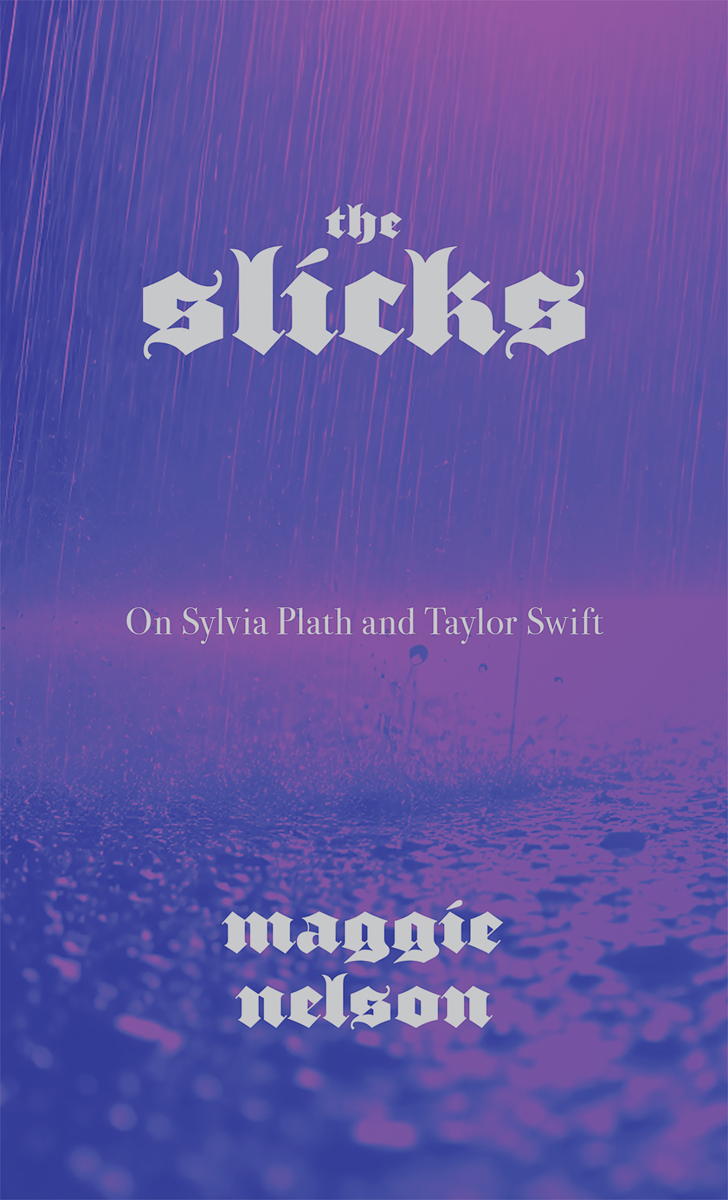
The Slicks: On Sylvia Plath and Taylor Swift, by Maggie Nelson,
Graywolf Press, 51 pages, $12
• • •
Maggie Nelson on Sylvia Plath and . . . Taylor Swift? Before tackling the highest-grossing live performer of all time (such blank statistics play a part in The Slicks, as we’ll see), the poet and essayist had written brilliantly and movingly about pop music in the past. In the New Yorker, on her discovery of Prince when she was ten years old: “I wanted to be a diminutive, profuse, electric ribbon of horniness and divine grace.” In a dialogue with Björk, recalling the singer’s performance in Lars von Trier’s Dancer in the Dark: “I literally could not leave the theatre. I thought I might have to be carried out by an usher.” But reading her new book-length essay about fame, excess, death, misogyny, and more, I kept thinking of any number of singers, musicians, transcendent superstars, and neglected avant-gardists I wished Nelson had chosen over Swift. My running list, just to stick with female contemporaries, includes Rosalía, Solange, Beyoncé, Lana Del Rey, Karin Dreijer, and St. Vincent—because, I suppose, I wanted a book about rhythm and tone and fearless invention. The Slicks is not that; for better and worse, it’s a book about labor and renown.
Why Swift and Plath? In part because in life and work they embody a perennial confusion between life and work: as soon as a song or a poem by a woman is deemed confessional, it is subject to veneration and disparagement, collective accesses (or excesses) of empathy and repulsion. The “I” of the poem or song is presumed to coincide with the name on the title page, record sleeve, or playlist; the work is not so much made as ejected: “the critic’s discombobulation at personal content has led them to apprehend a highly crafted pop song or memoir as craft-free discharge.” This is a self-defeating accusation, says Nelson, because if you cannot see or hear any artifice at work, that simply means the artifice is successful, and you have been convinced that what you read or listen to is unmediated by technique or cunning. With a female pop star, this notion often happily cohabits in the critical mind with the idea that all is actually fabricated and false, that the star is merely playing a part of her own or (more likely) some mogul’s invention. As in pop, so also in poetry, at least where “confession” is concerned: Plath oscillates in cultural fantasy between the sad girl who couldn’t help it (genius and suicide, that is) and an energetic striver with unseemly aspirations.
“She knew—and, more scandalously still, she gave full expression to—the thunderous force of her ambition: she had conviction of her genius, a fierce desire to manifest it, and a drive for others to receive the transmission.” Force, drive, expression, desire: what Nelson identifies here in Plath is also what, so she reminds us, Anne Carson describes in her influential essay “The Gender of Sound”—a type of female superabundance that stands in fluid, unsharp relief against the masculine virtue of sophrosyne, which Carson glosses thus: “prudence, soundness of mind, moderation, temperance, self-control.” With her “blood jet” of poetry, her tireless pursuit of publication, her refusal to recognize lit-snob hierarchies about which magazines were quite respectable to place a poem in—concerning all this and a great deal else, Plath is too much. (We might recall here the friends and family of Ted Hughes, who balked at his wife’s appetites: for success, yes, but also for food and domestic comforts in chilly postwar England.) And nothing succeeds like the excess of Plath’s death, which permanently throws the incomplete Ariel into its shadow. The poems in their turn are savagely extra: of course the father is also a fascist who is also Hughes.
Nelson very persuasively casts both Plath and the female artist in general in Carson’s anti-sophrosyne terms: an overspill of creative energy that contemporary Trumpian ideology would like to put back in its place alongside women’s freedom, rights, autonomy, and safety. What Nelson cannot do is ascribe anything like the vortical energy of the Ariel poems to the mature lyrics of Swift, who is now five years older than Plath ever was. (Nor to her music, but then The Slicks is not at all about music.) Never mind the old boomer-scholar controversies about whether Bob Dylan, say, could compete with John Keats; you can find such debates misguided and forced, but still wish for something more urgent, extravagant, or economical, knowing and unknowing, both flashier and more inscrutable, from pop lyricism. Certain lines live in the mind forever, no matter their obvious import or level of sophistication. Solange: I saw things I imagined. Del Rey: Now my life is sweet like cinnamon / Like a fucking dream I’m living in. Nelson has to admit that Swift simply can’t or won’t embark on lyric adventures that stand comparison with Plath’s—“welcome to the world of pop music; it ain’t poetry.”
Except, I suppose, when it is, when its pressure on body, soul, or mind has nothing to do with a song’s message and a lot to do with the sound of language as much as the sound of sound. Perhaps the difference between Swift and a poet or great lyricist is that the words to her songs seem not so much written as written down: their mere sense trumps their sensuous capacities. So where then is Swift’s excess? In those numbers I mentioned earlier. According to Nelson, it’s the sheer profusion of her product, the scale of performance and its scheduling, the piling up of eras and versions, the reality and the projection of endless labor—the labor of the star and her surrounding machinery, for sure, but also the tireless duties of fandom—that constitute her glutting talent, even genius. And yes, a female pop star is much more apt to be upbraided for such logistics, such riches. Fame and popularity don’t disqualify Swift from being a glorious pop star, any more than Plath is barred from greatness by still being a staple of young-adult inwardness. But one might just wish for a more audacious object of Nelson’s attention.
Brian Dillon’s memoir Ambivalence will be published by New York Review Books in 2026. He is working on a novel, Charisma.