


 Leo Goldsmith
In Lucrecia Martel’s first full-length documentary, a continued fascination with the limitations of perspective and the obtuseness of the bourgeoisie.
Still from Our Land (Nuestra Tierra). Courtesy Strand Releasing.
Our Land (Nuestra Tierra), directed by Lucrecia Martel, now playing in theaters in New York City and San Francisco,
opens in Los Angeles May 8, 2026
• • •
Despite its emphatically terrestrial title, Our Land begins in outer space. Viewed from a satellite, Earth appears as a distant blue-and-white orb in the void, before the film cuts to another airborne perspective, tracking across the verdant rural lands of northern Argentina. As a ghostly rendition of the Kyrie by the leftist folk singer Mercedes Sosa plays in the background, we descend closer to the surface, gliding in the unmistakable drift of an aerial drone, then follow a motorcycle along a country path to a soccer field.
This prologue is surprising, given that Our Land—the fifth feature from Argentine director Lucrecia Martel, and her first full-length documentary—centers on Indigenous land rights and the struggle for justice in the Chuschagasta community of Tucumán Province. This dispute, linked with centuries of settler-colonial expropriation, came to a head in October 2009, when sixty-eight-year-old community member Javier Chocobar was shot and killed during an altercation with three outsiders who claimed to own a small mining concern located on Chuschagasta lands. Once Martel’s camera alights on terra firma, we learn of these events, at least initially, through footage shot during a 2018 trial for Chocobar’s murder.
Satellites and drones on the one hand, judicial procedure on the other: two ways of framing this story that seem to align more with the gaze of the state, the law, or the military rather than that of el pueblo. For those familiar with Martel’s body of work, these images are doubly unexpected for their zoomed-out point of view. The perspectives of her previous films are much more confined, even claustrophobic, marked by intimate depictions of domestic and professional spaces composed in cramped shots: the hermetic, fetid domain of upper-class alcoholics in La Ciénaga (2001); the narrow world of adolescence and religious fervor in The Holy Girl (2004). In The Headless Woman (2008), a hit-and-run accident is rendered with such constriction of focus that the viewer cannot be certain it occurred at all. Her most recent narrative feature, Zama (2017), gestures toward the more expansive canvas of a period drama set during the years of colonial conquest, but it too evokes its protagonist’s limited vision through its own formal and metaphorical myopia.
Still from Our Land (Nuestra Tierra). Courtesy Rei Pictures.
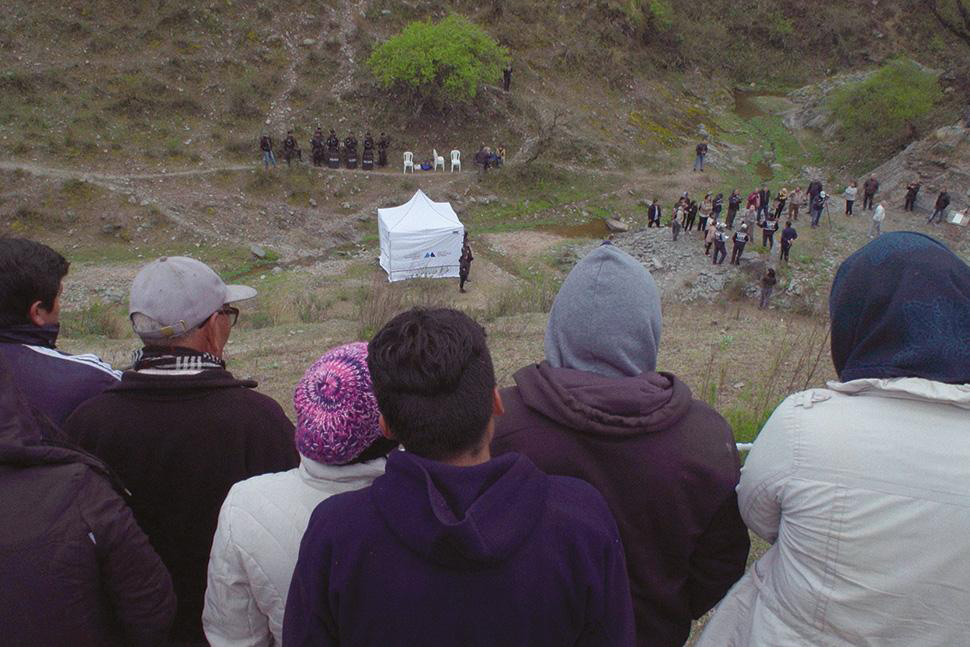
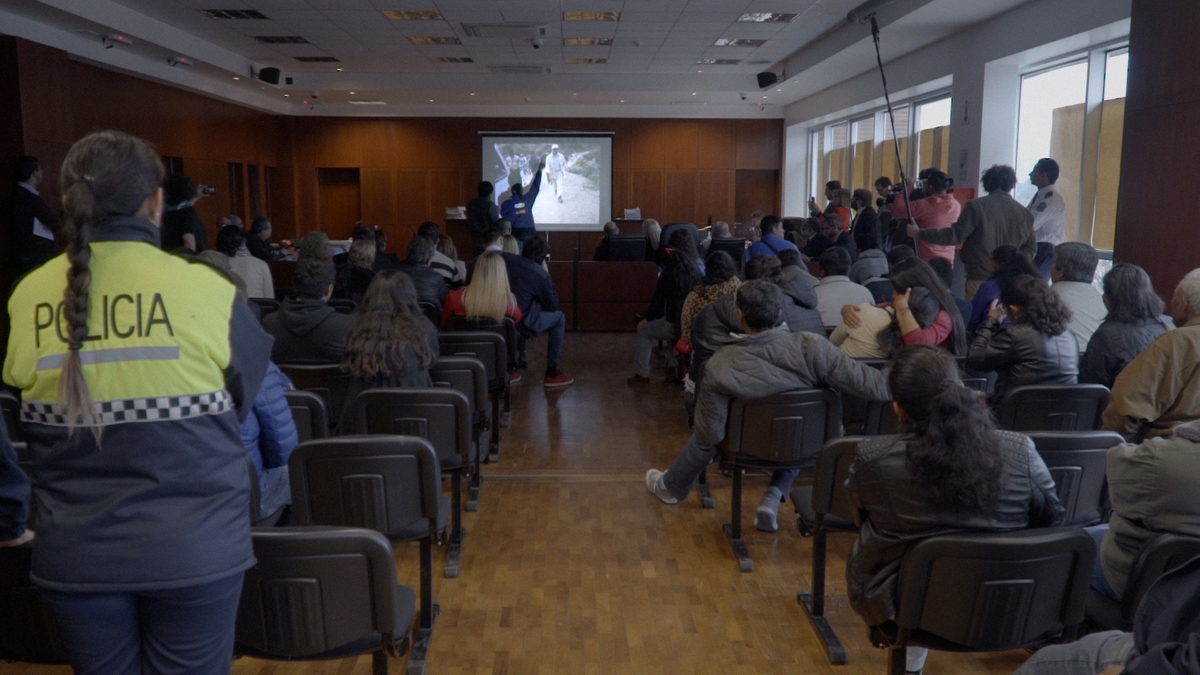
As nonfiction, Our Land at first seems like a very different kind of film, and yet it is still greatly concerned with the limitations of perspective, as well as the forms and technologies that capture and make its events legible as images. Midway through, a defense attorney in that 2018 trial formally objects to the fact that a film is being made—Martel’s film, the film we are watching. In fact, we have already seen the courtroom transformed quite literally into a cinema. Attendants set up a screen and arrange chairs for the viewing of the trial’s principal piece of evidence, a jerky, low-resolution video recorded by the accused depicting the lead-up to the murder before devolving into jagged pixels, with gunshots and screaming in the background. The trial demands that new images be made, too: the prosecutors’ forensic team leads a visit to the scene of the crime, turning it into a kind of location shoot in which the accused men reenact the events of the killing for the camera, complete with props and extras.
As in all legal dramas, the courtroom becomes a stage as well, revealing the inherent theatricality of the public trial and its supposed execution of justice. As a continuation of her previous films’ fascination with the bourgeoisie and their lack of self-awareness, the courtroom proves a natural setting for Martel—a theater of the absurd where the judges sip coffee from demitasse cups brought to them by an underling with a server’s tray and the microphone at the dais buzzes erratically, whining with audio feedback. In this milieu, Martel relishes any opportunity to expose the pomposity of authority, as when one of the accused proudly announces his credentials as an employee of the “Honorable Legislature” in “Historical Heritage,” or when a special-forces expert rises to demonstrate the way law-enforcement officers are trained to walk backward.
These comic moments are fleeting. Increasingly, it becomes clear that the proceedings are designed to structurally disadvantage—and humiliate—the members of the victim’s community, who are relentlessly grilled about their levels of education and literacy. During a segment that’s quite alien to the American judicial system, an Indigenous witness is even placed into direct, one-on-one confrontation with a defendant, a former cop with the clear upper hand.
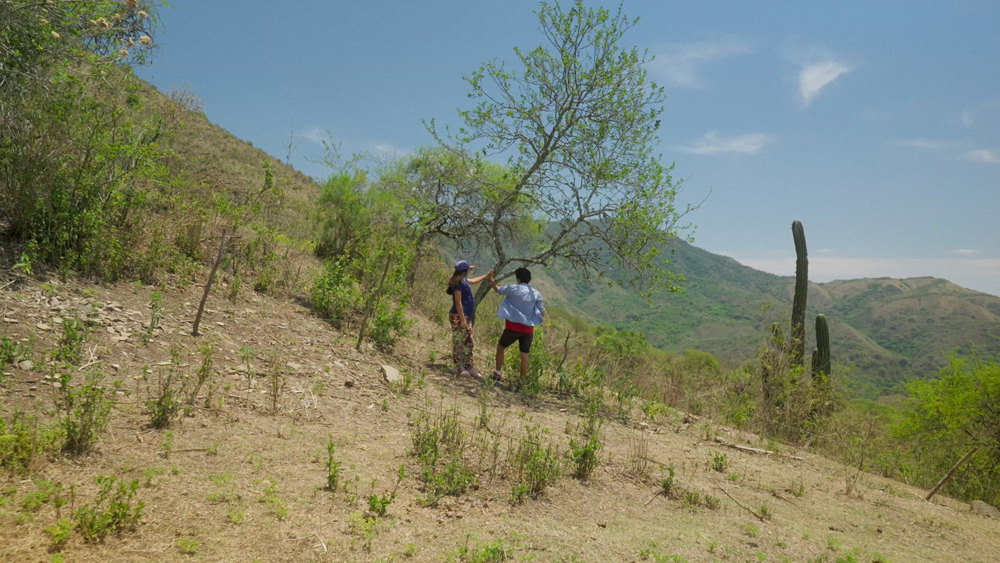
When the film intermittently leaves the courtroom, it becomes both more expansive and more intimate. The claustrophobia of the trial gives way once again to the view of the drone—still an outsider’s gaze, but more liberated—affording access to green pastures and dusty, vertiginous trails as we follow a herd of goats, a wild horse, and humans through Tucumán’s rugged terrain. Freed from legal protocol, the authority of colonial documentation, and the performance of justice, Our Land deviates into the personal and the domestic, memory and imagination. We look on as elders leaf through decades-old photographs of a village dance. The community assembles for a costumed procession. A young couple ascends to the top of a hill to discuss their ideas for building a home.
Still from Our Land (Nuestra Tierra). Courtesy Strand Releasing.
Martel in this way signals an awareness of her own position as interloper. Both the film’s structure and Ernesto de Carvalho’s cinematography delicately convey the sense of a slow approach toward its subjects. (Our Land owes this form, at least in part, to the contributions of two editors, Jerónimo Pérez Rioja and Miguel Schverdfinger, and cowriter María Alché, an actor-director whose first film credit was her role as the horny and delusional title character in The Holy Girl.) As the film draws nearer to both the people and the land, it also offers perspectives on the Chuschagastas’ contested status in Argentina. More than once, it is presented less as a tradition one is born into than as a status one must reckon with. Older community members narrate a process by which they realized, then came to accept, an identity and all that comes with it: the brunt of racism, dispossession, and disenfranchisement, of which the Chocobar murder is just one instance.
Undeniably, one of the documentary’s principal aims is to point out how these forces persist in the twenty-first century through ignorance, casual racism, and legal and economic structures designed to exclude the Chuschagastas. More insidious still, their Indigenous status itself is continually undermined. In one scene, a defendant refers to them as “Indigenous, allegedly.” In another, a defense attorney gruelingly questions a witness about the process by which one becomes a member of the Indigenous community, as if it were a country club.
All of Martel’s films resist conventional cinematic shortcuts to psychological interiority. In Our Land, too, she finds another way into the intimate domestic spaces of the Chuschagasta community, while acknowledging she is not a part of it. At the same time, the film makes clear the ways in which a settler state constantly places the burden of authenticity, of identity, of land rights, onto the dispossessed: the colonized must always provide evidence that they are colonized. Cinema can work on either side of this struggle, and Martel demonstrates that its position must be questioned—and sometimes altered by force. In one aerial shot late in the film, a passing bird knocks the drone out of the sky, sending it tumbling to earth.
Leo Goldsmith is a writer, teacher, and curator based in Brooklyn. He writes about art and film for such publications as Artforum, art-agenda, the Brooklyn Rail, and Cinema Scope.