


 Jennifer Krasinski
A twenty-five-year survey at the Guggenheim illuminates the run-up to the artist’s fluid and gestural steel sculptures.
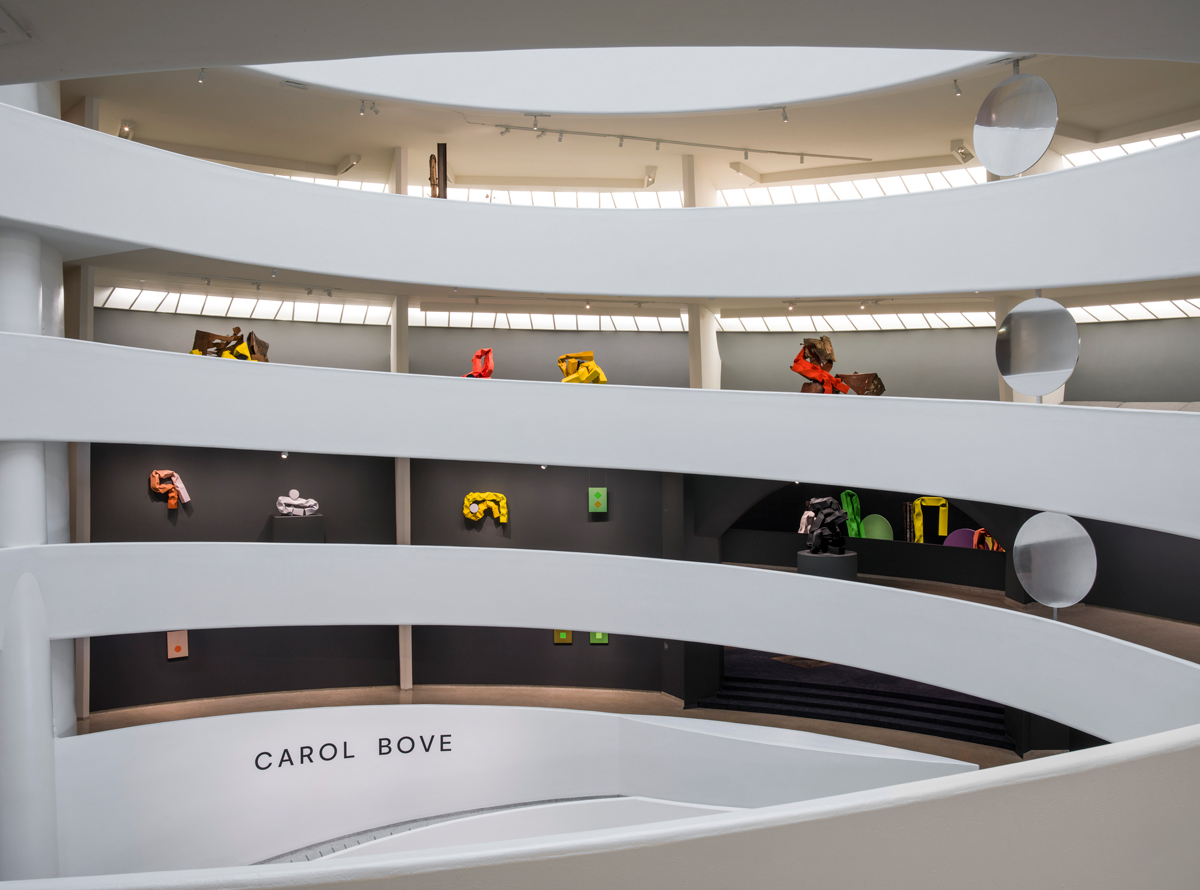
Carol Bove, installation view. Courtesy Solomon R. Guggenheim Museum. Photo: David Heald. © Solomon R. Guggenheim Foundation.
Carol Bove, curated by Katherine Brinson with Charlotte Youkilis and Bellara Huang, Solomon R. Guggenheim Museum, 1071 Fifth Avenue, New York City, through August 2, 2026
• • •
One of the many enchantments of the Guggenheim’s spiral is how it can run time in two directions at once. Descend its ramp, walking clockwise from the top floor, to take in the museum’s twenty-five-year survey of Carol Bove’s work in chronological order, beginning with light-handed pen drawings and sculptural assemblages she made in the 2000s. Back then, she was thinking around and about found objects, road-testing their resonances. Or, go up the ramp, counterclockwise, and trace her trajectory backward from Sweet Charity (2026), seven towering sculptures freshly made for this exhibition in the style and materials for which she is perhaps now best known: aluminum and stainless steel that’s been improbably crushed, rumpled, and wrinkled, and coated in high-intensity pigments—burnt orange, dusky lavender, canary yellow, and so on—that give her metals a hard-shell-candy finish.
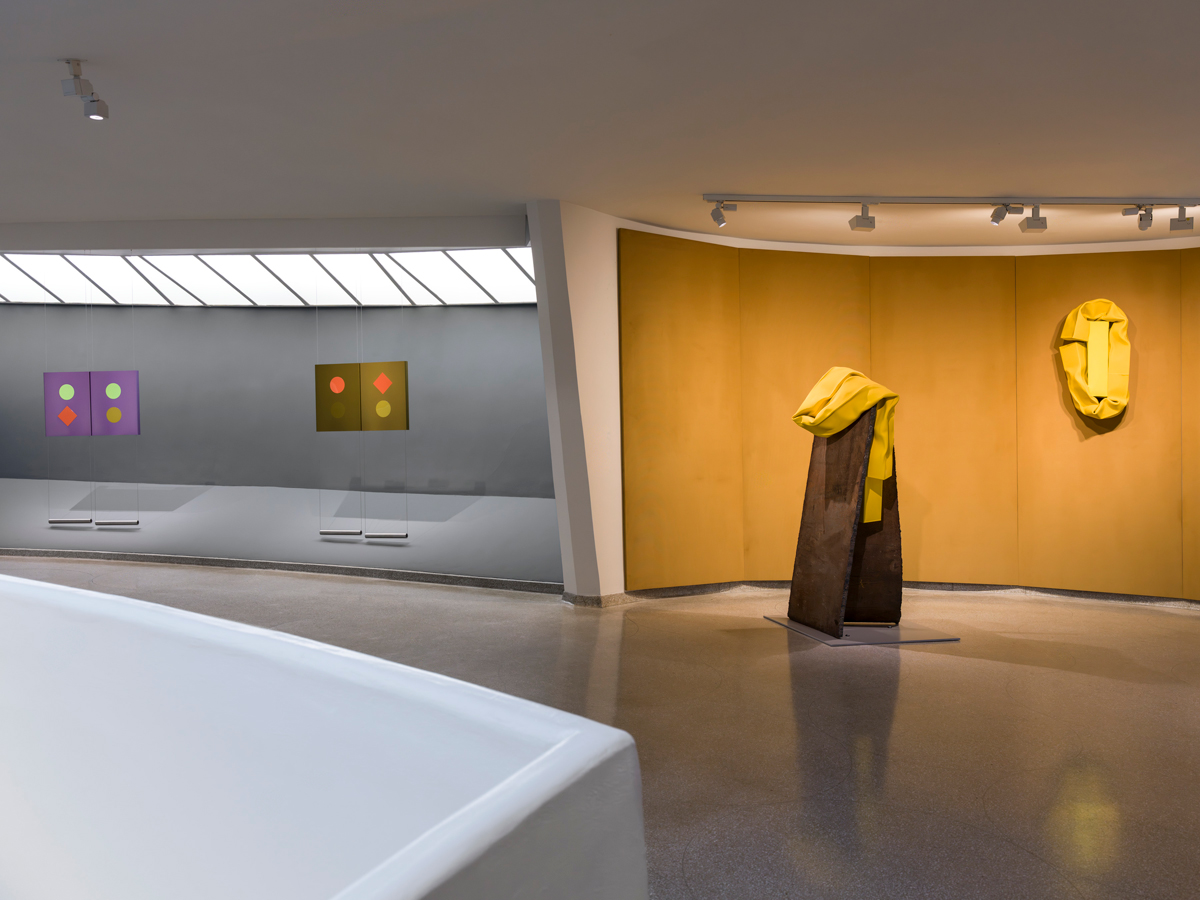
Carol Bove, installation view. Courtesy Solomon R. Guggenheim Museum. Photo: David Heald. © Solomon R. Guggenheim Foundation. Pictured, far left and second from left: Widdershins 81, Widdershins 82, Widdershins 87, and Widdershins 88, all 2026. Center right: 10 Hours, 2019.
It’s difficult to imagine a better context for Bove’s ideas than in Rebay and Wright’s “temple of spirit.” Her work has always been thoughtful, precise, aimed at bending our perceptions of the material world, breathing a little space between the acts of looking and seeing. Here Bove takes on the museum itself, installing, yes, but also integrating and intervening so its many pieces and parts and spaces feel, together with the contents of her exhibition, like a sum-total über-artwork. Six aluminum disks, large and luminous as full moons, which she positioned one per floor, one above another, quickly catch and carry the eye from the lobby up to the museum’s oculus. Bove also designed and placed chess sets throughout the museum, and loungers to lie down on, so visitors can play and rest too. Selections from her Widdershins and Deosil series—words that mean counterclockwise and clockwise, respectively—hang at the top and bottom of the Guggenheim’s ramp and throughout the show, gentle if abstract guideposts reminding us which way we’re heading.
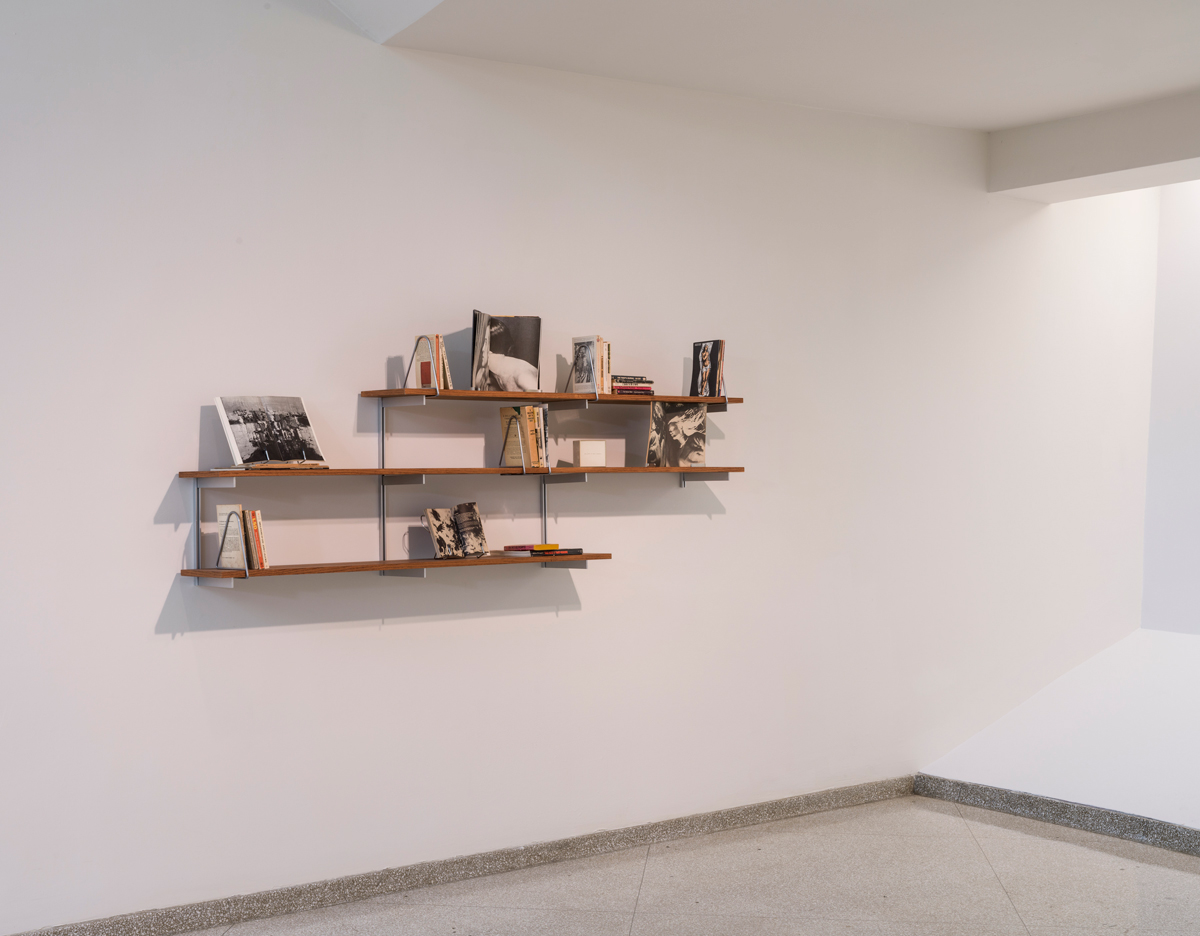
Carol Bove, installation view. Courtesy Solomon R. Guggenheim Museum. Photo: David Heald. © Solomon R. Guggenheim Foundation. Pictured: Adventures in Poetry, 2002.
For what it’s worth, I began at Bove’s beginnings, preferring the forward momentum of a narrative unfolding, a practice developing. For early works such as Adventures in Poetry and How People Get Power (both 2002), Bove selected and politely arranged books and other objects on wood shelving as domestic decor, her choice of reading materials doubling as a portrait of the Baby Boomers’ social and political marrow, covering topics ranging from the sexual revolution to civil rights to self-realization. Bove soon pivoted to milking juxtapositions of found and forged materials for the ways in which they act and react with one another, shifting their presence and, per the viewer, their possible relationships and meanings. She freshly composes the elements comprising The Foamy Saliva of a Horse (2011)—including driftwood, seashells, peacock feathers, and delicate silver and gold chains—every time it’s shown, which in effect creates a time-based sculpture from otherwise still stuff.
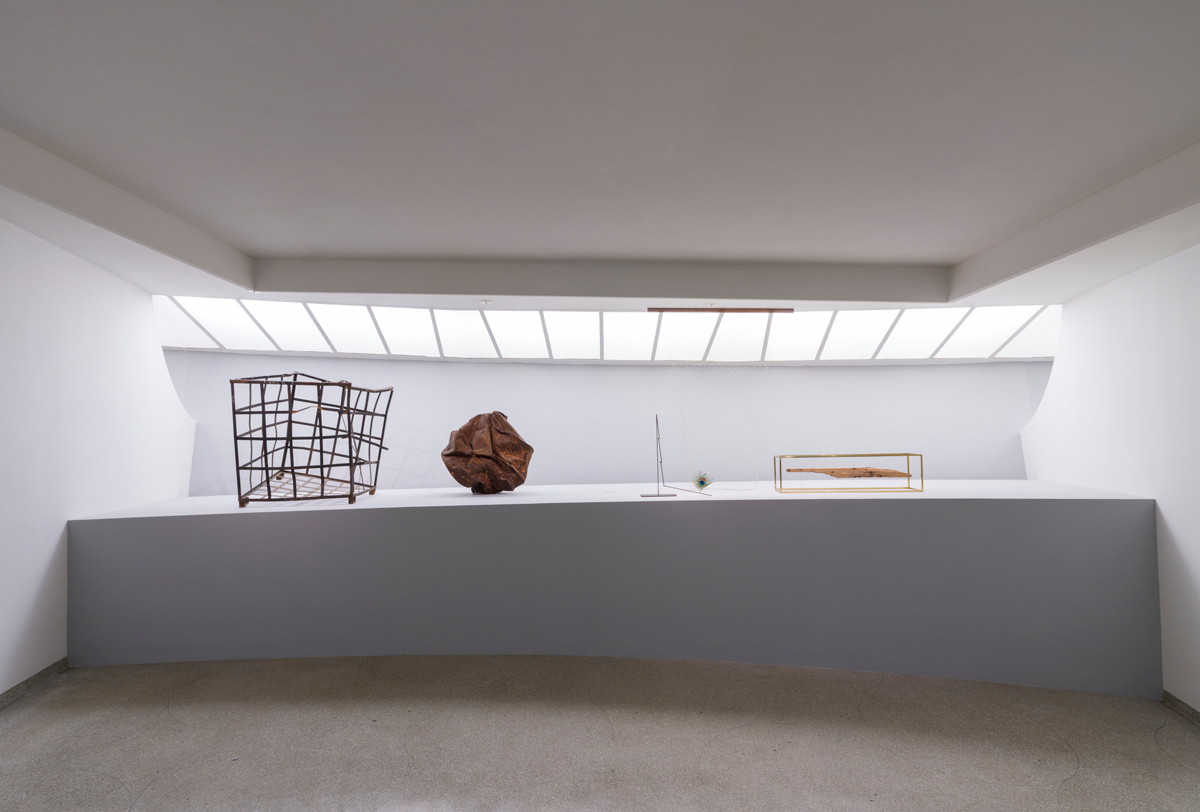
Carol Bove, installation view. Courtesy Solomon R. Guggenheim Museum. Photo: David Heald. © Solomon R. Guggenheim Foundation. Pictured: The Foamy Saliva of a Horse, 2011.
Around 2016, Bove began to work with steel and urethane paint to create what she refers to as “collage sculptures,” that year producing graceful pileups of bent metal like Mouse Hole and Luxembourg, the roughness of each mediated by thrills of color and punctuated by perfect circles. Soon she honed the mechanical process by which she continues to make one of the world’s strongest, most rigid materials look fluid, gestural, getting it to wrinkle, pucker, slouch, and drape. Behold show ponies like 10 Hours (2019), a standing steel slab with yolk-yellow stainless casually tossed over its shoulder like a jacket, and Secondhand Damnation (2023), an almost lickable form coated in the sweetest hues of lilac and tangerine, which seem to melt one into the other.
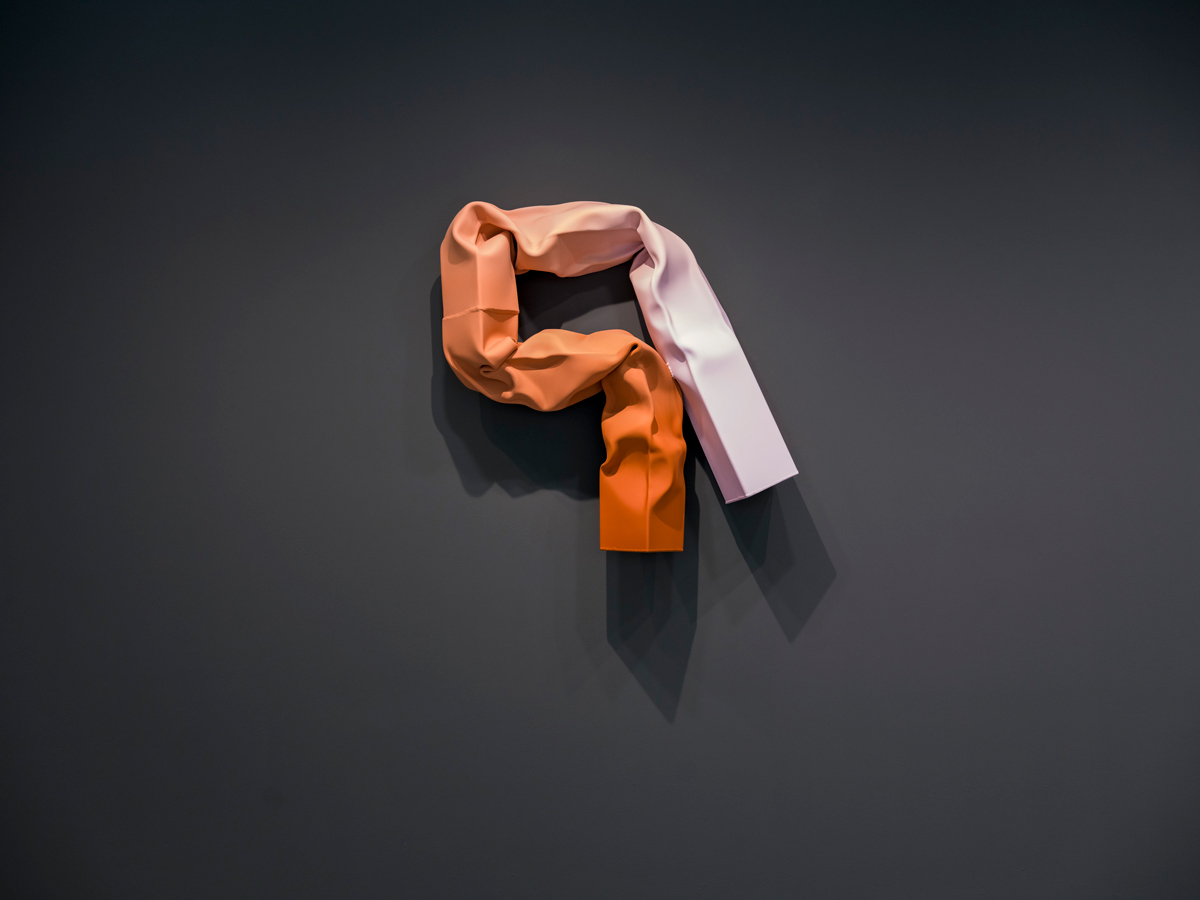
Carol Bove, installation view. Courtesy Solomon R. Guggenheim Museum. Photo: David Heald. © Solomon R. Guggenheim Foundation. Pictured: Secondhand Damnation, 2023.
Throughout the exhibition, Bove pays homage to those artists who have shaped her thinking by interjecting their work among her own. Her taste is exquisite, and—despite her mechanical processes—she seems a clear fan of the hand and its powers to channel and transform. (Bove was a cocurator of the wonderful Fragments of a Faith Forgotten: The Art of Harry Smith, presented at the Whitney Museum of American Art in 2023–24, celebrating this precious eccentric, a filmmaker and rabid collector of records and paper planes who was considered by some a mystic.) An ink drawing from the 1950s by the too-little-known poet and artist Lionel Ziprin, who experienced visions and believed he could talk to the spirit worlds; Agnes Martin’s impenetrable, vulnerable Little Sister (1962), for which she meticulously drew dots and dashes in oil and ink; September 13, 1959, an assemblage made that same year by Bruce Conner from stuff like paste jewels, beads, and pantyhose: in situ, these works perform as a kind of urtext for Bove’s practice, though she herself is such a different kind of maker.
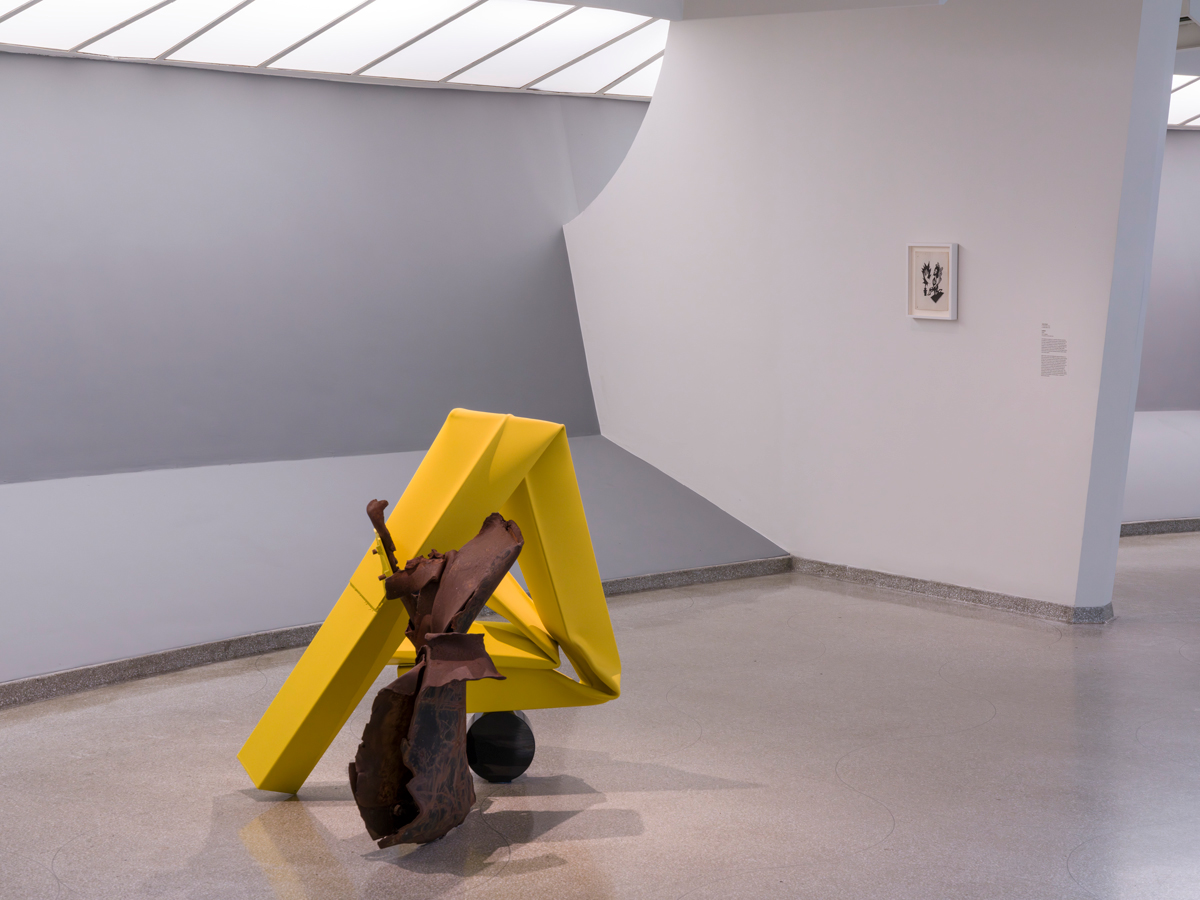
Carol Bove, installation view. Courtesy Solomon R. Guggenheim Museum. Photo: David Heald. © Solomon R. Guggenheim Foundation. Pictured, left foreground: Mouse Hole, 2016. Upper right, on wall: Lionel Ziprin, Untitled, ca. 1950s.
I found it honest and refreshing, the lack of one-to-one influence, how Bove doesn’t do the usual drawing of tidy lineages between herself and them. That said, I couldn’t help but note that her work much more closely resembles—in form and therefore spirit—certain artists who go weirdly unmentioned: Carl Andre, David Smith, and certainly John Chamberlain, with whom she shared a two-person exhibition at the San Francisco Museum of Modern Art in 2019–20. His Fantail (1961, not on view), for example, is a heap of busted car parts composed to call to mind a bird. The work counterbalances the violence inherent in its materials, its fabrication, with the levity of both its subject and the artist’s prompt to imagine something from nature in this sight of man-made wreckage. I thought of Chamberlain’s piece when looking at Bove’s A Bird (2017), made of found steel as well as stainless, a bright yellow beam bent just so to give the sense of a beak, a feather, a wing perhaps.
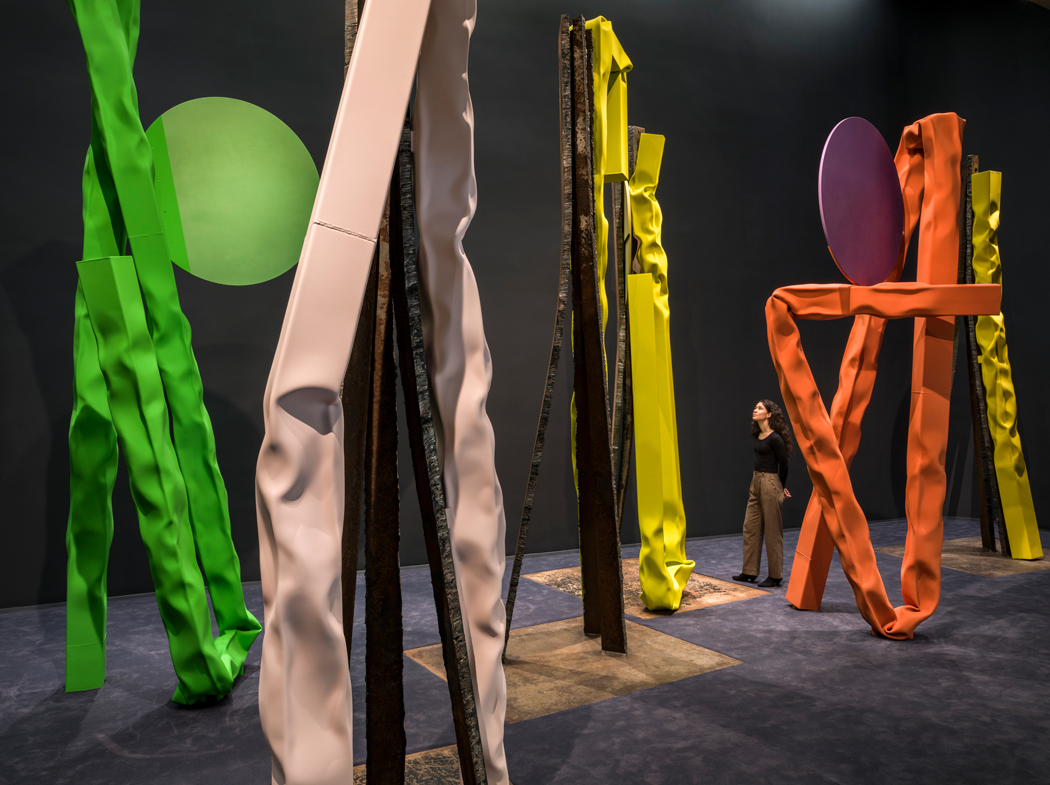
Carol Bove, installation view. Courtesy Solomon R. Guggenheim Museum. Photo: David Heald. © Solomon R. Guggenheim Foundation. Pictured: Sweet Charity, 2026.
I confess I didn’t experience the bucking of gravity until I stood at the feet of Sweet Charity, a thicket of lithe, leggy, undomesticated things titled after Bob Fosse’s classic musical from the late 1960s. These towering, theatrical sculptures are so lively, stretching and collapsing at the same time, performing various balancing acts, their vibrant colors filling the otherwise dark room at the bottom of the Guggenheim’s ramp with brightness and delight. It was then, as I walked in and around these dancing forms, that for a moment, the heaviness of the world seemed to lift completely.
Jennifer Krasinski is a writer, critic, and senior editor at Bidoun.