


 Reinaldo Laddaga
A new show highlights the astonishingly phantasmagoric works created by the artist in response to the rise of National Socialism.
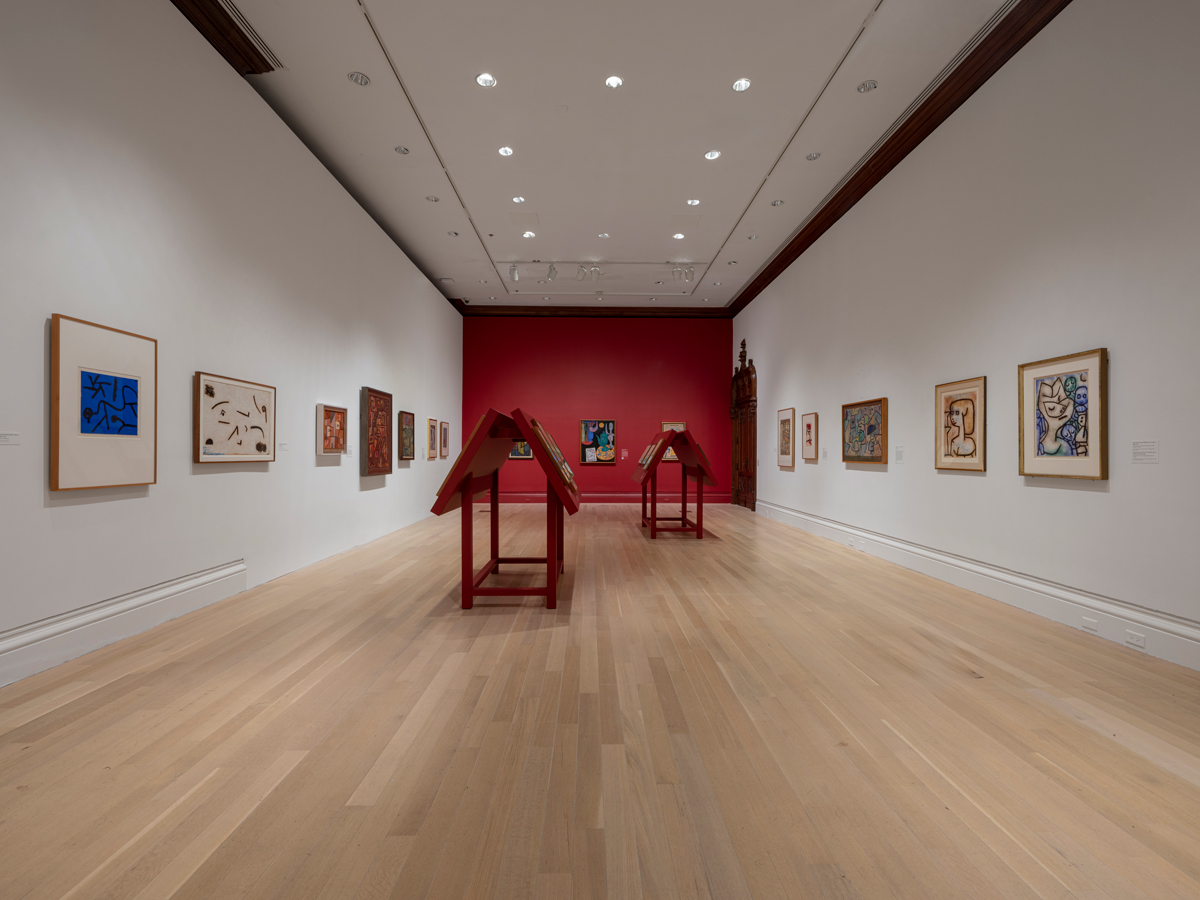
Paul Klee: Other Possible Worlds, installation view. Courtesy the Jewish Museum. Photo: Kris Graves Projects / Julian Calero.
Paul Klee: Other Possible Worlds, curated by Mason Klein, the Jewish Museum, 1109 Fifth Avenue, New York City,
through July 26, 2026
• • •
Walking through the exquisite exhibition of Paul Klee’s late work at the Jewish Museum, faced with the maddening variety of themes, techniques, and styles on show, I found myself thinking of the Portuguese author Fernando Pessoa—that tireless inventor of heteronyms, distinctive poetic personalities that we get to know by the writings they putatively produced. I told the friend I was with that it felt as though we were in a group exhibition bringing together the work of several painters. And she drew my attention to this text by the artist, inscribed on one of the walls:
Individuality is not an elementary sort of thing, but an organism. Elementary things of different sorts coexist in it, inseparably. If one tried to separate them, the components would die. My self, for instance, is a dramatic ensemble. Here a prophetic ancestor makes his appearance. Here a brutal hero shouts. Here an alcoholic bon vivant argues with a learned professor. Here a lyric muse, chronically lovestruck, raises her eyes to heaven. Her papa steps forward, uttering pedantic protests. Here the indulgent uncle intercedes. Here the aunt babbles gossip. Here the maid giggles lasciviously. And I look upon it all with amazement, the sharpened pen in my left hand.
This would not be a bad description of what we see at the Jewish Museum: something like the cacophonous performance of a multitude of artists (refined and vulgar, clumsy and virtuosic) who advance and retreat, eager to be seen and heard, much like those chatty or silent figures of the quote whose pirouettes and poses the artist is bent on recording with the proverbial sharpened pen. A shared sensibility—we sense it—underlies all the expressions, but it is capable of taking on so many forms that we leave the exhibition convinced that, despite the artist’s considerable renown over the last century, Klee is still a great mystery.
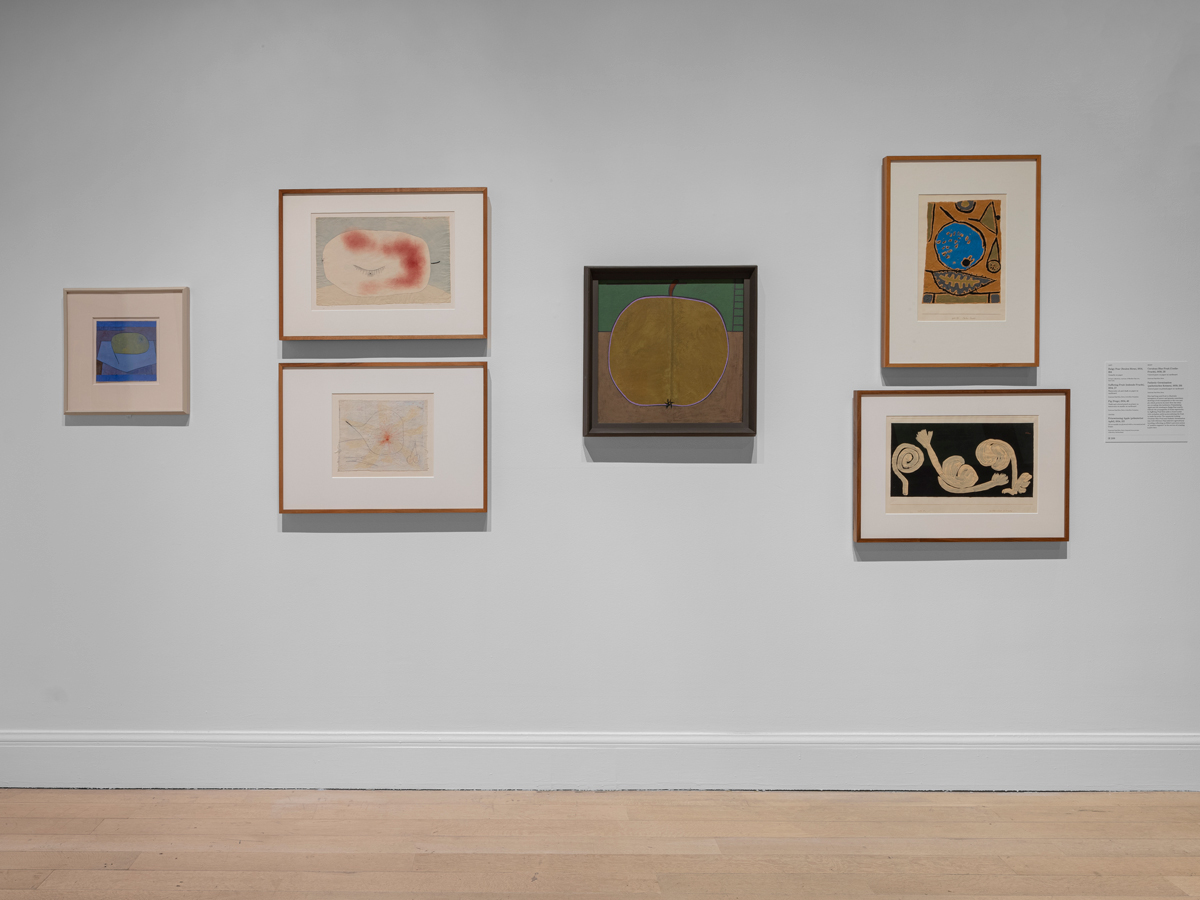
Paul Klee: Other Possible Worlds, installation view. Courtesy the Jewish Museum. Photo: Kris Graves Projects / Julian Calero.
He was born in Bern in 1879, and after a slow development as a visual artist—parallel to his study and practice of the violin—Klee began producing the work for which he is known during the first decade of the twentieth century. This work was intensely individual, usually executed in small formats, and, from the beginning, oscillated between dreamlike lyricism and a propensity for cruel and extravagant satire. Its character was already well-defined when the artist joined the Blaue Reiter group, alongside Gabriele Munter, Wassily Kandinsky, and Franz Marc, becoming one of the leading figures of avant-garde art. In the period immediately following World War I, Klee’s recognition grew considerably, although from the outset his compositions of evanescent colors and labyrinths of delicate lines—inspired by ornamentation and children’s drawings—were also dismissed as trivial and overly feminine, and his grotesques as signs of decadence. During the 1920s, he taught painting at the Bauhaus in Dessau. The enormous teaching load and a change in leadership at the institution led him to move to Düsseldorf in 1931, where, freed from that burden, his pace of production—a hallmark from the start—accelerated decisively, so much that in the final year of the decade he created 1,253 cataloged works (between four and five each day) using the most varied techniques. This happened as Klee’s world was crumbling. Beginning in 1933, the rise of National Socialism—which identified him as one of the leading figures of degenerate art—forced him into a series of relocations that culminated in his return to Bern, where in 1935 he was diagnosed with the degenerative disease from which he would die in 1940.
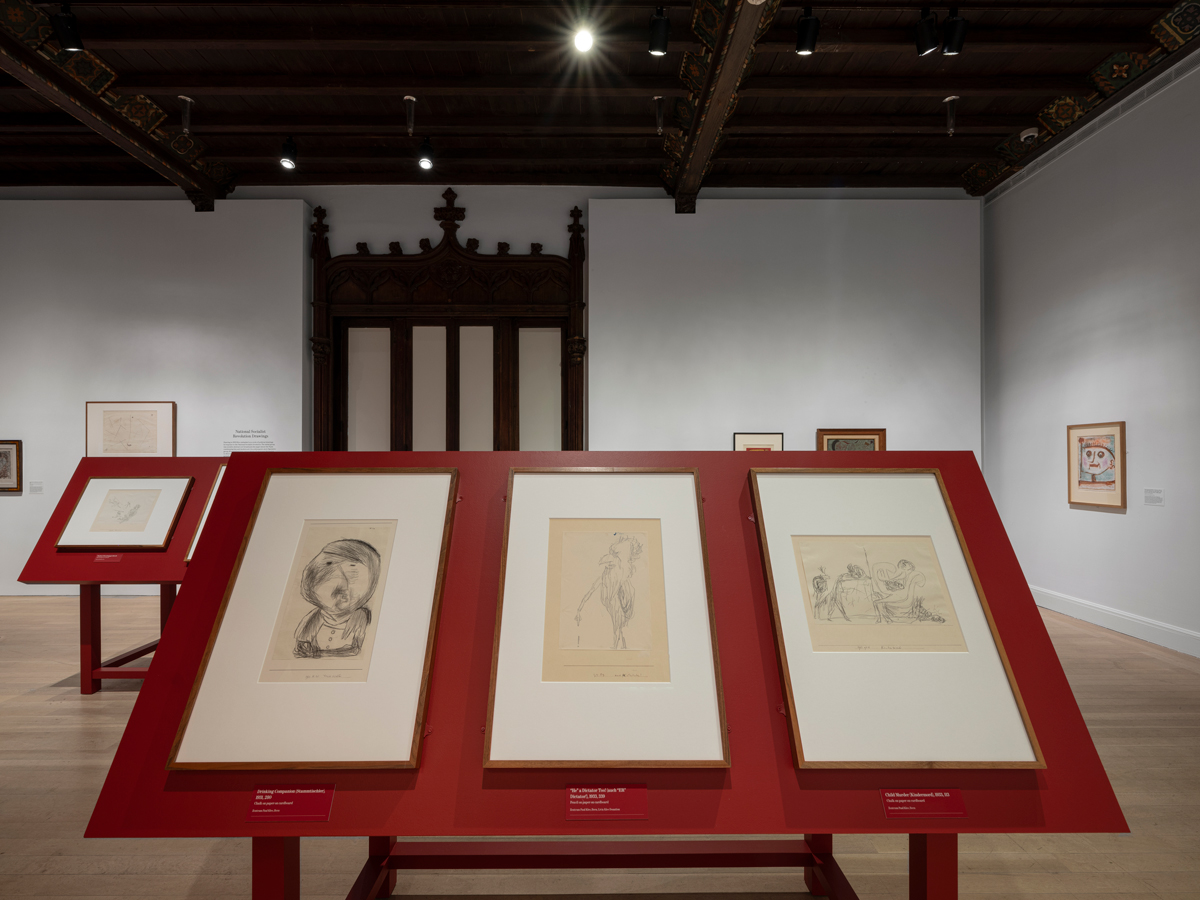
Paul Klee: Other Possible Worlds, installation view. Courtesy the Jewish Museum. Photo: Kris Graves Projects / Julian Calero.
This decade, perhaps the least known in Klee’s oeuvre, is the focus of the Jewish Museum’s exhibition, which presents an excellent collection of paintings and a large selection of drawings, many of which belong to a 1933 series created in response to the rise of National Socialism. These drawings show us the artist—often identified with the tender, the delicate, and the fantastic—reacting to the political tragedy of his time through Goyaesque phantasmagorias. The figures inhabiting these opaque scenes are astonishingly amorphous and rendered in swift and awkward scribbles, as if the artist were anxious to shed his incredible skill, having discovered the power of being inarticulate. Here, Klee is at his most anti-aesthetic—in this series, as well as in several paintings where clownish or demonic faces are rendered as if with lipstick and mascara. No other works remind me so much of these pieces as Philip Guston’s drawings of Richard Nixon from the 1970s.
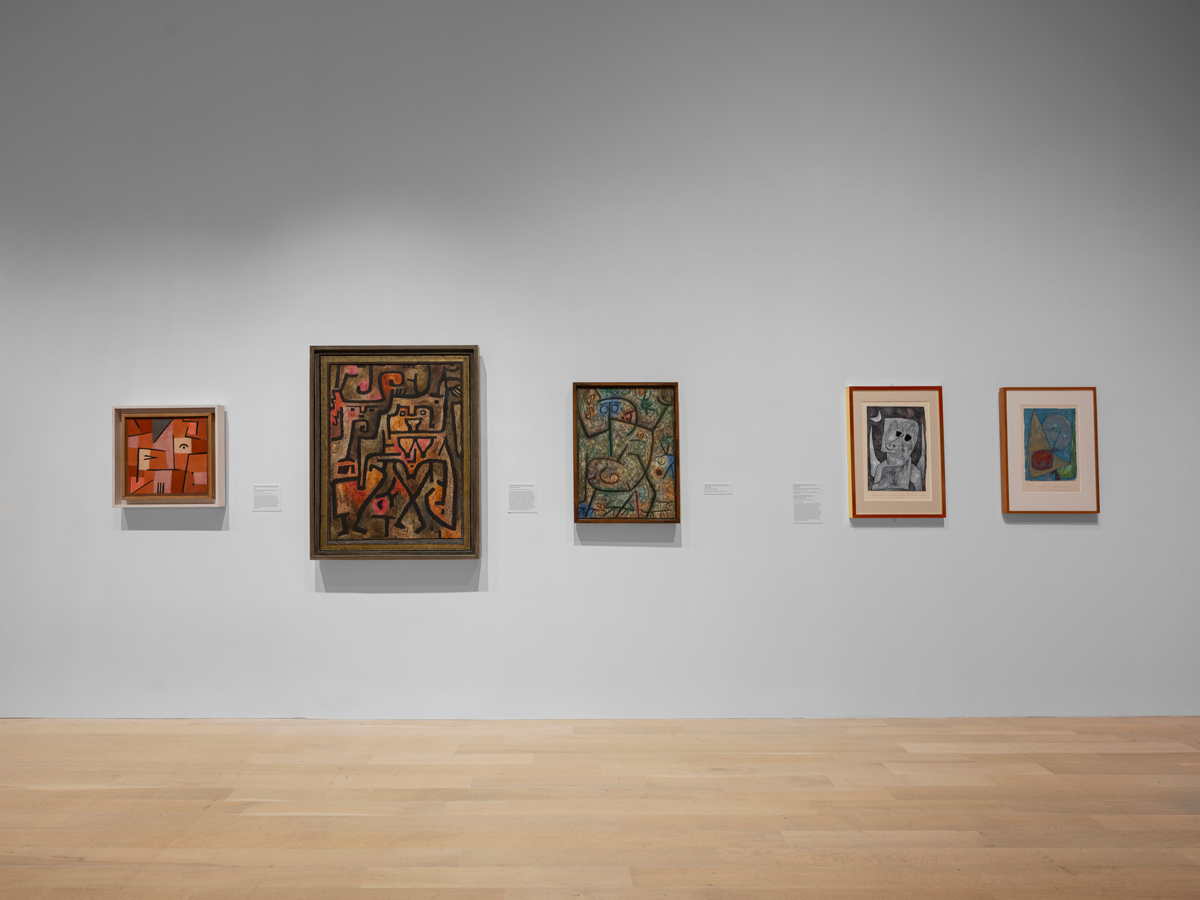
Paul Klee: Other Possible Worlds, installation view. Courtesy the Jewish Museum. Photo: Kris Graves Projects / Julian Calero.
But this almost punkish Klee—unlike Guston—never abandoned a taste for delicate, crystalline beauty. In the same year as his seismographic drawings of the Nazi ascent, he painted a flower that emerges from a network of colored bands that makes us think of Agnes Martin, and deliriously detailed pointillist compositions where the eye gets lost in the opalescent play of shades and tones. Sometimes the canvases of the 1930s contain nothing more than two or three impetuous, improvised, almost Gutai-like strokes. But at other times they are intricate labyrinths of patches of color traversed by erratic lines, labyrinths so complex that one cannot disagree with the critic David Sylvester when he notes that “every point is as crucial as every other and there is never a point on which the spectator’s eye is allowed finally to come to a rest,” compelling the spectator “to enter into a relationship with it [the image] that is analogous to his relationship with nature.”
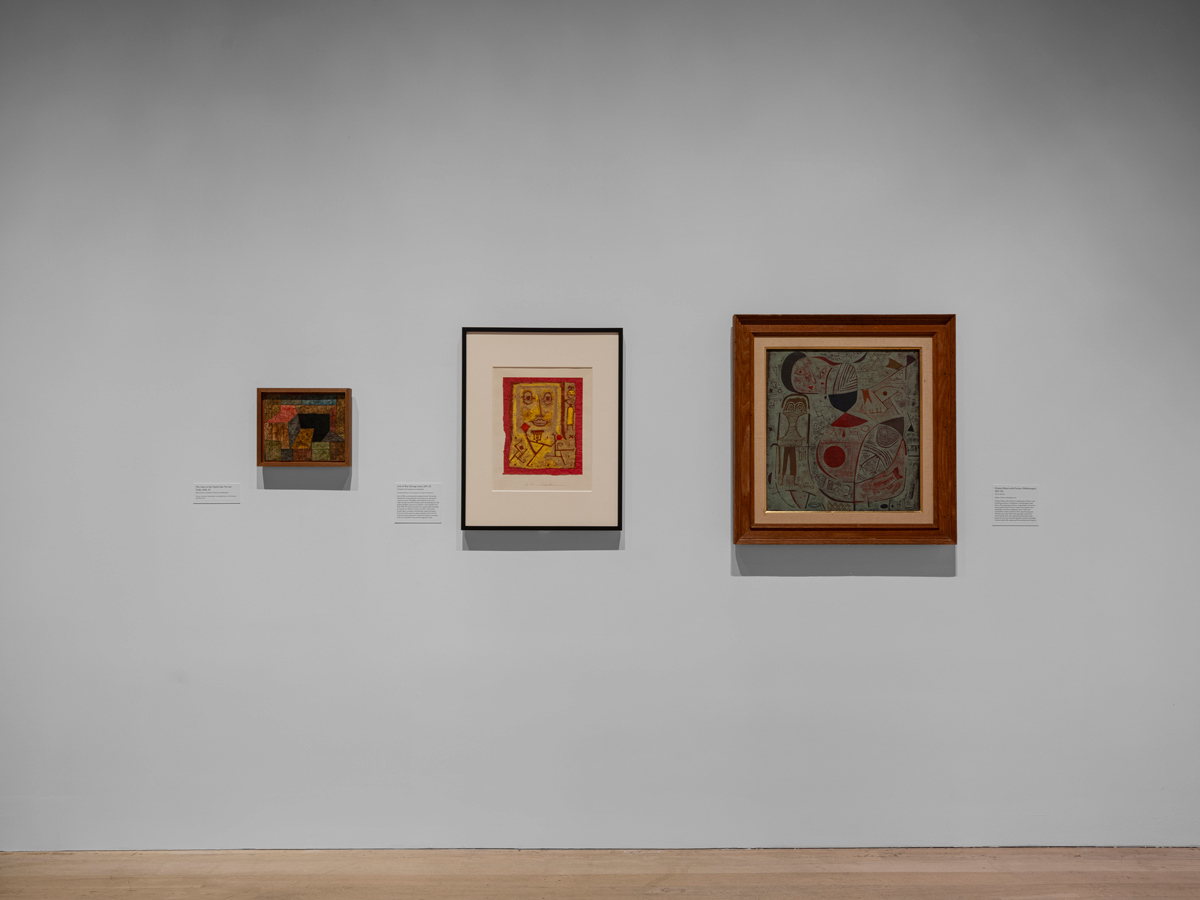
Paul Klee: Other Possible Worlds, installation view. Courtesy the Jewish Museum. Photo: Kris Graves Projects / Julian Calero.
I mentioned earlier that Klee was a violinist (and his wife a pianist). This exhibition has something of a performance about it: the virtuoso who plays diverse pieces in various techniques and styles, each time at greater speed. Upon reading about the exorbitant number of works he would produce in his later years, I thought of Andy Warhol. Klee had an enormous influence on the American artist, an influence far less recognized by critics than that of Marcel Duchamp. Warhol was a great advocate of speed, because speed helps one to abandon the more conventional forms of quality, disobey the common demand for stylistic coherence, and arrive at the point where practice becomes integrally interwoven with daily life. There is no doubt that this is the point Klee set out to reach; in this respect, his program is as radical as Duchamp’s and perfectly ripe for rediscovery. The show at the Jewish Museum is a forceful invitation to revisit this figure who, while universally celebrated, remains largely unknown.
Reinaldo Laddaga is an Argentine writer based in New York. The author of numerous books of narrative and criticism, he taught for many years in the Romance Languages Department of the University of Pennsylvania. His latest works are Los hombres de Rusia (The Men from Russia), a novel; Atlas del eclipse (Atlas of the Eclipse), a book about walking in New York at the height of the COVID crisis; and El coleccionista de cabezas (The Head Collector), on Andy Warhol.