


 Melissa Anderson
Maurice Pialat’s compassionate 1971 miniseries examines the Great War’s fracturing of civilian life.
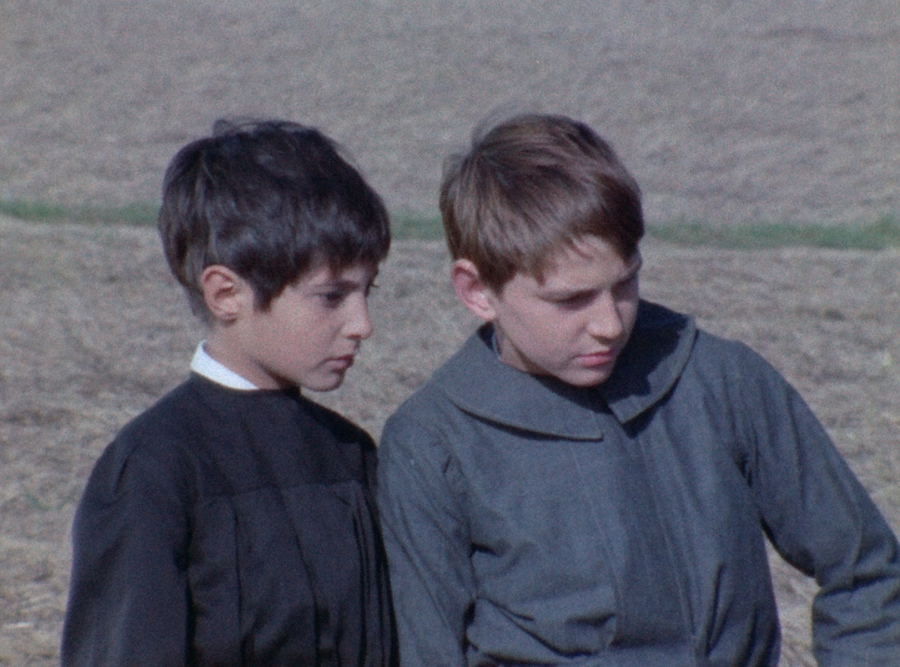
Hervé Lévy as Hervé Gardy and Michel Terrazon as Michel Latour in La maison des bois. Courtesy Janus Films.
La maison des bois, directed by Maurice Pialat, Film at Lincoln Center, New York City, now playing through April 28, 2026
• • •
A World War I miniseries from 1971 that takes place far from the front lines, Maurice Pialat’s La maison des bois (The House in the Woods) features more scenes of kids engaged in mock battle than actual military combat. Tears are shed more copiously than blood. While the carnage of the trenches and the Somme offensive remain off-screen, Pialat’s compassionate television drama—which has been digitally restored and is now receiving its first-ever theatrical run in the US—examines the Great War’s fracturing of civilian life, specifically how it upended quotidian existence for the nation’s most vulnerable citizens: its children.
A signal figure of France’s post–New Wave, Pialat, born in 1925, came to feature filmmaking late. After abandoning an unsuccessful career as a painter, in 1951 he began making shorts, both fiction and documentary. Pialat was forty-three when L’enfance nue (Naked Childhood, 1968), the first of his ten features, opened in France. As its title suggests, the movie is an unadorned, unsentimental depiction of a troubled ten-year-old foster kid named François, played by Michel Terrazon, one of several nonprofessional or first-time performers in the cast. Owing in part to Pialat’s extraordinary talent for directing children, which L’enfance nue clearly evinced, he was commissioned by French public television to helm La maison des bois, whose seven episodes aired from September to October of ’71. Rewriting René Wheeler’s original script, which he found too mawkish, with his frequent collaborator Arlette Langmann, Pialat made room for improvisation during the shoot.
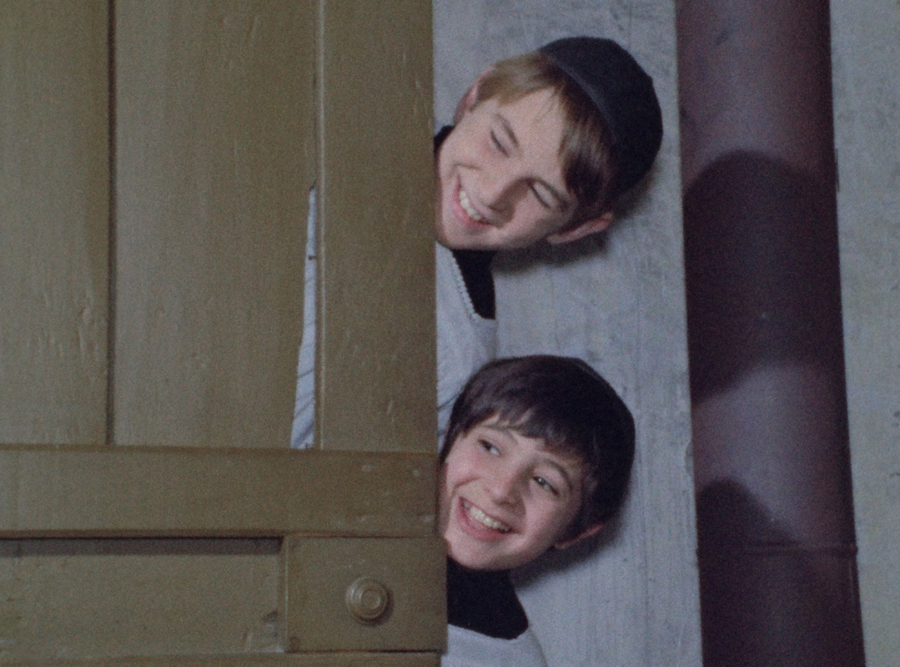
Michel Terrazon as Michel Latour and Hervé Lévy as Hervé Gardy in La maison des bois. Courtesy Janus Films.
Filmed primarily in Oise, a department just north of Paris, La maison des bois opens with a lone soldier (Yves Laumet), attired in the standard horizon-blue uniform, replete with wool side cap and greatcoat, striding across a field. After a quick reunion with his beloved, this service member on brief leave pays a visit to the all-boys primary-school classroom he once led, now overseen by an instituteur named Testard, played by Pialat himself. Excitedly mobbed by his former charges, the soldier is introduced to three new pupils from Paris: Michel (Terrazon), Bébert (Albert Martinez), and Hervé (Hervé Lévy), all of whom have been placed by their overwhelmed mothers with a local family, the Picards, while their fathers are on active duty and the French capital is under significant threat.
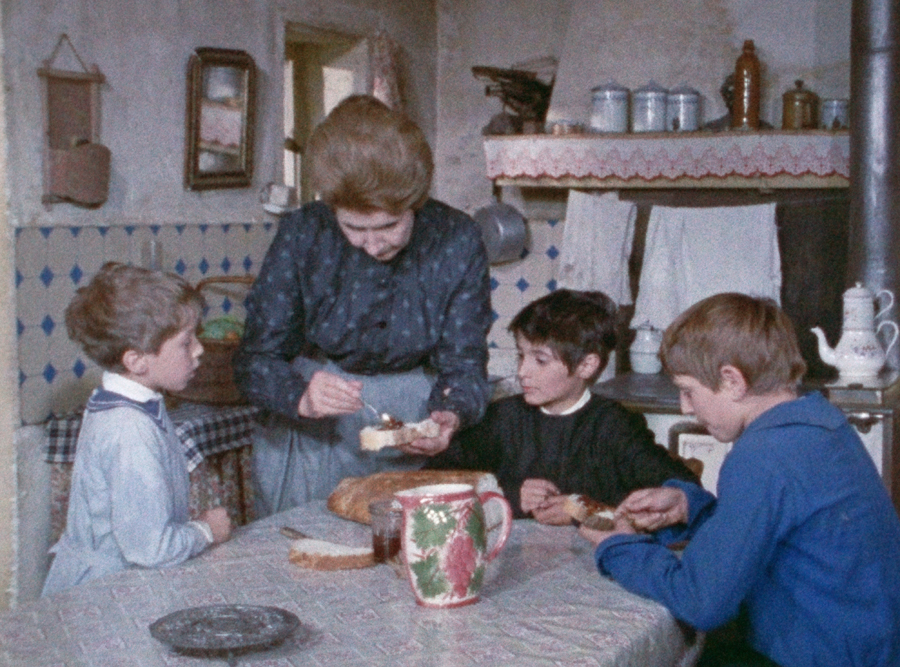
Albert Martinez as Bébert Pouilly, Jacqueline Dufranne as Jeanne Picard, Hervé Lévy as Hervé Gardy, and Michel Terrazon as Michel Latour in La maison des bois. Courtesy Janus Films.
The Picards—father Albert (Pierre Doris), mother Jeanne (Jacqueline Dufranne), teenage son Marcel (Henri Puff, another alum of L’enfance nue), and daughter Marguerite (Agathe Natanson), the elder sibling by a year or two—are the residents of the home of the title, a warm, humble dwelling made somewhat chaotic by its trio of boisterous prepubescent lodgers. Jeanne, exceptionally kind and forbearing, ministers to all the uprooted boys with equal care but makes no secret of the fact that Hervé is her favorite.
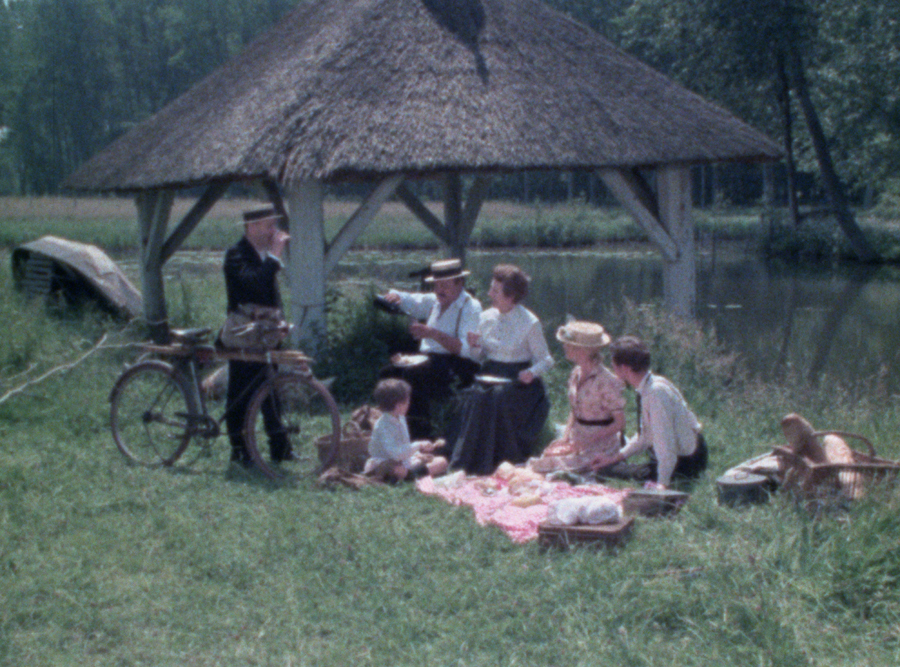
Still from La maison des bois. Courtesy Janus Films.
It’s easy to see why. Hervé is both more fragile—while Michel and Bébert are lavished with treats by their mothers during their semi-regular Sunday visits to the sticks, he has not heard from his since she deposited him with the Picards—and more endearing than his Parisian age-mates, able to arouse the affection and admiration of nearly every adult he meets. The haughty Marquis (Fernand Gravey), who lives alone in palatial splendor, invites the lad to lunch with him and later gifts the boy a copy of The Old Curiosity Shop. After Hervé makes a delivery to Mme. Moret (Eliette Demay), a new neighbor and lieutenant’s wife, she’s so taken by the stripling that she, too, asks him to stay for a meal. Her husband (Charles Mallone) can’t resist taking Hervé for a ride in a fighter plane. “What a kid!” the commissioned officer exclaims of his young pal.
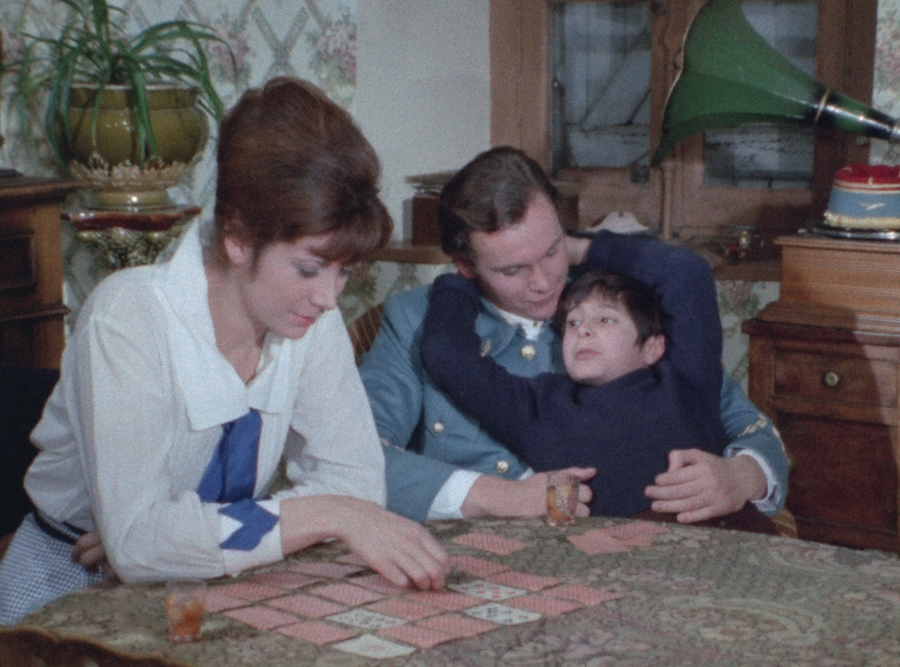
Eliette Demay as Michèle Moret, Charles Mallone as the Lieutenant, and Hervé Lévy as Hervé Gardy in La maison des bois. Courtesy Janus Films.
Although Hervé emerges as the protagonist among the extensive dramatis personae, Pialat is keen to show this pint-size main character not only in isolation—as when, to escape another intolerable Sunday lunch with the visiting Parisian mamans chez Picard, he takes off on a solo fishing trip—but also as one of a pack. Scenes of Testard’s students celebrating the signing of the armistice or of a gaggle of boys in motion—whether running, playing, marching in step with armed combatants, or gawping while rushing past an ambulance carrying those wounded in battle—crackle with unpredictability. Unrushed, these segments unfold with the immediacy of cinéma vérité, capturing the unscripted responses of very tiny neophyte performers: an inconsolable little boy bursting into very real tears as his classmates exult in France’s victory; the timid Bébert (or, more accurately, Albert Martinez) revealing a talent for imitating farm animals.
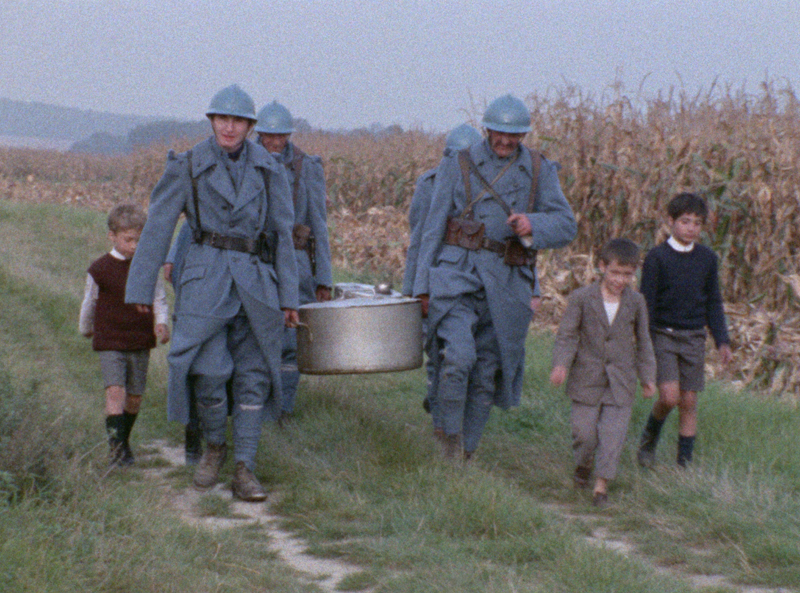
Still from La maison des bois. Courtesy Janus Films.
Just as entrancing as the spontaneous responses of Pialat’s mostly untrained, under-twelve actors are the reactions to war’s relentless catastrophes by the adult cast, some of whom also appear to be novices, as evidenced in a segment at the local café. Over cups of coffee, a middle-aged man about to ship out tries to comfort his ancient mother—dressed, perhaps preemptively, head-to-toe in black—as she begins to weep: “We don’t all meet our end there.” In a scene lasting no more than fifteen seconds, we watch as all the radiance once emitted by Jeanne is fully snuffed out while she sits alone in silence, undone by loss.
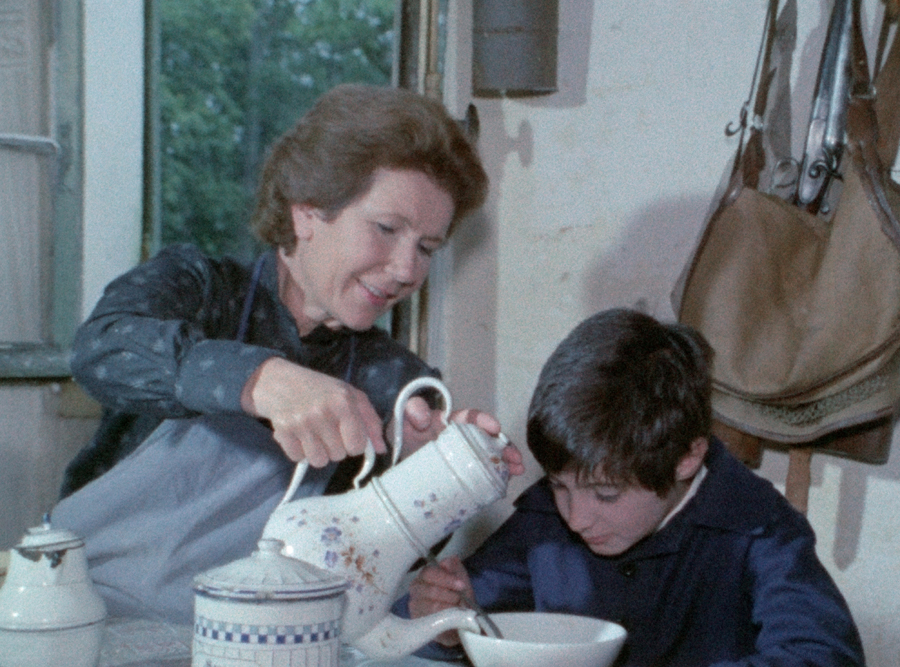
Jacqueline Dufranne as Jeanne Picard and Hervé Lévy as Hervé Gardy in La maison des bois. Courtesy Janus Films.
Jeanne is played by a professional who would work with Pialat again in his breakthrough film, Loulou (1980), a tale of class-clashing amour fou starring Isabelle Huppert and Gérard Depardieu in his first of four movies with the director. (Pialat died in 2003, at age seventy-seven.) Surprisingly, several of the child performers in La maison des bois, who astonish with their ease in front of the camera, wouldn’t appear in another film or would have just one subsequent screen credit. They include not only Hervé Lévy but also Magali Vachet, who plays a kindergartner housed with the Picards after the war’s end, and Brigitte Perrier, who arrives later in the series as Hervé’s new, slightly older stepsister. These remarkable children would never achieve the renown of Pialat’s greatest discovery, Sandrine Bonnaire, who, at fifteen, portrayed the tempestuous lead in À nos amours (To Our Loves, 1983), and would then star in Agnès Varda’s Vagabond (1985) and films by Claude Chabrol and Jacques Rivette. (À nos amours, along with L’enfance nue and 1978’s Graduate First, about adolescents confronted with dead-end lives, accompanies Film at Lincoln Center’s presentation of La maison des bois.) But thanks to the man who cast and guided them in this touching wartime saga, they have been granted immortality.
Melissa Anderson is the film editor of 4Columns and the author of a monograph on David Lynch’s Inland Empire from Fireflies Press. A collection of her film criticism, The Hunger, is now available from Film Desk Books.