


 Ania Szremski
Light in the dark, dark in the light: the Austrian Romani artist’s work is given space to speak for itself in a show at the Drawing Center.
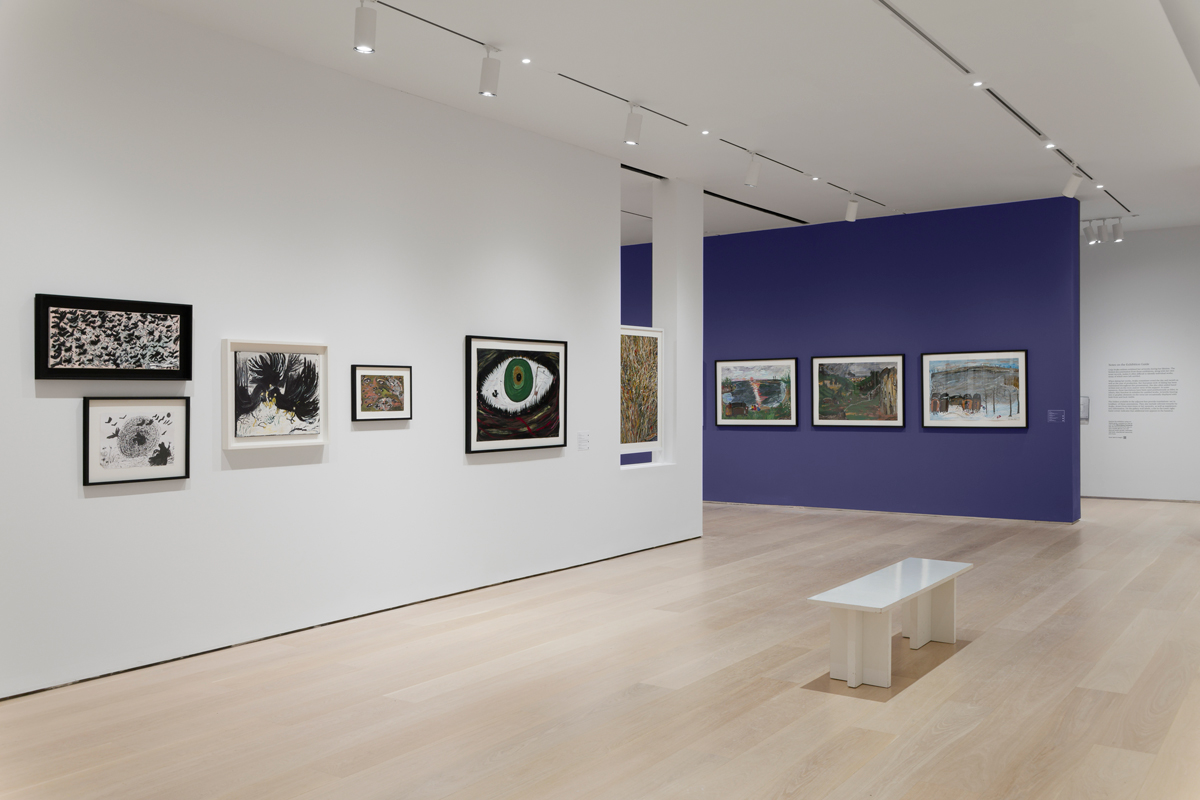
Ceija Stojka: Making Visible, installation view. Courtesy the Drawing Center. Photo: Daniel Terna.
Ceija Stojka: Making Visible, organized by Lynne Cooke with Noëlig Le Roux, the Drawing Center, 35 Wooster Street, New York City,
through June 7, 2026
• • •
Ceija Stojka painted dark pictures, and she painted light pictures. For years, she painted them on her kitchen counter, working from memory—both her own and those received from others—while her husband slept, during the night, that time when memories come. She didn’t start making them until she was about fifty-six, in late 1989 or early 1990, after she returned home to Vienna from a trip to several cities in Japan. While there, she had promised to mail a group of kindergartners she visited, who were busy with an art project, some pieces of art by her own grandchildren, as an exchange. Back home, when she went to make good on her promise and was examining a lovely unfinished watercolor by her young granddaughter, she suddenly lifted the brush herself—and then never put it down.
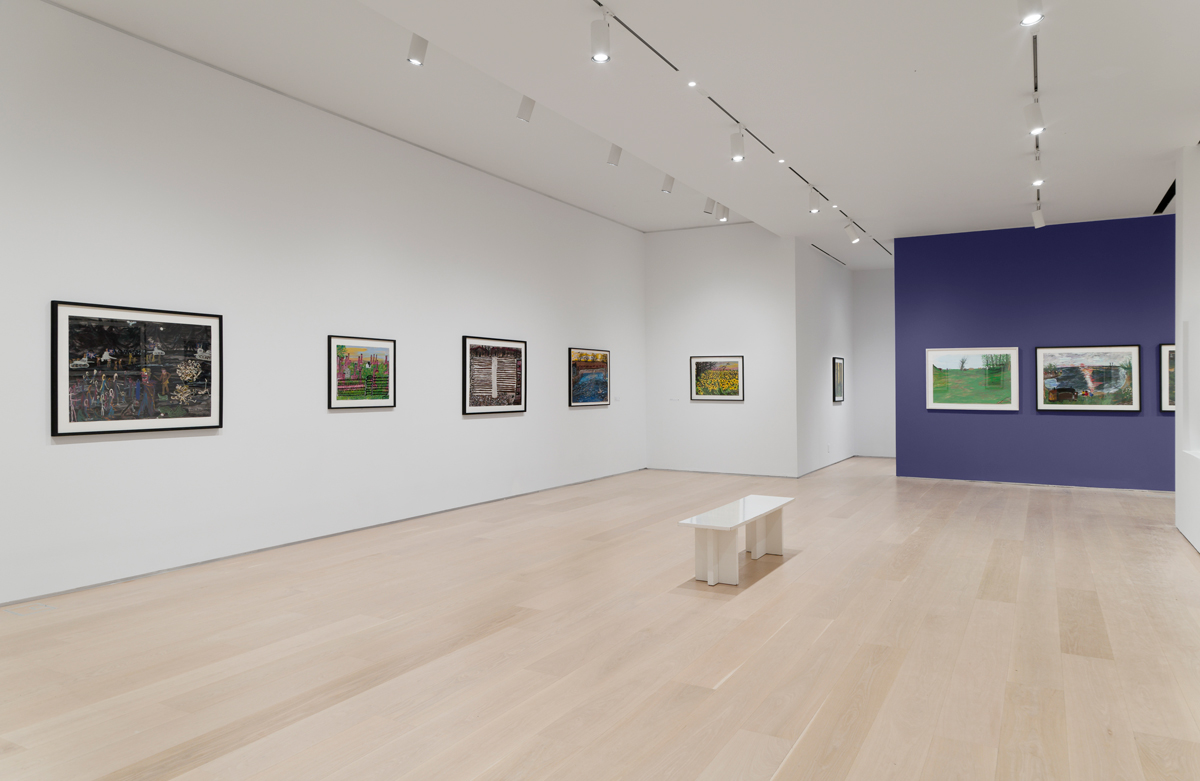
Ceija Stojka: Making Visible, installation view. Courtesy the Drawing Center. Photo: Daniel Terna.
Why had this middle-aged Viennese woman found herself in Japan around the time the Wall fell? She had been invited to speak at an anti-racism conference—because, before the pictures, there were the words (fittingly, perhaps, as she came from a family of story- and fortune-tellers). In the late ’80s, she had published a memoir of surviving the camps as a girl during World War Two, camps where she was taken at age nine with her mother and sisters, the camps that would kill her father (she remembers, specifically, how he had worn his best suit to the one where he was murdered) and her littlest brother. Her whole family had been interned among the over five hundred thousand Roma and Sinti people the Nazis persecuted and murdered during the Holocaust, which in the Romani language is called Porajmos, “the devouring.” Stojka’s memoirs became German-language bestsellers, making her the person who spoke for the people history ignored. And then, when she started painting, she became the person who wouldn’t let us look away.
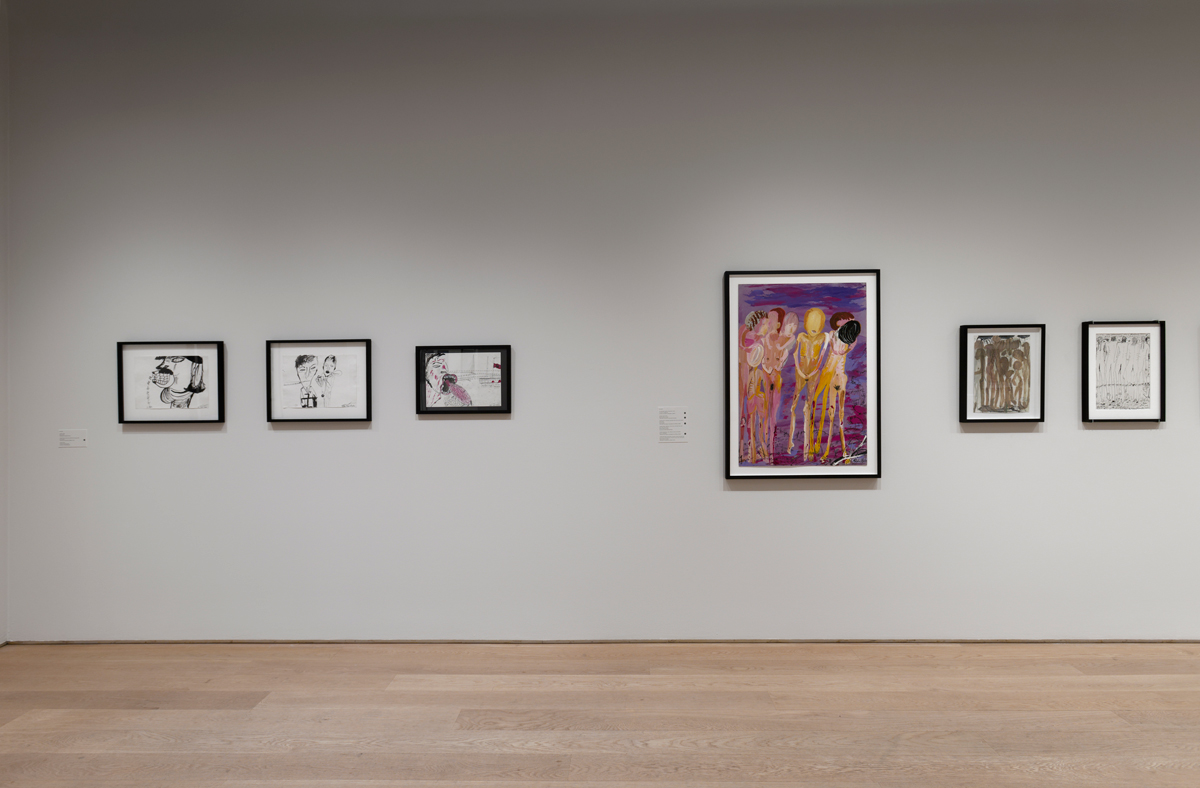
Ceija Stojka: Making Visible, installation view. Courtesy the Drawing Center. Photo: Daniel Terna.
In the current show at the Drawing Center, Ceija Stojka: Making Visible, which collects more than sixty works by the artist, we see her dark pictures first. The pictures are not hazy, like memories can be—even the abstract ones are still somehow startlingly vivid, specific. We see: an incendiary red ground, with two goose-stepping stick figures, their rangy black limbs forming swastikas, foreboding ebony Vs of ravens behind them. Inky ravens that recur everywhere. As well as malicious dogs. Naked emaciated men and women. Disembodied eyes. Tall black polished boots, also everywhere; one larger than life, unattached to a body, stepping in front of a flaming pit into which fall tiny, vulnerable, peppermint-pink bodies. Swastikas, swastikas. Cracking whips. Crematorium chimneys surrounded by weeds, colored a shocking blush. All are dated, but none are formally titled, though many include writing—image and word always went together for Stojka.
“Even death is terrified of Auschwitz,” she wrote on one.
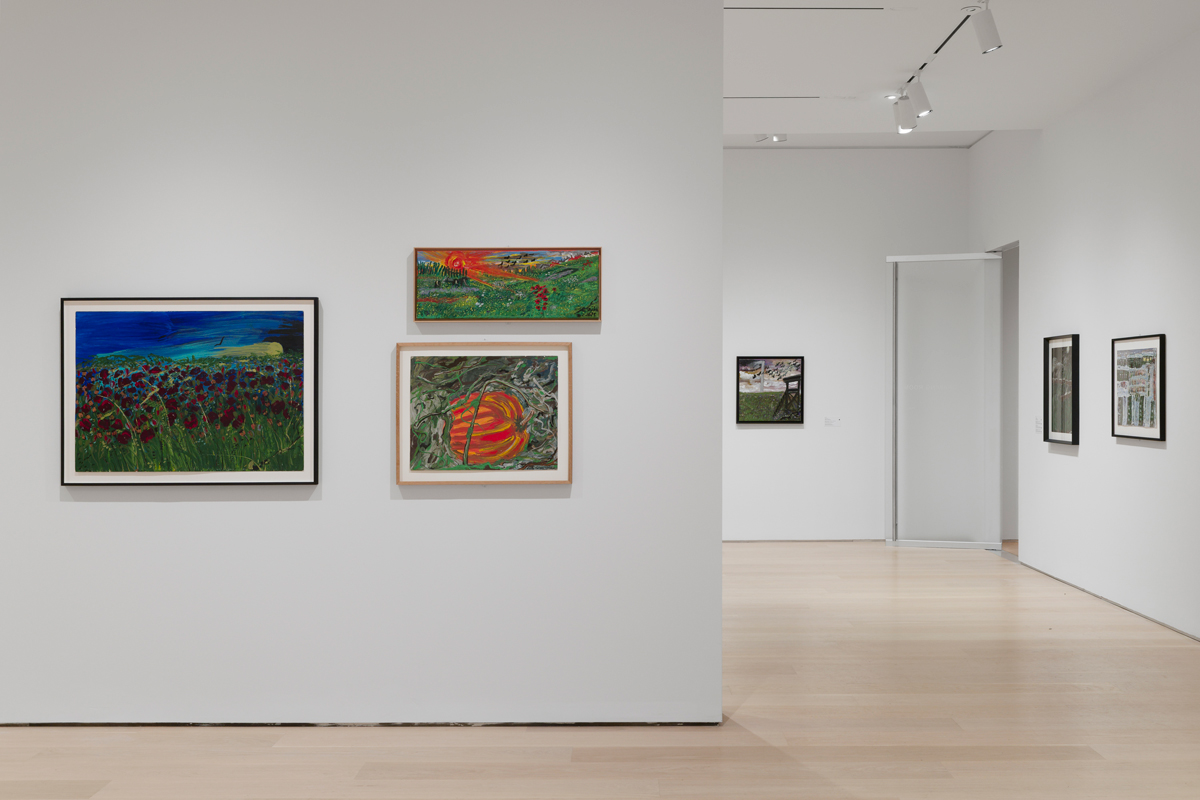
Ceija Stojka: Making Visible, installation view. Courtesy the Drawing Center. Photo: Daniel Terna.
But then, turn the corner in the big main gallery, and there are the light pictures. Ecstatic visions of nature that break your heart. A pumpkin colored more orange than orange itself. A field of dreamy poppies (poppies to remember, poppies to forget) waving in the indigo night. Ecstatic sunflowers—Stojka’s favorite flower, and the emblem of her people—painted so thickly you could eat them off the canvas, the bright yellow acrylic pigment seemingly unmixed until you look closer, and see tiny veins of pink marbled in. (Sometimes she used her fingers to apply the paint, as if the brush weren’t fast enough.) A suite of works following the seasons that are composites of prewar girlhood memories. Stojka’s family, besides being storytellers and fortune tellers and musicians and poets, had traded horses, and traveled the lower Austrian countryside in caravans. We see tiny happy girls and tiny happy ponies in heavenly landscapes.
“But what happened to the horses?” she asked when she was old.
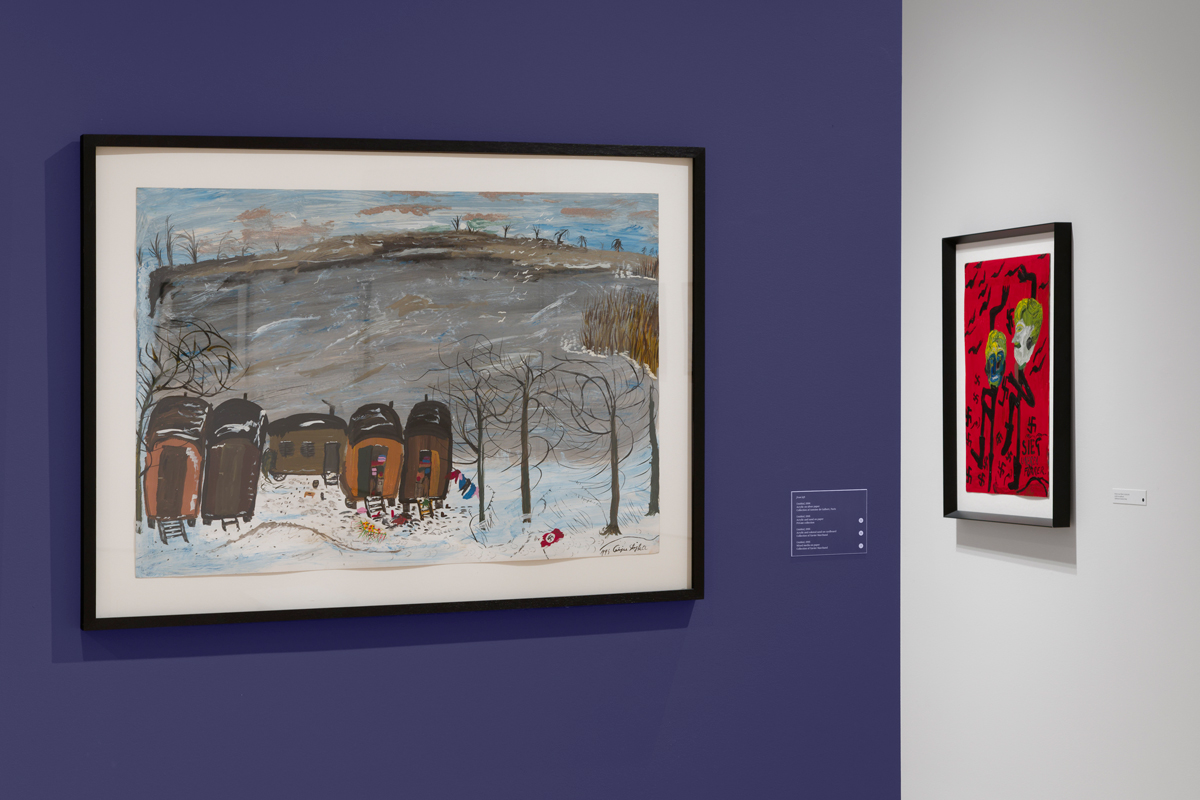
Ceija Stojka: Making Visible, installation view. Courtesy the Drawing Center. Photo: Daniel Terna.
Before she died in 2013, but after her painting career had taken off in the mid-2000s, Stojka was upset that her light pictures were so often dismissed in favor of the dark ones. Curators, writers, viewers seemed too predisposed to bloodlust. Part of the problem was how she was framed from the start. After a few smaller shows at Vienna’s Amerlinghaus, where for years she taught workshops for young people, in 2004 she had a significant breakthrough with a major exhibition at that city’s Jewish Museum, in which her paintings and drawings were categorically read through the context of the Shoah. Other curators would go on to organize exhibitions with similar political programs. At the Drawing Center, curator Lynne Cooke has tried, crucially, to do something different, both with this show and with the accompanying publication. The work is allowed to speak for itself—instead of lengthy, imposing didactics stuck to the walls, there’s a printed-out exhibition guide you can orient your visit with, if you want. Otherwise, the paintings and sketches are given room to breathe, unencumbered by curatorial interpretation, hung more or less chronologically, from the mid-’90s to the mid-2000s, tracing the evolution of Stojka’s specific practice. The dark pictures and the light pictures are presented side-by-side, so we can see how, in fact, they’re somehow not so different, that there’s light in the dark, and dark in the light.
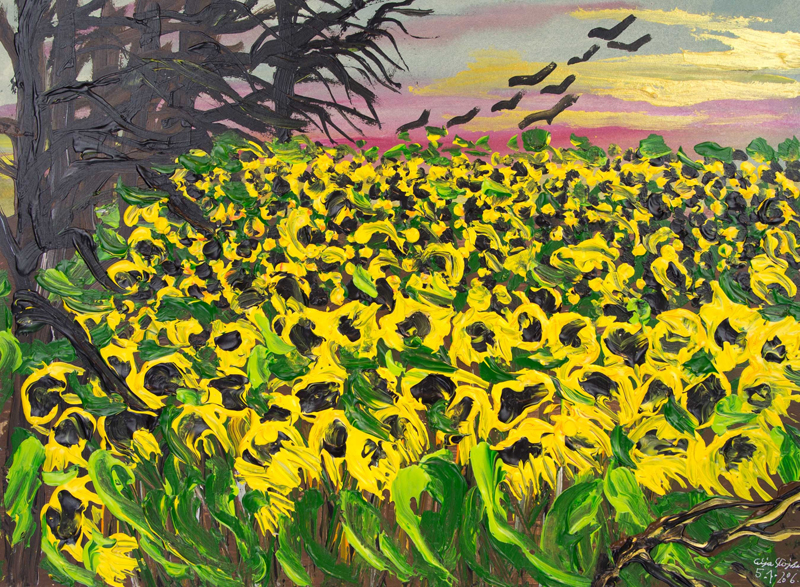
Ceija Stojka, Untitled, 2006. Acrylic on cardboard, 19 5/8 × 25 5/8 inches. Photo: Diego Castellano Cano. © Artists Rights Society (ARS) / Bildrecht.
There’s no escaping history in this viewing, of course, but we encounter the works before we meet the woman, and that’s essential for helping to resuscitate them from biographical overdetermination. If you want to learn more, go downstairs, where there’s a small trove of archival materials—a timeline situating Stojka’s life and practice in Austrian history, from WWII through renewed postwar discrimination against the Roma and Sinti people in that country to the election of a Nazi in 1986 to the Austrian presidency amid a popular fascist resurgence. (The more things change . . . ) There are her sketchbooks, with drawings and poems, and photos from the trip to Japan. And the projection of a deeply moving feature-length documentary directed by Stojka’s early champion, Karin Berger, a profoundly personal portrait of the artist. Stojka sketches at her dining table, her left forearm visible, on which is tattooed “Z 6399.” Z, the designation for Romani. She shows us her garden on her terrace, the tree she keeps for her son who died too young, her favorite sunflowers. In her paintings, the flowers are never cut.
Ania Szremski is the senior editor of 4Columns.