


 Julia Bryan-Wilson
To have and to withhold: an exhibition of the Cuban artist’s works emphasizes the body’s dynamism even when tied up, gagged,
or otherwise confined.
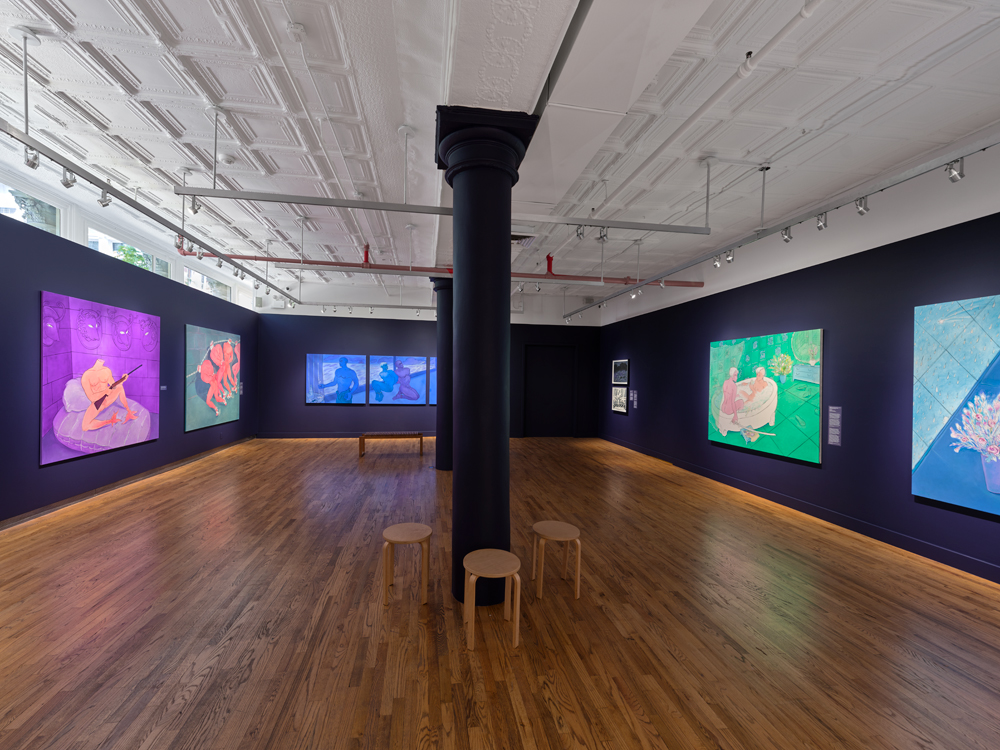
Rocío García: The Object of Power is Power, installation view. Photo: Garrett Carroll. © Leslie-Lohman Museum of Art.
Rocío García: The Object of Power is Power, curated by Carmen Maria Machado, Leslie-Lohman Museum of Art, 26 Wooster Street, New York City, through September 20, 2026
• • •
A rainstorm pelts the window as a person, ankles trussed, lies on a bed; nearby, a naked woman arranges a floral bouquet. Or: a masked, shirtless man is tethered via a neck collar and chain to a stake in the snowy ground; just over the hill, a white rabbit frolics. Or: a headless man with chicken feet seated on a purple tufted cushion holds up a rifle; a row of trophy animal heads lines his bunker-like, cinder-block room. Rocío García’s oil paintings operate akin to mannered mystery plays, with bodies arranged in charged choreographies that are insistently theatrical. Her solo exhibition of eight large canvases and several smaller-scale drawings at the Leslie-Lohman Museum, tightly curated by renowned queer Cuban American author Carmen Maria Machado, highlights how her work synthesizes idiosyncratic visual narratives, art-historical borrowings, and a pop sensibility into compositions that are both meticulously arranged and provocatively unresolved.
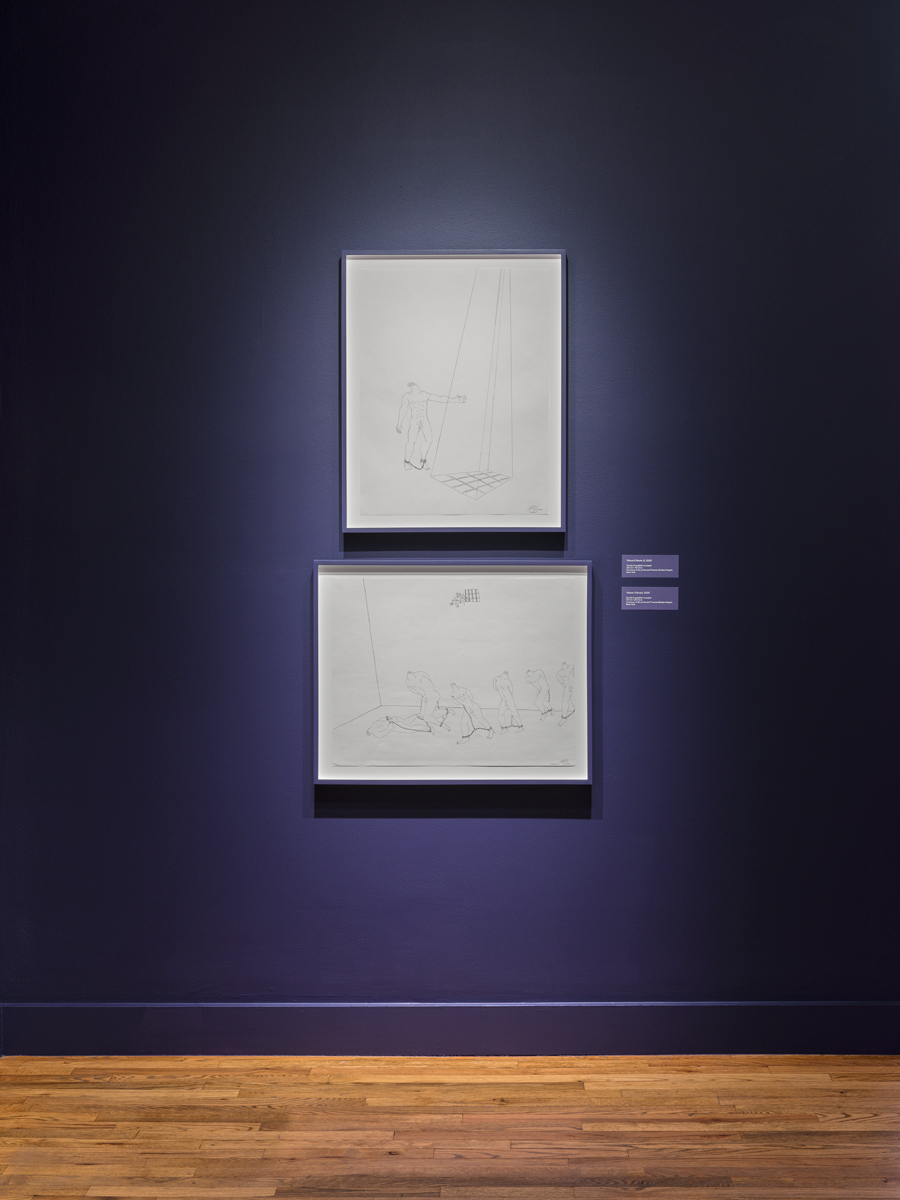
Rocío García: The Object of Power is Power, installation view. Photo: Garrett Carroll. © Leslie-Lohman Museum of Art.
Born in Cuba in 1955 and coming of age under Fidel Castro, García studied first at the prestigious Academia Nacional de Bellas Artes San Alejandro, then left the island at the age of twenty-two to attend the Repin Academy in Leningrad. She now lives in Havana, where she is a respected teacher and stalwart of the LGBTQ+ scene. Her formative movement between Cuban cultural strictures and Soviet academic education shaped a visual vocabulary that balances monumental, schematized figures—recalling Russian artists such as Kuzma Petrov-Vodkin—with the graphic flatness and sequential logic of both comic strips and ukiyo-e prints. Her hybrid training helps explain her interest in the drama of bodily gestures as well as the spatial mechanics of scene-making.
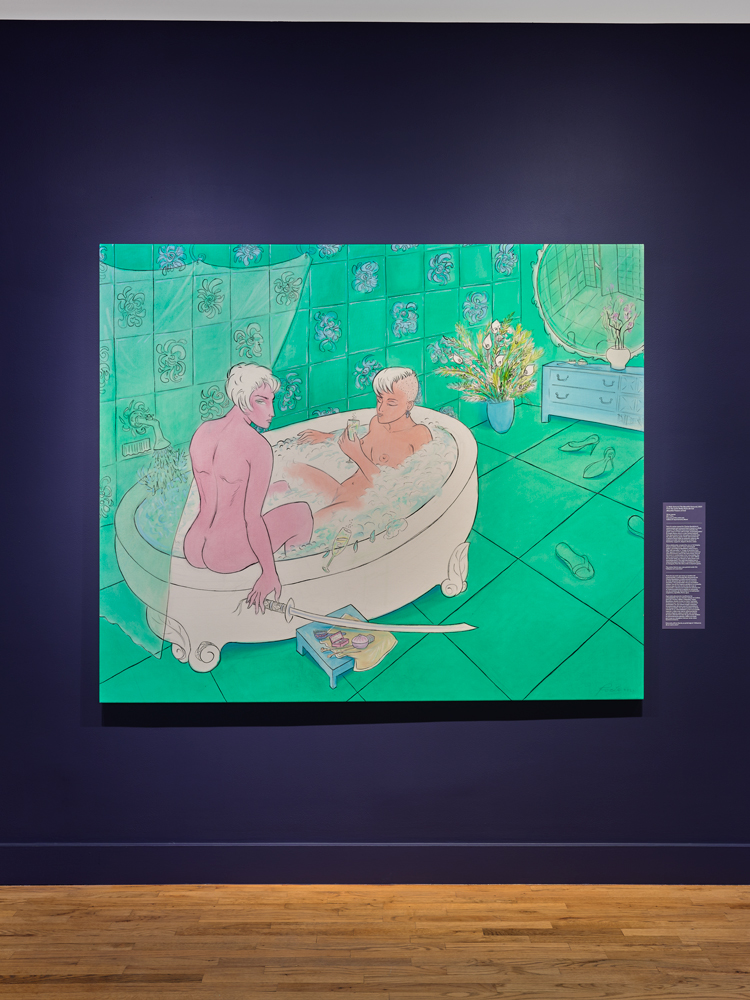
Rocío García: The Object of Power is Power, installation view. Photo: Garrett Carroll. © Leslie-Lohman Museum of Art. Pictured: La Bella Samurai (The Beautiful Samurai), from the series Bellas flores del mal (Beautiful Flowers of Evil), 2021.
Bathed in uniformly thin washes of colors, her paintings are also moodily cinematic, attuned to the psychological import of framing techniques like the close-up and the wide shot. She crops with alarming efficiency, hacking off significant elements for uncanny effect, as when, in La Bella Samurai (2021), a disembodied arm opens a bathroom door to interrupt two women soaking in a frothy tub. (Not to worry, reader; one of the bathers has a protective sword at the ready.) Economically distilled conflict, shorn from expository context, is another García hallmark. As with film stills or the panels of a storyboard, enigmatic situations are compressed into a single frame—or splayed across diptychs and triptychs—to imply action occurring before or after the pictured moment. Many works condense dramatic intensity into a single pose or interaction; this invites the viewer into the interpretive work of imagining what has happened elsewhere.
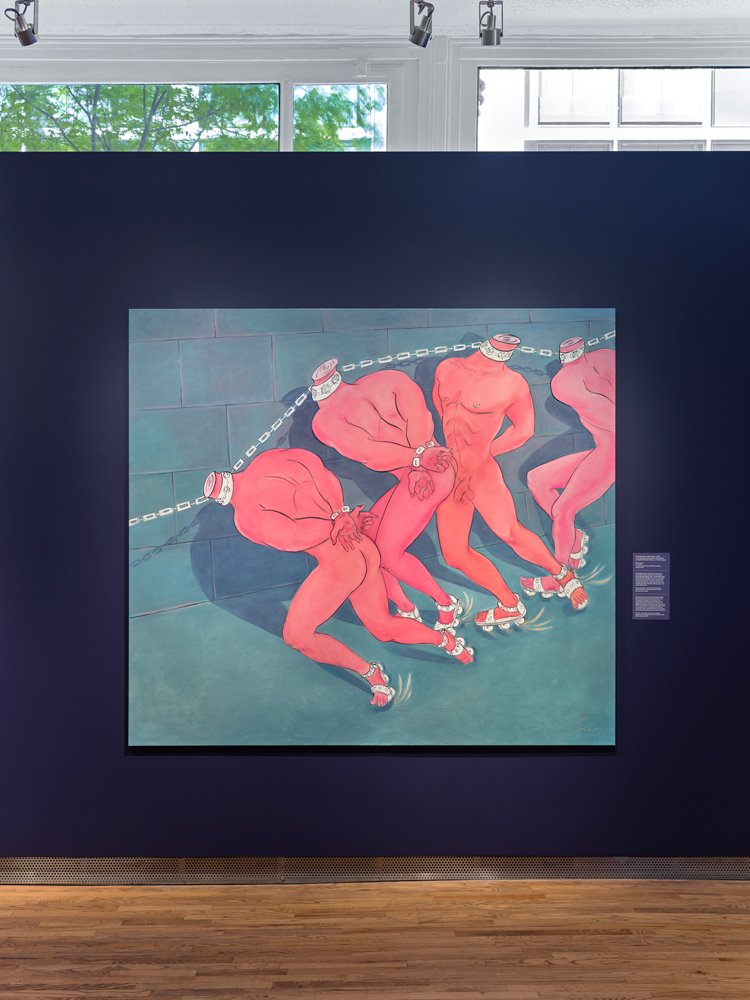
Rocío García: The Object of Power is Power, installation view. Photo: Garrett Carroll. © Leslie-Lohman Museum of Art. Pictured: Los patinadores (The Skaters), from the series El Gran Chef, alias Paticas de pollo (The Great Chef, aka Chicken Legs), 2023.
The withholding of explicit plot points creates an interplay of revelation and concealment that generates the psychological tension animating her canvases. For instance, in The Skaters (2023), four decapitated orange-skinned men whirl chaotically on skates inside a prison cell. They are chained together and their hands are bound. Yet the metal collars around their necks could easily be slipped off, and the motives for their imprisonment are unclear.
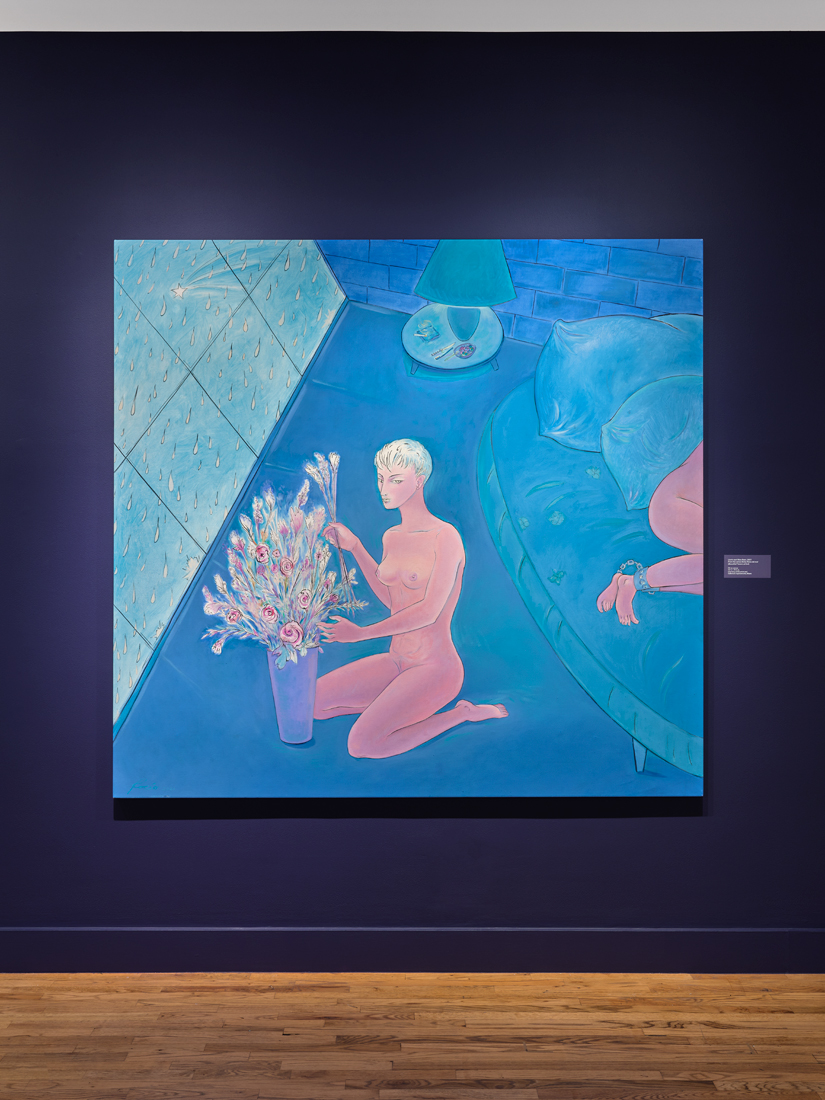
Rocío García: The Object of Power is Power, installation view. Photo: Garrett Carroll. © Leslie-Lohman Museum of Art. Pictured: Lluvia azul (Blue Rain), from the series Bellas flores del mal (Beautiful Flowers of Evil), 2021.
García wields a delicate touch as a draftsperson, and her compositions are guided by a fluid contour line and the friction between closely observed details (a smoldering cigarette, fizzing champagne) and stark, generic backgrounds. Well-appointed domestic interiors appear to satirize stereotypes about homosexuality as a symptom of “bourgeois decadence,” which has historically been a common discourse about gay men in particular. The artist’s figures are frequently in a state of torsion, with elegant, tapered fingers and a sleek athleticism that emphasize the body’s dynamism even when tied up, gagged, or otherwise confined.
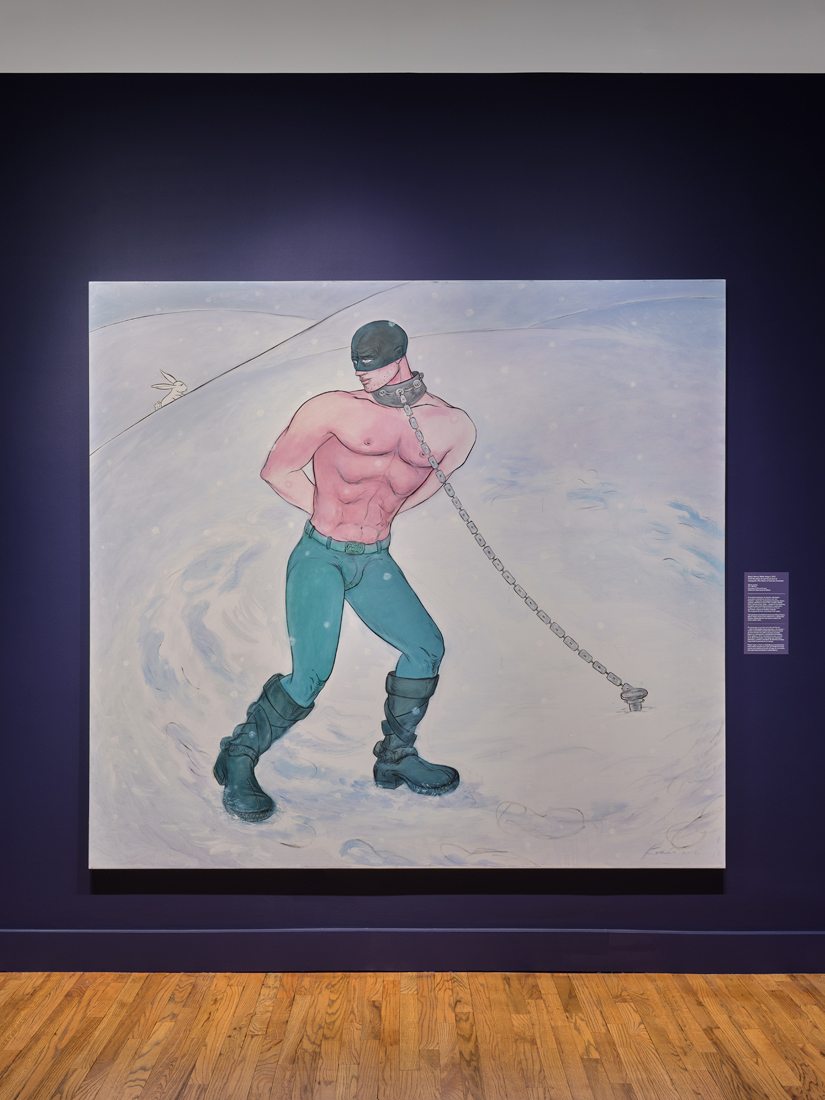
Rocío García: The Object of Power is Power, installation view. Photo: Garrett Carroll. © Leslie-Lohman Museum of Art. Pictured: Magia blanca (White Magic), from the series El regreso de Jack el Castigador (The Return of Jack the Punisher), 2012.
Transforming tropes of queer desire into scenes of transgression that emphasize threat, longing, and thrill, García turns to a repertoire of characters (like the masked man Jack the Punisher) to probe sexualized fantasies. She often paints with a casual indifference to conventional markers of gender. Recurring motifs—chains, ropes, and funny-scary “chicken-men”—are anchors of her personal symbology. Sometimes objects appear with the deliberate precision of a prop master who sets Chekhov’s proverbial gun in place in the first act, leaving us to guess why, when, and how it will fire. Like the Last Blues (2006), from a larger series, is a three-part caper rendered in saturated lavenders and periwinkle. It has the logic of a fever dream, in which cartoonish absurdity and political commentary on the state’s criminality coexist.
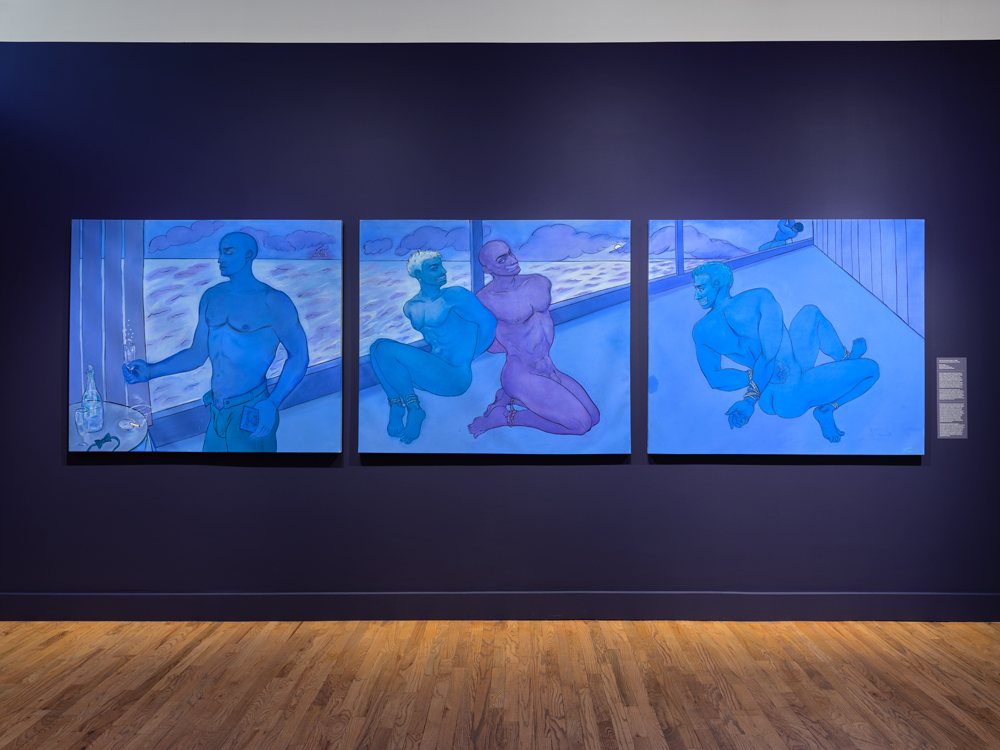
Rocío García: The Object of Power is Power, installation view. Photo: Garrett Carroll. © Leslie-Lohman Museum of Art. Pictured: Like the Last Blues (Tríptico), from the series El Thriller (The Thriller), 2006.
Machado’s novel In the Dream House (2019) delved into same-sex partner abuse, and many of the works gathered here emphasize control—governmental and interpersonal—or hint at violence creeping into the frame. Machado’s wall labels are beautifully written, and do not direct us too heavily toward overly definitive iconographic decoding. What is compelling about García’s oeuvre is the way her canvases present unfamiliar delirium and simultaneously nod to well-worn idioms. Power is notoriously difficult to depict; it can be slippery, diffuse, prone to misdirection. In her paintings and drawings, García stages power ambiguously: seemingly clear-cut scenes are recast into queer BDSM situations where the locus of control shifts, dissipates, or becomes unreadable. Her paintings thereby interrogate what it means to represent force—social, sexual, or political—within a medium historically overburdened by grandiose claims. (How much we have demanded of painting! How hard it continues to labor!)
García’s work recalls the fragmentation of Soviet montage while simultaneously embracing the intimacy of analogue manga. She synthesizes influences across geographic and generational limits, from Chagall’s oneiric space to Hokusai’s compositional clarity. Within and beyond the realm of contemporary painting, I see kinship with figures as divergent as Alison Bechdel, John Wesley, Roberto Gil de Montes, and Tom of Finland. Her formal strategies reflect a sustained engagement with “the graphic” as a conceptual problem, from the flattening of faces into types to the explicitly perverse. With an aesthetic language at once reduced and sensuous, her paintings meditate on line, contour, planar color, and the boundaries between embodiment and emblem. Rendering some men acephalous permits her to explore bodies stripped of specific identity, alluding to the erotics of anonymous cruising and the disorder of leaderless societies. It is also a strategy that redirects our attention to the communicative force of posture and the relationships between figures.
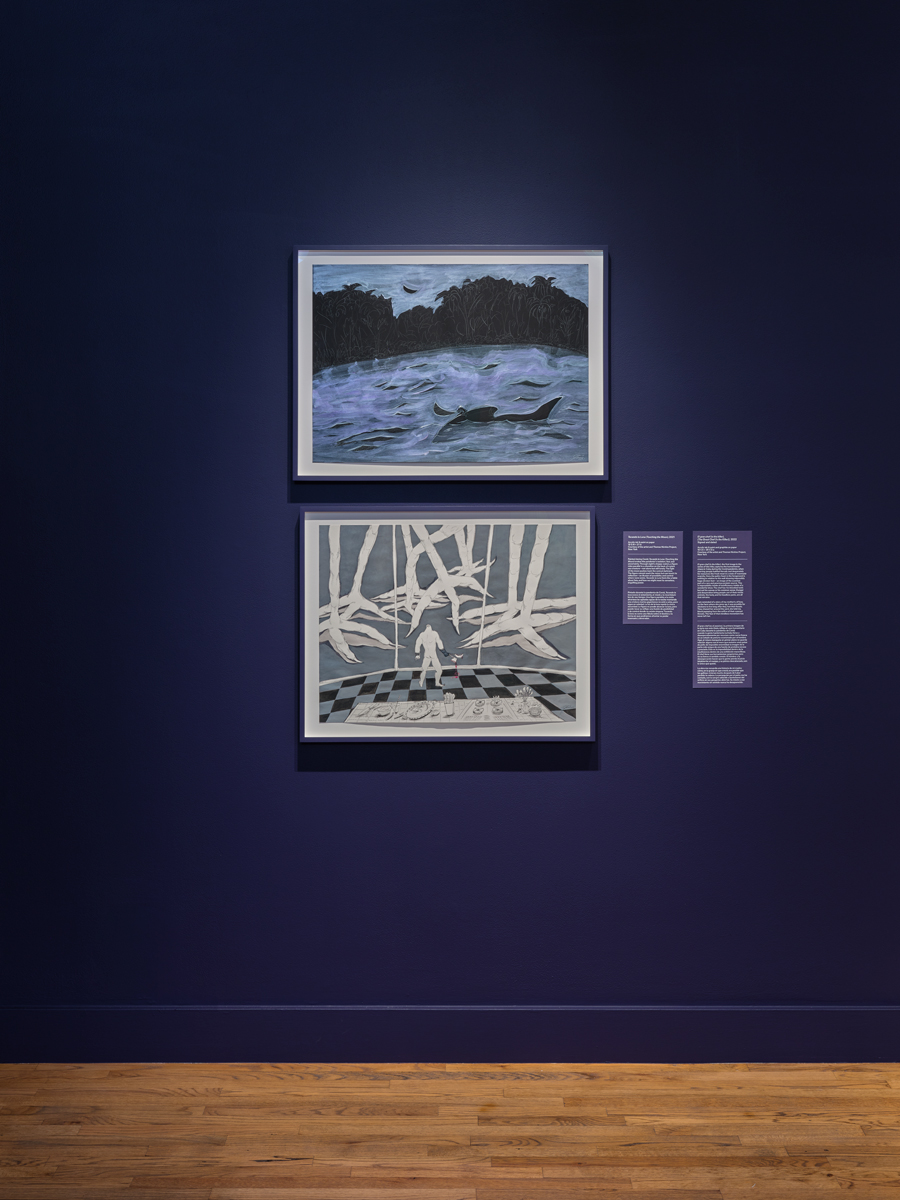
Rocío García: The Object of Power is Power, installation view. Photo: Garrett Carroll. © Leslie-Lohman Museum of Art. Pictured, bottom: El gran chef (is the killer) (The Great Chef (Is the Killer)), 2022.
Humor, horror, and the grotesque punctuate the cool poise of García’s surfaces. Spatial disorientations and surreal forms generate unsettling comedy—a headless man stands before a forest of giant chicken feet, his hatchet and scythe dripping blood—which allow menace to appear as play. Who is receiving pain, and who inflicts it? Who consented to give punishment, who agreed to receive it? The wit in these pieces prevents them from becoming merely allegorical; instead, it preserves complexity and ambivalence, making room for multiple interpretive trajectories. With its alchemy of high and low, her art is defiantly elusive and sly. She invites spectators into noirish tableaux where identity, power, and desire are open questions; the curtain might rise to reveal either crisis or catharsis. García’s paintings traffic in suspense and omission: equally important are what is shown and what is withheld.
Julia Bryan-Wilson teaches contemporary art and queer studies at Columbia University.