


 Jennifer Kabat
Claudia Horn’s book about one of capitalism’s greatest critics presents a tantalizing vision of Luxemburg the eco-socialist.
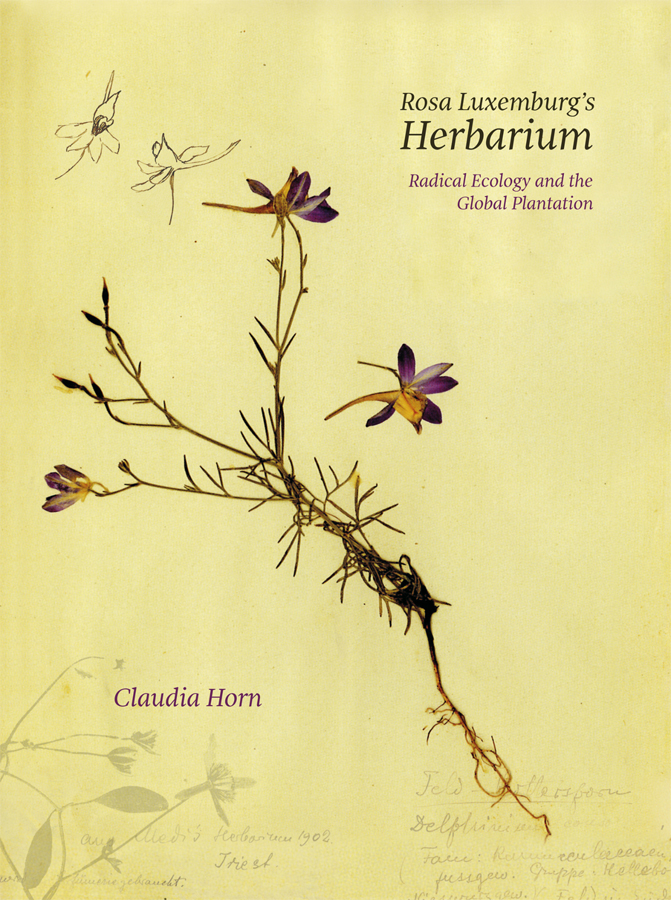
Rosa Luxemburg’s Herbarium: Radical Ecology and the Global Plantation, by Claudia Horn, OR Books, 225 pages, $30
• • •
A ziplock bag of dead, leathery tree leaves sits on my desk. I found them at an intersection in Berlin, between the zoo and Muji. Traffic was speeding by, and I kneeled to photograph chickweed and plantain growing in the pavement, searching for something—some psychogeography—that might connect me to one of capitalism’s greatest critics, Rosa Luxemburg. She also loved flowers and wrote from prison, “I feel so much more at home in a plot of garden like the one here, and still more in the meadows when the grass is humming with bees, than at one of our party congresses.” That was in a letter to Sophie Liebknecht, with whose husband, Karl, Luxemburg would cofound the revolutionary Spartacus League and eventually the German Communist Party. I wanted these plants to hold Luxemburg, to knit me to this place and to her.
Luxemburg fought for the oppressed but didn’t believe in identitarian politics or divisions. For her the crisis was capitalism, and in her letters she saw the plight of other species as much as our own. She stood up against nationalism and the First World War and was the first Marxist thinker to link capitalism to colonialism, in her mammoth The Accumulation of Capital. As soon as she finished the book in the spring of 1913, she started keeping an herbarium. My friend, Bard Berlin professor Agata Lisiak who has written on Luxemburg, tells me this was the happiest period of her life. She had a young lover and a new home. This summer brings Rosa Luxemburg’s Herbarium: Radical Ecology and the Global Plantation, dedicated to her plants and ideas. Written by Claudia Horn, a lecturer in political economy at King’s College London, the book includes essays on Marx and Luxemburg, on capitalism’s use of monocultures, and a truncated history of botany and imperialism that could easily have begun three hundred years earlier, as well as some eighty reproductions of the more than 375 specimens Luxemburg collected.
Luxemburg gathered flowers and weeds in Berlin’s suburbs and at the three prisons where she was held for her antiwar activity. She pressed pansies, willowherb, St. John’s wort, buddleia, vinca, and yarrow (named for Achilles, who reportedly used it to staunch his warrior’s wounds). There’s wild carrot (an abortifacient), selfheal (named for its medicinal qualities), and goosefoot—lamb’s quarters. Rich in minerals, it tastes like a sweeter version of spinach and proliferates everywhere in Berlin today. Apparently in 1915, too. She found it in the yard of a women’s prison. I wonder if she ate it. There are the drawings she made to limn the missing part of flowers, like the snapdragons her secretary and comrade Mathilde Jacob brought her in jail, and a note listing related plants: foxglove, mullein, even the beautifully named gracewort. Most moving of all: the elm leaves Luxemburg found September 18, 1915. “The wind blew it into the cell from the prison yard,” she writes.
Born in 1871 to a bourgeois Jewish family in Russia-ruled Poland, she spent a year in bed as a child, misdiagnosed with TB. She was short and sharp and walked with a limp. Luxemburg studied botany and zoology before getting a doctorate in economics in Zurich. By that point, she was also editing a radical newspaper, writing for socialist publications, and had cofounded a Marxist party modeled on Germany’s SPD. That wasn’t enough. She needed to be in Germany, which she figured had the greatest chance of revolution. She moved to Berlin in 1898 and joined the SPD’s intellectual wing, gave speeches, and taught in the party school where provincial workers got an education. It was a remarkable experiment in revolutionary pedagogy, and from her lectures she wrote Accumulation of Capital and Introduction to Political Economy, which examined Western economies’ voracious consumption of precapitalist systems, from England’s enclosures to Indigenous South America and plantations.
Horn stitches together the herbarium, Luxemburg’s correspondence about the beyond-human world, and her ideas in her two books. What emerges is a tantalizing vision of an eco-socialist. “Capital needs other races,” Luxemburg wrote in 1913, “to exploit territories where the white man cannot work.” Here she is on how capitalism devours all in its way: “The accumulation of capital is a kind of metabolism between capitalist economy and those pre-capitalist methods of production without which it cannot go on, and which, in this light, it corrodes and assimilates.” (Her damnation is ever more apt, as Horn notes that four multinationals control most agricultural production globally, while “75% of plant genetic diversity” has disappeared over the last century.) There is Red Rosa, who loves nature but doesn’t see it as a balm. (It is so “cruel that I suffer very much.”) She also refuses to believe in some precapitalist Eden: “How little in reality the primitive communist structures had to do with general freedom and equality.” Then there is her fellow feeling for other species: mice, bison, flower buds and ladybugs, even wasps. The day I arrived in Berlin, a vespula Germanica—known for its viciousness—stung my hand as I held my suitcase. Yet here she is trying to save one that flew into her cell on the first warm spring day. She needed to “deliver it once again to freedom.”
Perhaps what is most amazing in Horn’s book is the sheer transcendence Luxemburg experiences while incarcerated. “I’ve never known such a springtime . . . Maybe that’s because it came after a year in a prison cell or because at that time I had an exact knowledge of every bush and every blade of grass . . . How glad I am that three years ago I suddenly plunged into the study of botany the way I do everything, immediately, with all my fire and passion, with my entire being, so that the world, the party, and my work faded away for me and only one passion filled me up both day and night: to be outdoors roaming about in the springtime fields, to gather plants until my arms were full . . . I am now at home in the realm of greenery.” I only wish we could see more of that greenery Luxemburg so lovingly gathered—or even have an index to all the plants. The original herbarium is locked away in Poland’s Archiwum Akt Nowych. Dedicated researchers have difficulty accessing it, and few images are online. The prints here are yellowed. Agata explains it’s fading to the images in storage, though Horn never mentions this. I’m grateful for how Horn lays Luxemburg’s dense economic treatises together with the letters, but she rarely discusses the actual plants in the herbarium, not specifically, not how they might reflect her political ideas and have been borne by capitalism and colonialism. Perhaps that is some other writer’s book to come.
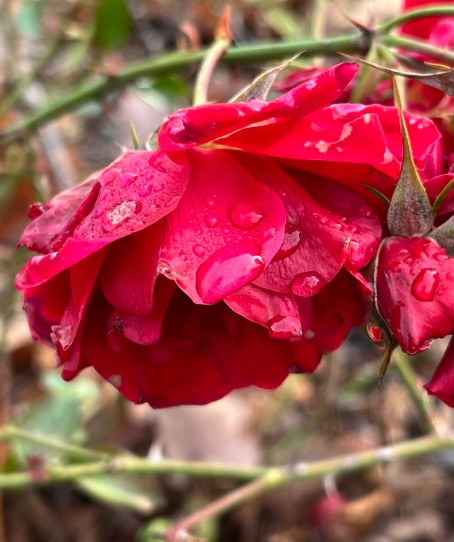
At the end of her letter to Sophie Liebknecht about the bees and meadows, Luxemburg wrote, “I really hope to die at my post, in a street fight or in prison.” She did. At the end of World War I, Luxemburg was freed from prison, but in January 1919, with the new Weimar government’s tacit approval, right-wing militias kidnapped her and Karl Liebknecht. They were taken to the Hotel Eden, on whose site I found those leaves. First Liebknecht was shot, then Luxemburg. Her body was dumped in the Landwehr Canal. She was there for months, identified by Mathilde Jacob in May. Now she’s buried next to Liebknecht, and on the day I visited, a spray of roses had been left on Red Rosa’s grave. It was raining. Water outlined each petal. In one letter from prison, she quotes the poet Eduard Mörike:
So that all the flowers quivered,
So that all fragrances became more vivid,
So that a higher redness touched the rose.
Thank: Callie’s Berlin, Agata Lisiak, Nathaniel Flakin and his Revolutionary Berlin walking tours.
Jennifer Kabat’s books The Eighth Moon (2024) and Nightshining (2025) are published by Milkweed Editions. Her writing has been in Best American Essays, Granta, BOMB, Harper’s, and McSweeney’s. She lives in rural upstate New York and serves on her volunteer fire department.