


 K. Austin Collins
On race and retail: Boots Riley’s mile-a-minute film is a wild mix of the heist genre, the ensemble comedy, labor satire, and outright science fiction.
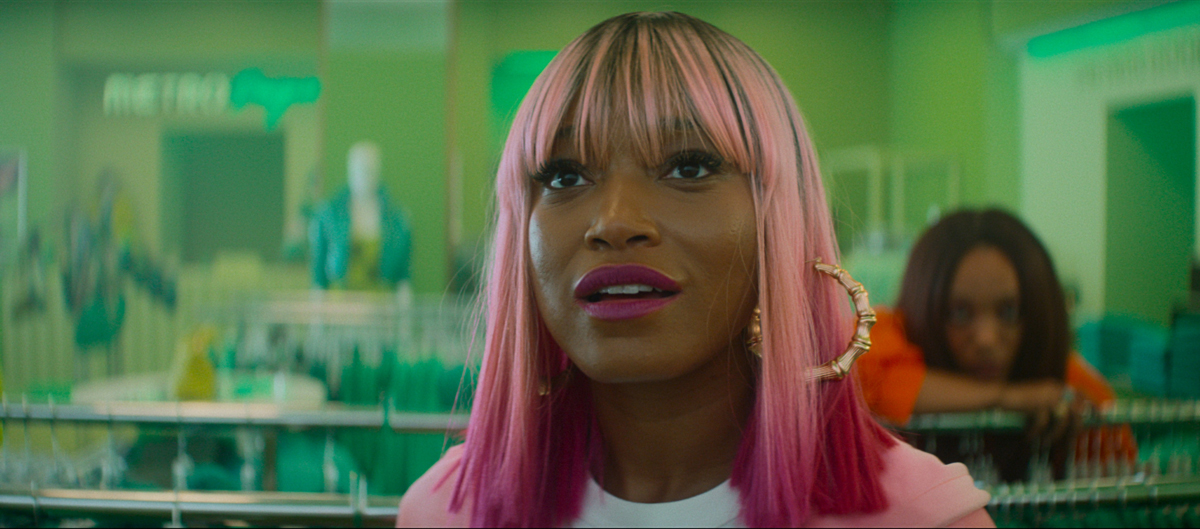
Keke Palmer as Corvette in I Love Boosters. Courtesy Neon.
I Love Boosters, written and directed by Boots Riley,
now playing in theaters
• • •
Boots Riley’s I Love Boosters feels like a desperate film, the work of someone who’s put everything he has to give—every sight gag, one-liner, tossed-off aside, and political idea he’s ever dreamed up, every color he’s ever seen and lesson on dialectical materialism he’s ever received, everyone he hates, everyone he loves—into a cramped 105 minutes. The movie, his second, shares a title with a song Riley released through his rap group The Coup back in 2006, making it seem like an apt summary of the career-long obsessions he’s held as a filmmaker, rapper, and activist, since joining the Labor Party as a teenager. In its compulsive showmanship, I Love Boosters has the restlessness of a first film. But in its buzzer-beater eagerness to say it all before the clock runs down, the movie comes across, not without some poignancy, as a last one. Whether or not that’s the case will depend, at least somewhat, on people seeing the movie—buying tickets, not stealing them, which is the kind of irony Riley no doubt appreciates.
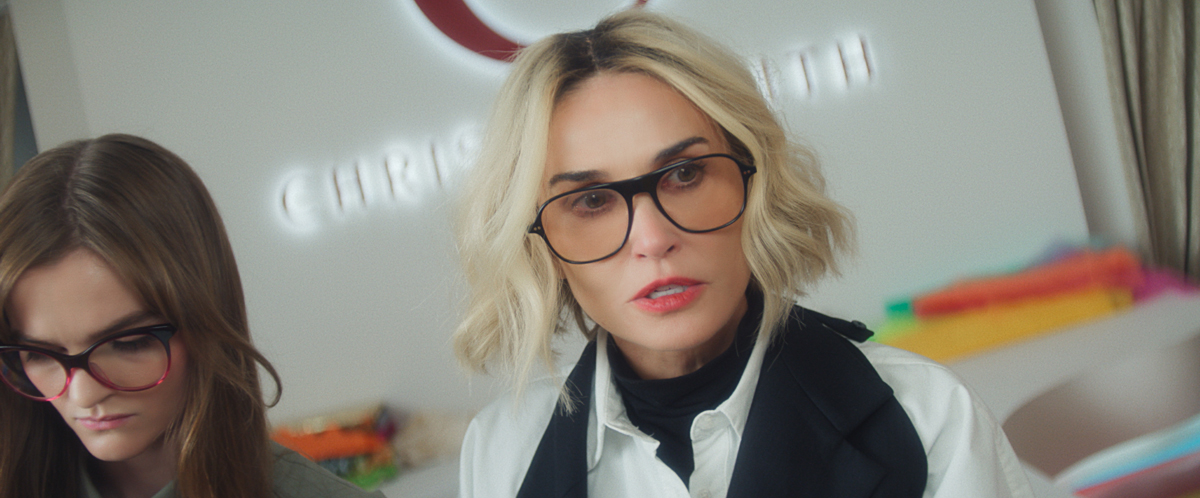
Kerris Dorsey as Jamie and Demi Moore as Christie Smith in I Love Boosters. Courtesy Neon.
The movie is about a young Oakland woman named Corvette (Keke Palmer), a booster—her trade made clear as early as the movie’s opening scene, when she lures a man back to her apartment under the guise of sex only to try to sell him a pair of stolen shoes—who belongs to a trio of women the media calls the Velvet Gang, ostentatious shoplifters wreaking havoc on Bay Area clothes retailers. Their main target is Metro Designers, an overpriced boutique owned by a former child genius–turned Studio 54 coke addict–turned Chanel muse–turned billionaire fashion mogul, Christie Smith (Demi Moore). Corvette—who lives in an abandoned chicken shack that she has, per Riley’s characteristically bohemian ethos, repurposed into a home—wants to be a fashion designer like Christie until she realizes that the tycoon has stolen one of her designs. So begins the Velvet Gang’s epic Robin Hood story, in a film that wildly mixes the heist genre, the ensemble comedy, labor satire, and outright science fiction.
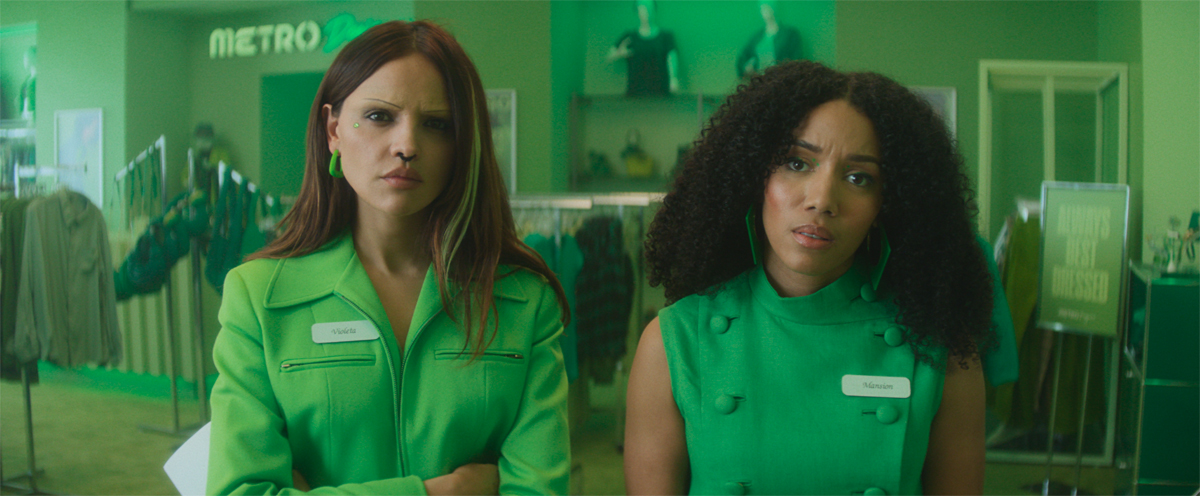
Eiza González as Violeta and Najah Bradley as Mansion in I Love Boosters. Courtesy Neon.
Boosters’ outrageousness will be no surprise to anyone who’s seen Riley’s first feature, Sorry to Bother You (2018), which is also committed to finding the grotesque, heady fun in class warfare. Similar to that earlier film’s insights into the drudgery of telemarketing, Boosters sends up the specific degradations of an underpaying retail job: lunch breaks that last only thirty seconds, cringey customer-service mantras (shoppers are to be treated to “max vibes”), uniforms the employees must pay for out of their own checks. Plainly, it is a system worth disrupting. And because this is a film with an eye toward international class solidarity, the Velvet Gang eventually joins forces with Jianhu (Poppy Liu), a representative of the exploited workforce in China, where Metro’s overpriced garments are actually produced. This is a global film, by way of Corvette’s gradual awakening to class consciousness. Stylistically, this affords Riley the leeway to do what he loves most, shifting under our feet, jumping between ideas at such a fast clip that we almost become anesthetized to how much more outlandish things are growing by the minute. It could be a metaphor: the film as a representation of the rapid, unthinking accumulation one doesn’t notice until the problem is too big, too vast, to save.
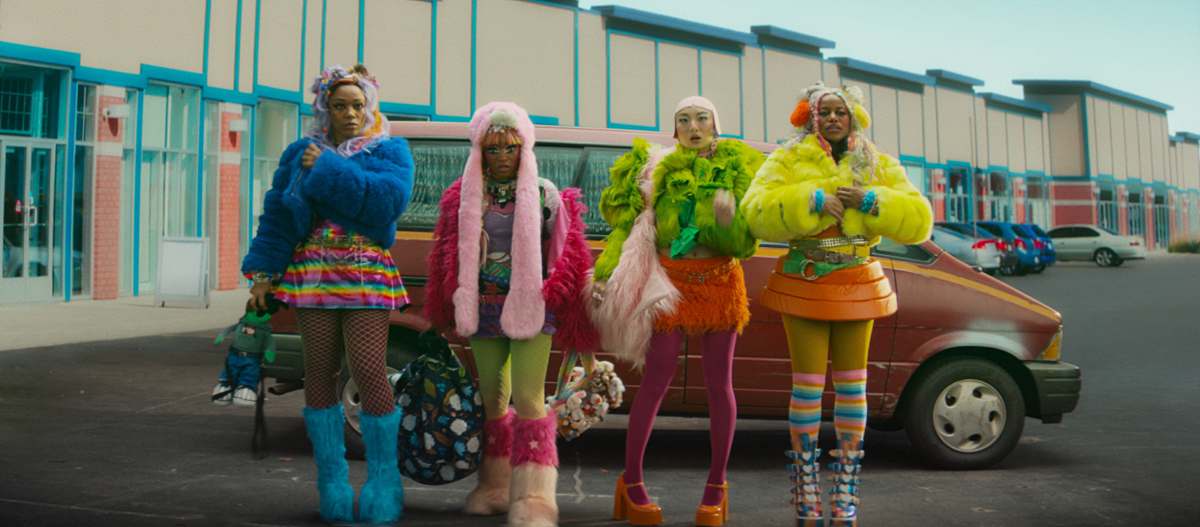
Naomi Ackie as Sade, Keke Palmer as Corvette, Poppy Liu as Jianhu, and Taylour Paige as Mariah in I Love Boosters. Courtesy Neon.
Sometimes this strategy works. Riley’s best trick is to take bits of collective Black social and political knowledge and wield them with a wink. Black cultural truisms abound in his work. In Sorry to Bother You, the necessity of code-switching and using one’s “white voice” on the phone gets passed down from elder to youth like ancient wisdom, only to manifest, surreally, as a white voice-over emerging from a Black man’s mouth. In Boosters, to get into one of the posher (read: white) stores in San Francisco, Velvet Gang member Mariah (Taylour Paige) holds her breath until she’s light-skinned enough not to arouse suspicion—a sharp twist on the colorist trope we’ve come to expect in conversations about race and retail. Or take the astute detail of Corvette proudly proclaiming to Christie that her favorite color is “turquoise” and receiving the correction, in a subtle form of class-shaming, that the hue in question is actually aquamarine.
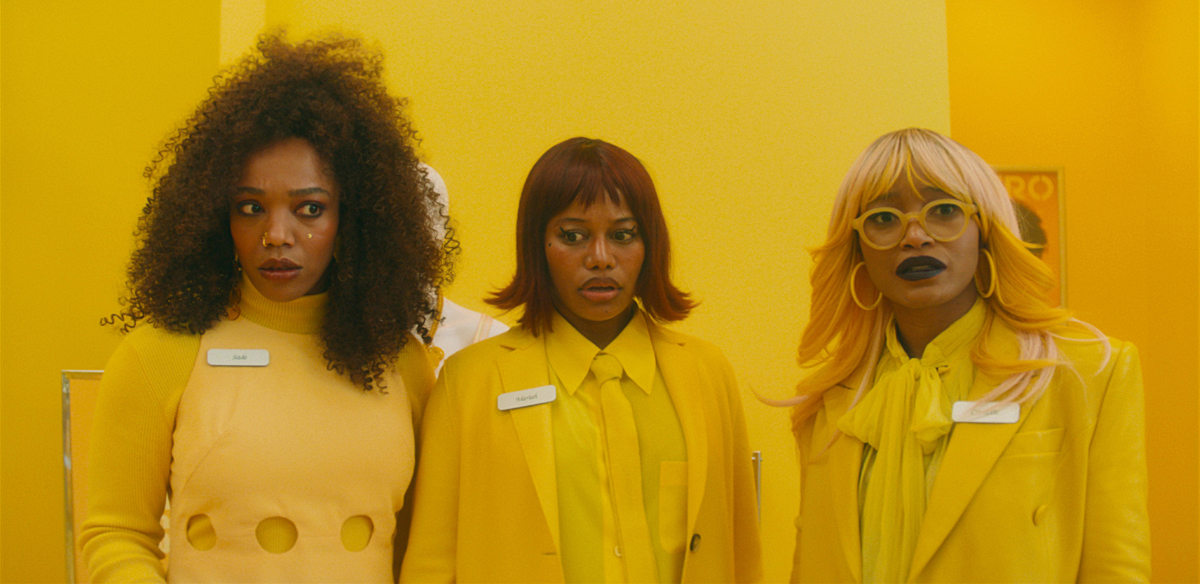
Naomi Ackie as Sade, Taylour Paige as Mariah, and Keke Palmer as Corvette in I Love Boosters. Courtesy Neon.
Riley’s style is unabashedly postmodern, a mile-a-minute mélange of jokes and allusions, to the point that both his films eventually start to sag with tedium. Yet, on the other hand, his near-constant attention to media’s omnipresence, its worrying ability to numb working-class consciousness into complicit submission—one of postmodernism’s old saws—proves invigorating. In Sorry to Bother You, infomercials sell chipper Day-Glo fantasies of slave labor. In Boosters, people are incessantly watching things on their phones: YouTube streamers, TV newsclips with a rotating cast of anti-proletariat sellouts. Consumption is constant; the world is always trying to sell you something while extracting even more from you in the same moment.
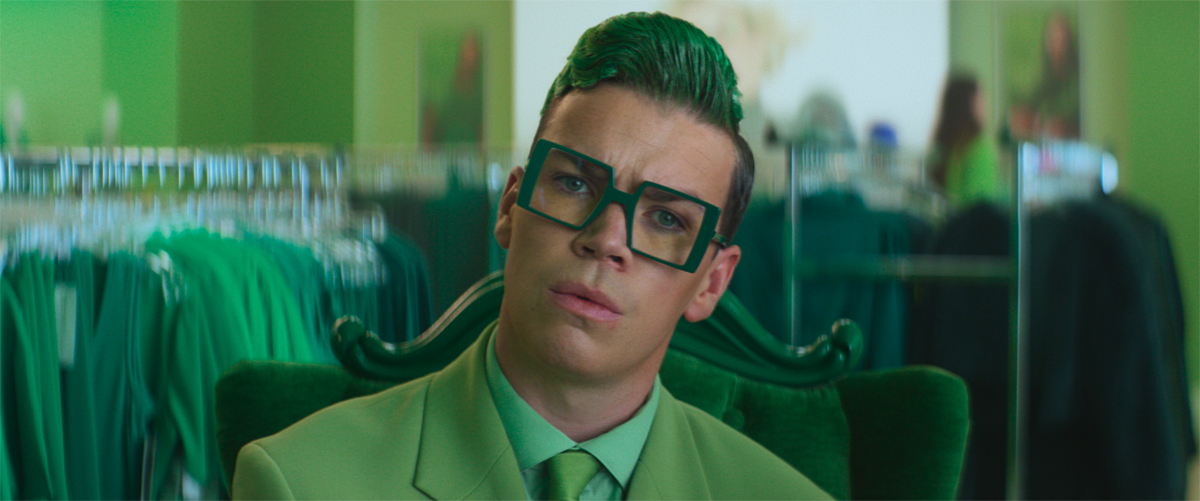
Will Poulter as Grayson in I Love Boosters. Courtesy Neon.
But Riley, too, is extracting more—too much—from his premise. At one point, his only solution for the problem of too many strands flying in too many directions is to introduce a teleportation device that triples as a heavy piece of symbolic machinery. Turn one dial and you’ve got a direct line to a Chinese factory floor, where a strike is underway. Turn another and you’re in deconstruction mode, reducing people and objects to their constituent thesis and antithesis. Call it late-stage didacticism. By the time this gizmo appears, some of the real joys of the film—images like Corvette stuffing boosted items into her Juicy Fruit–pink tracksuit with an avidity befitting Violet Beauregarde—are far behind us, and we must now contend with a teleportation chase scene, think-tank con artists flayed of their skin, and a cunnilingus vampire played by LaKeith Stanfield.
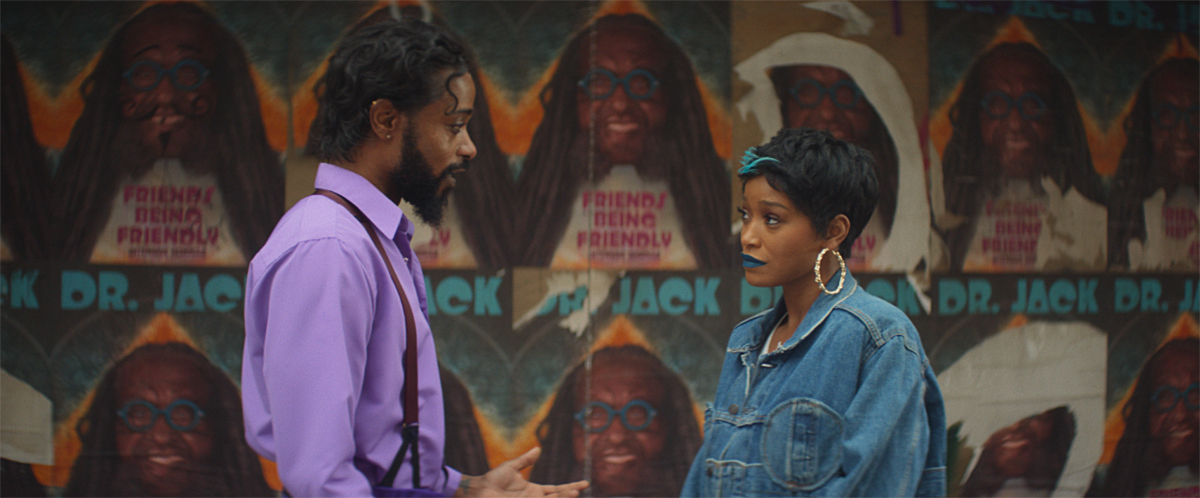
LaKeith Stanfield as Pinky Ring Guy and Keke Palmer as Corvette in I Love Boosters. Courtesy Neon.
Recently, Riley has been embroiled in debates on X over the political inconsistency of releasing a $20 million film this critical of late capitalism through Annapurna—founded by Megan Ellison, whose father, Larry, is one of the evil billionaires of the moment. One perhaps naive idea about radical filmmaking is that it must cost as little money as possible to be politically valid. But Riley seems to view his project less as a matter of working independently of the system than of using the system’s own money against it, siphoning off capital to worthy DIY artists like his collaborators—stealing, in a way, not unlike the heroines of his film. Fair enough. But what matters as much as the price of the weapon one uses is the nature of that weapon—the sharpness of the spear. And I Love Boosters is fighting with a dull blade.
K. Austin Collins is a film critic whose work has appeared in Rolling Stone, Vanity Fair, and the Atlantic. He is the author of forthcoming books on Frederick Wiseman and Black police officers.