


 Julie Phillips
In her new novel about an author researching the Modernist writer, Deborah Levy examines rootlessness and expatriation, partnership and friendship, freedom and devotion to one’s art.
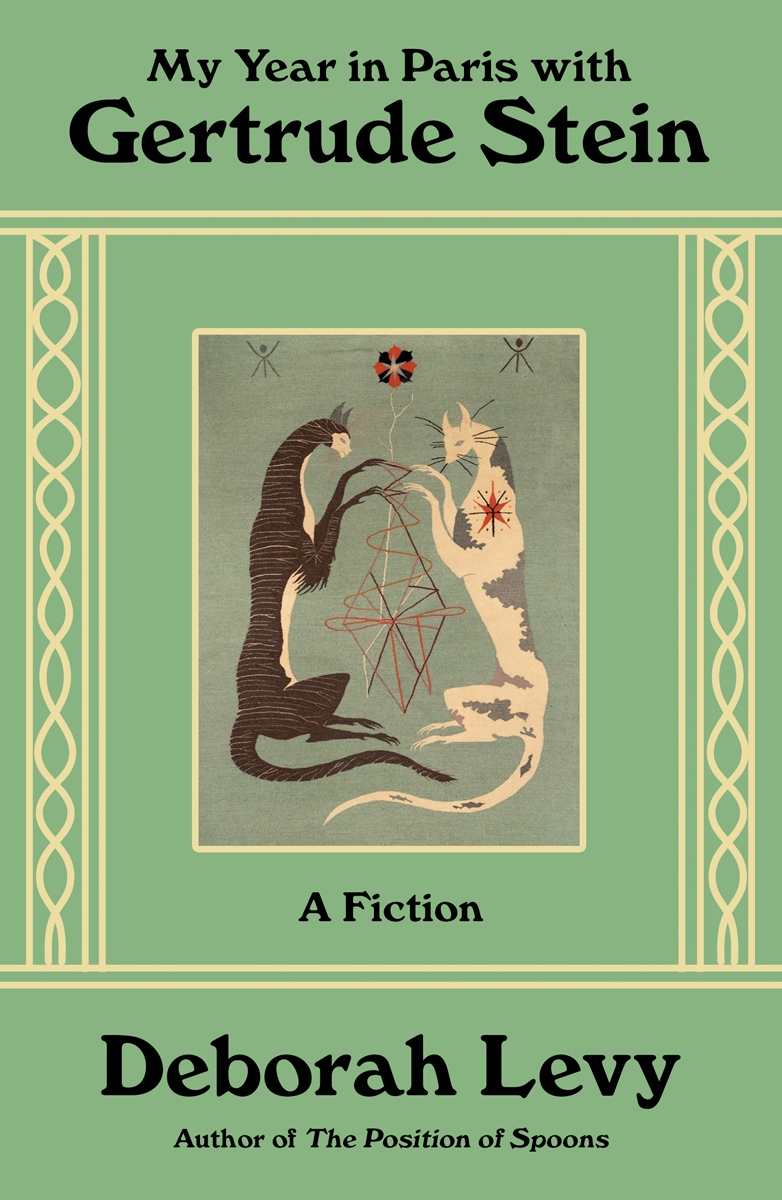
My Year in Paris with Gertrude Stein, by Deborah Levy,
Farrar, Straus and Giroux, 228 pages, $27
• • •
Elusive and irresistible, Gertrude Stein has been turning up lately as a touchstone for writers attracted to her arrogance, her playfulness, the way she drew a mist of associations and evasions across the purport of her prose. Her work seduces with the promise of intimate understanding (she wanted to uncover what she called people’s “bottom nature”) and frustrates with meanings that remain private, or perhaps an authorial self that doesn’t want to cohere. If she chose to be obscure, is it up to readers to do the work of understanding her? Should we try to find her at all or just enjoy the confusion?
Two recent Stein books have put their money on finding. In her accomplished work of archival sleuthing, Gertrude Stein: An Afterlife, biographer Francesca Wade noses into the relationship between Stein and Alice B. Toklas, her spouse (they called each other “wifey” and “hubby”), finding clues in Toklas’s jealous rages and Stein’s acquiescence. Novelist Prudence Bussey-Chamberlain, in her sexy, fun, and exquisitely odd mystery Bone Horn (out next month in the US), tries to get to the bottom of the couple’s private life—pun intended, as the main character speculates on their writer-secretary relationship and who did what to whom.
Deborah Levy, on the other hand, prefers exploring what it means not to know. My Year in Paris with Gertrude Stein is narrated by an author researching an essay on Stein’s life and work: her study with William James, her portrait by Picasso, her Modernist experiments with the rhythm, sense, and nonsense of words. But it’s also a lighthearted, free-associative novel about female friendship and literary inspiration. With the insight and curiosity that characterize her fiction (Hot Milk, Swimming Home) and her acclaimed memoirs, Levy examines rootlessness and expatriation, partnership and friendship, freedom and devotion to one’s art.
“Eva called to say she had lost it,” the nameless narrator begins. “It,” in this case, is Eva’s equally nameless cat. This bit of wordplay becomes a leitmotif as three friends crisscross Paris, searching for the cat and losing, and finding, various iterations of “it.” Eva, an artist of Spanish-Danish parentage, uses video calls to maintain a long-distance marriage that she fears is going under. Fanny, a French financial advisor, has many lovers but forfeited her parents’ affection when they caught her kissing a girl. The third, the narrator, is an older single woman who lives in London, is “not entirely British,” and whose sense of home keeps giving her the slip.
The not-Levy narrator wanders through Père Lachaise, trying to locate Stein’s headstone while recounting anecdotes about the famous Modernists buried there: Modigliani, Oscar Wilde, Apollinaire. “Being yourself is funny as you are never yourself to yourself,” she quotes Stein, and wonders if her words are “what modernity is all about. Not being yourself. . . . Stein, the daughter of immigrants, was obsessed with what she called ‘composition.’ . . . How do we put ourselves together?” She shows us Stein’s capability for profound estrangement, which could explain her early embrace of Cubist painting: she was used to the normal looking strange.
What does a writer or artist have to lose in order to do her work? Not just her sense of perspective. At different points, Stein loses her temper, refutes her brother’s put-downs, rejects namelessness. She abandons her corsets, and with it the hourglass figure that was a sign of her times. Meanwhile, in Paris, art was shaking off representation and conformity. So was Stein’s writing, with which the narrator has a love-hate relationship. Sometimes she finds it self-indulgent and wants to “smack it in the chops.” But she also wonders if “getting it” is overrated. “I like reading books I don’t understand,” she tells Fanny, who replies, “Why not have some sex you don’t understand” instead?
The narrator strongly resembles the British–South African Levy, especially as she appears in her 2021 memoir Real Estate: sixtyish, cosmopolitan, uprooted from her old home in London by a divorce, and thinking about what a woman might have to gain to become the protagonist of her own story. (Her ironically titled 2019 novel The Man Who Saw Everything investigates the parallel question of what a man might gain if he paid more attention to women’s inner lives.) In My Year in Paris, the narrator sees Stein’s expatriation, her move in her twenties to France, as an act of self-creation, and draws parallels with her own Parisian friendships and the ways in which she, Fanny, and Eva create each other.
In Levy’s fiction, the characters often find out their own dimensions by crashing into hard objects—sometimes actual objects, but usually people: family members, friends, lovers, and strangers with their own needs and desires. Here, in contrast, the three friends support each other against the threat of loneliness and meaninglessness. Levy likes to produce characters as they are required by the plot, and so, toward the end of the book, Jean-Luc appears, an enigmatic man who may be the actual owner of Eva’s cat. He also just might be a “snow leopard,” the narrator’s term for the rarest of creatures, a man her age who is interested in more than listening to himself talk.
Levy has said she tries to keep a balance in her work between everyday details and moments of strangeness. In My Year in Paris, there isn’t much that is truly mysterious. The narrator’s practical friends Eva and Fanny keep bringing her back to earth, spiritually and intellectually:
When Fanny walked back to pick up her phone, I told her that the philosopher Jacques Derrida had been very interested in Stein.
“We have plenty of excellent writers of our own, including Derrida. Marguerite Duras knew how to use a comma, so did Balzac. If you excuse me I need to do some admin now.”
At one time, Levy planned to write a biography of Stein, and some bits of My Year in Paris do feel like they’ve been recycled from another project. (Is a repurposed text both lost and found?) If the combination of Levy’s light tone and the bookish details on Stein doesn’t always come together, all the parts of this novel are delightful in themselves: funny, wide-ranging, and worthy of their comma-challenged muse.
Julie Phillips’s most recent book is The Baby on the Fire Escape, on mothering and creative work.