


 Aruna D’Souza
A traveling retrospective of essential viewing makes an elegiac landing at the Philadelphia Museum of Art.
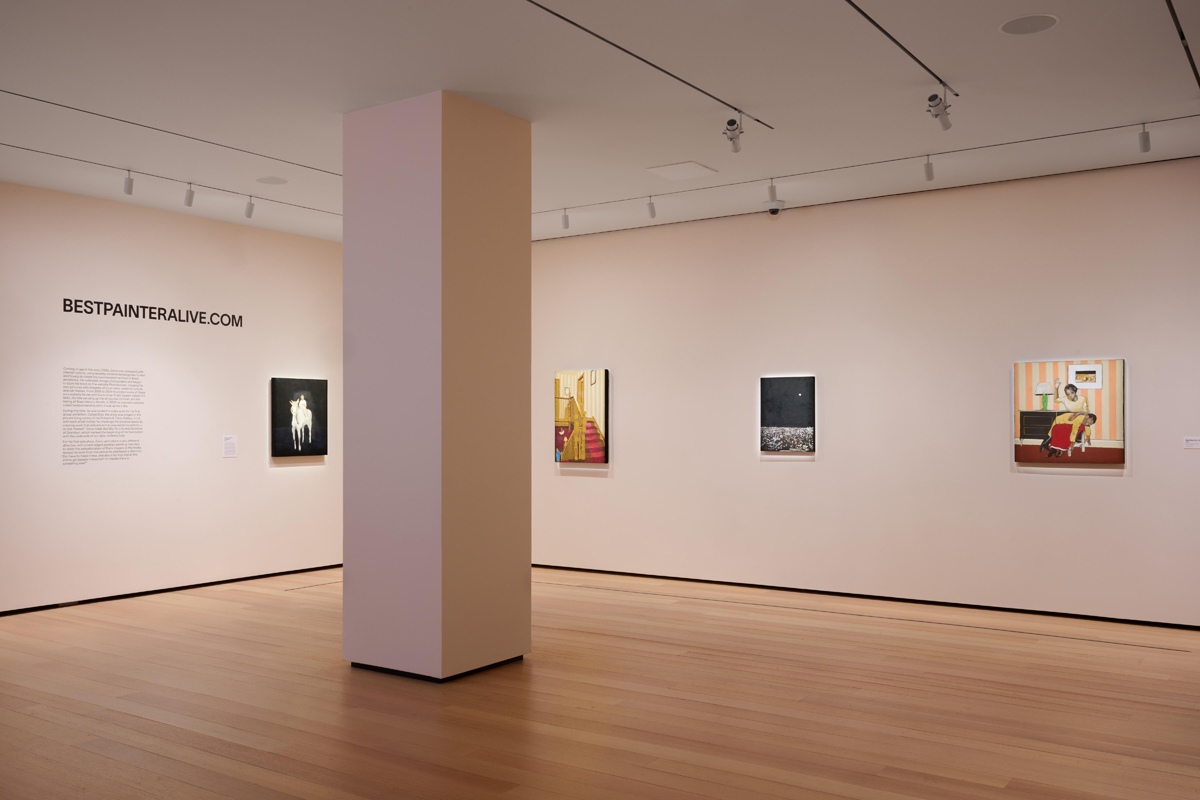
Noah Davis, installation view. Courtesy Philadelphia Museum of Art. Pictured, far left: Forty Acres and a Unicorn, 2007. Second from left: Delusions of Grandeur, 2007.
Noah Davis, Philadelphia Museum of Art, organized by Eleanor Nairne and Wells Fray-Smith with Camila Rondon, 2600 Benjamin Franklin Parkway, Philadelphia, through April 26, 2026
• • •
Now on view at the Philadelphia Museum of Art, Noah Davis gathers more than sixty paintings, sculptures, and works on paper by the artist; this is the fourth iteration of a show that was previously held at DAS MINSK in Potsdam, the Barbican in London, and the Hammer Museum in Los Angeles. It is essential viewing. Davis, who died in 2015 at the tragically young age of thirty-two, was a painter of Black quotidian life—“normal scenarios, where drugs and guns are nothing to do with it,” he once said—but that ordinariness always seemed to coexist with the magical, the wondrous, the supernatural. A boy rides not a horse but a unicorn. Another contemplates climbing a staircase that may as well be Mount Everest. A little girl sits primly, hands in lap, on the edge of a bed, face obscured by a ghoulish mask. A young man takes flight among his cavorting peers. A woman, posing in a slightly shabby backyard, evokes an Egyptian goddess. Ballerinas dance in a housing project; a conductor directs an invisible orchestra from the stoop of an empty building.
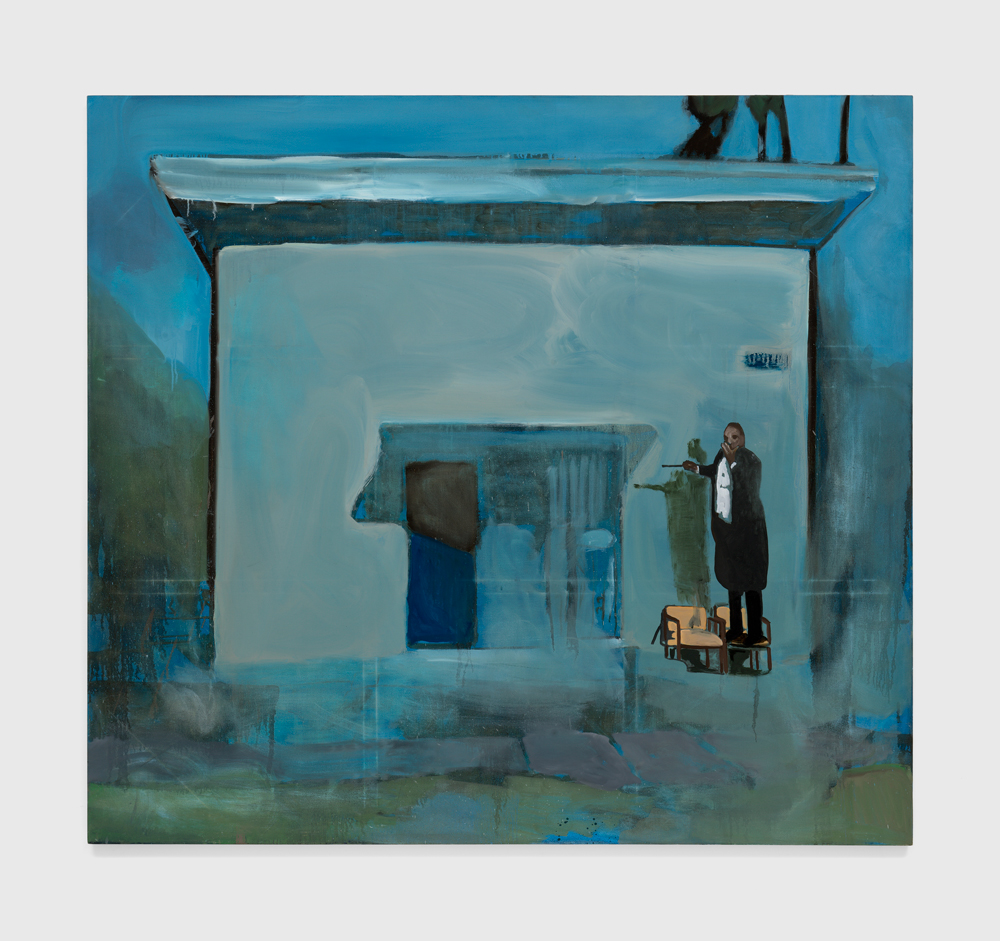
Noah Davis, The Conductor, 2014. Oil on canvas. Courtesy the Estate of Noah Davis and David Zwirner. Photo: Kerry McFate. © Estate of Noah Davis.
This is work that makes space for a picture of life that is informed by history—always—whether that history is part of the ongoing legacy of anti-Blackness in this country, or the history of art itself. 40 Acres and a Unicorn (2007) refers, of course, to broken post-Emancipation promises of reparation, but here disappointment turns to wonder; Pueblo del Rio: Arabesque (2014) to failed social experiments in low-income housing, reimagining such sites not only as those of unrealized dreams but also of creative potential. 1975 (3), 1975 (8), and 1975 (9), all from 2013, are based on photographs taken by Davis’s mother, Faith Childs-Davis, when she was a teenager on Chicago’s South Side. They depict children delightedly splashing in neighborhood pools, but are haunted by the all-too-recent fact of segregation. Delusions of Grandeur (2007), the painting of the boy at the bottom of the stairs, comes straight out of Édouard Vuillard; Isis (2009) echoes Edgar Degas. A series of works from 2013, titled The Missing Link, draws upon sources from the Western art canon (Courbet, Mondrian, Rothko, and so on), applying them to subjects—Black subjects—that such a canon has only rarely acknowledged. And then there are the glimpses of the art of Black makers—Kerry James Marshall, Henry Taylor, Jennifer Packer, among others—whose thinking informed his, and vice versa.
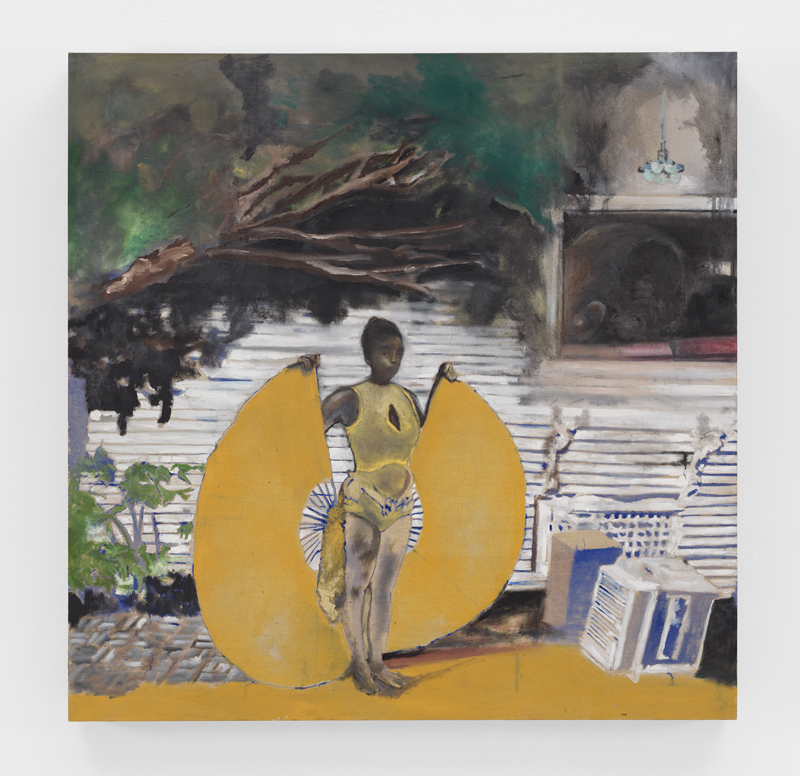
Noah Davis, Isis, 2009. Oil and acrylic on linen. Courtesy the Estate of Noah Davis and David Zwirner. Photo: Kerry McFate. © Estate of Noah Davis.
I first saw the show in Los Angeles, installed in the Hammer’s soaring, airy, white-walled galleries, and it filled me with a kind of joy that is hard to describe—my heart pounded, my brain was going a mile a minute. A true Stendhal moment. In Philadelphia, the mood is decidedly different: in low-ceilinged rooms with no natural light, painted black, gray, puce, purple, dark blue, and terra-cotta, the effect is mournful, elegiac. I get it: it’s hard to look at the virtuosity of Davis’s brush and not be gripped by a deep sadness at what we have lost, especially standing in front of the untitled works he made in the month or so before he died of a rare form of cancer. An old man shuffles, hunchbacked, in front of a wall that resembles a Rothko painting; two girls nap on a couch, their bodies forming a fascinating counterpoint of limbs and torsos while their heads settle into crooked elbows; a man sprawls out on the ground like a dying hero, rivulets of diluted oil paint washing down the canvas like tears.
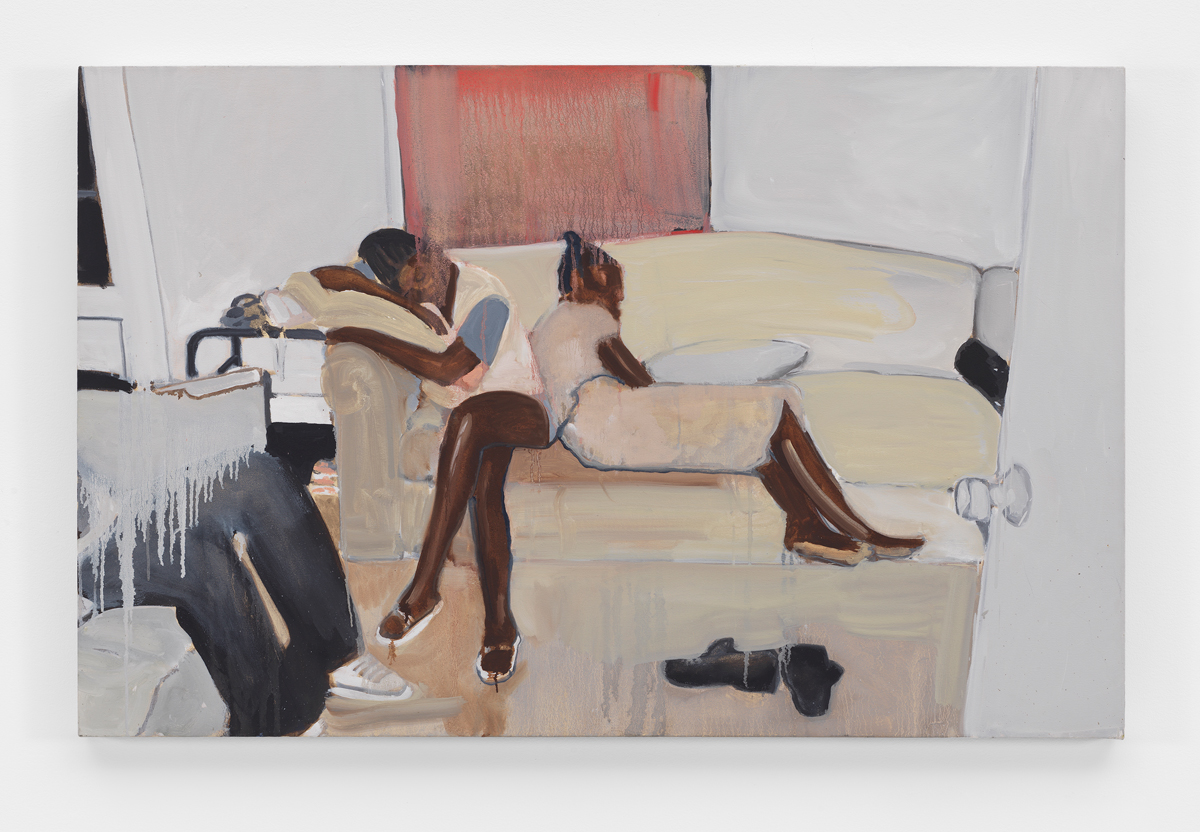
Noah Davis, Untitled, 2015. Oil on canvas. Courtesy the Estate of Noah Davis and David Zwirner. Photo: Kerry McFate. © Estate of Noah Davis.
For me, though, the most grief-producing moment in the show is the installation of works that pay homage to Davis’s role as cofounder, with his wife, Karon, of the Underground Museum in 2012. The brilliantly conceived space in Arlington Heights, which took up four storefronts on a busy thoroughfare, functioned as an exhibition venue, a community center, and a gathering spot. Davis intended to fill it with museum-quality pieces so that the residents of this working-class, largely Black and Latino neighborhood could access such work as easily as their white, middle-class peers did. When he discovered art institutions wouldn’t lend to him, he began making replicas instead—of Dan Flavin’s fluorescent light sculptures, Marcel Duchamp’s bottle rack, Robert Smithson’s mirror-and-sand displacements, Jeff Koons’s glass-encased vacuum cleaner. Davis’s lights were cheap shop lights, though, and his vacuum cleaner was bought used on Craigslist—substitutions that resulted in quietly hilarious and canny “ghetto” versions of high culture. He dared his audiences to try to explain the difference between the originals and his imitations, or provoked them to realize that they, too, had the wherewithal to make art.
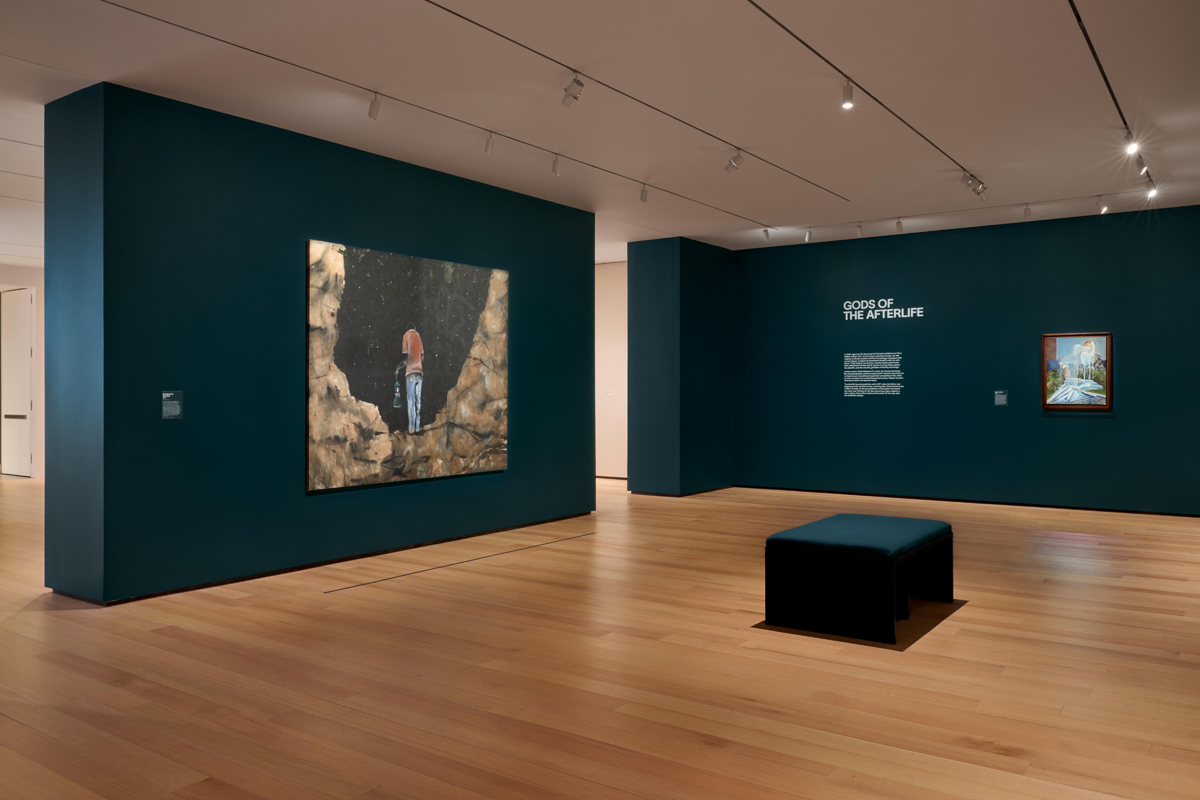
Noah Davis, installation view. Courtesy Philadelphia Museum of Art.
The Underground Museum was a result of Davis’s goal “to change the way people view art, the way people buy art, the way they make art.” It’s all the more heartbreaking, then, that it died, in part, as a consequence of the art world’s modus operandi. When the curator Helen Molesworth arrived at LA’s MOCA in 2014, she made the Underground Museum her project, offering to arrange loans for a series of shows that Davis planned from his deathbed; he lived long enough to see two of them realized, including a screening of William Kentridge’s Journey to the Moon (2003), which is on view here. After Davis’s passing, the market for his work went into overdrive thanks to David Zwirner gallery, which began representing the estate in 2020. At the same time, the Underground Museum, with the help of Molesworth, began a perhaps too-fast drive to formalize itself as a by-the-books institution (by establishing a board, acquiring nonprofit status, securing foundation money, and hiring professional directors). Things began to fall apart; the center could not hold. Zwirner mounted an expansive exhibition in 2020 in New York, curated by Molesworth, that included a room meant to convey the anti-institutional informality of the Underground Museum. That show traveled to Arlington Heights in 2022—and ended up being the last exhibition there before the venture crumbled under the weight of the family’s grief, as Karon Davis said in a statement at the time. One wonders if the weight of paperwork, fundraising, and all the other trappings of the 501(c)(3) life played a role, as well.
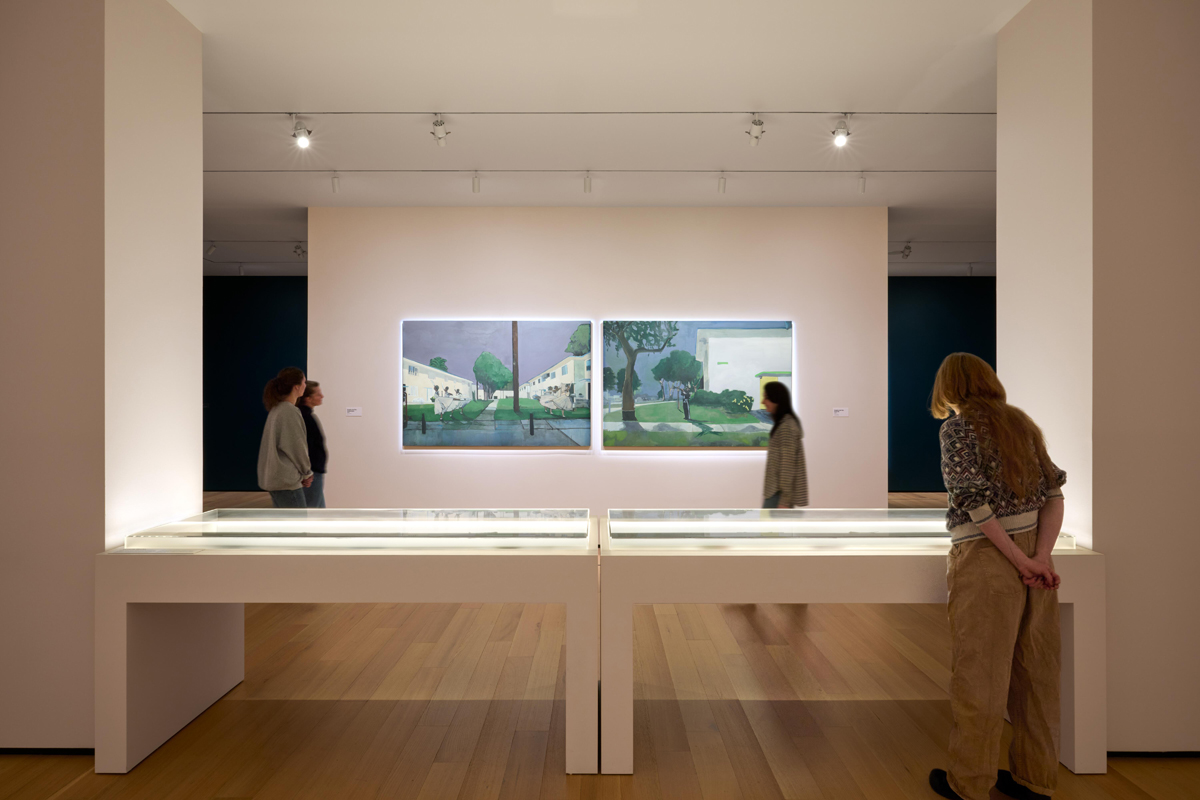
Noah Davis, installation view. Courtesy Philadelphia Museum of Art. Pictured: Pueblo del Rio: Arabesque, 2014.
What we are left with, in the wake of this collapse, are elegant shows with a blue-chip vibe, like this traveling retrospective. Unusually, instead of being simply underwritten by the gallery, as is the norm these days, the exhibition’s tour was financed in part by print editions that Zwirner produced of two of the painter’s most iconic images—a strangely extractive move. This inside-baseball detail is a small indication for me of how Davis’s legacy has been transformed into business as usual when it comes to how people view art, buy art, make art. It’s almost too much to bear, especially for a show that is too important to miss.
Aruna D’Souza is a writer and critic based in New York. She contributes to the New York Times, 4Columns, and Hyperallergic. Her new book, Imperfect Solidarities, was published by Floating Opera Press in 2024.