


 Sukhdev Sandhu
Created in collaboration with Anselm Kiefer, a new book by the late Alexander Kluge reveals the polymath’s dizzying,
allusive, spellbinding depths.
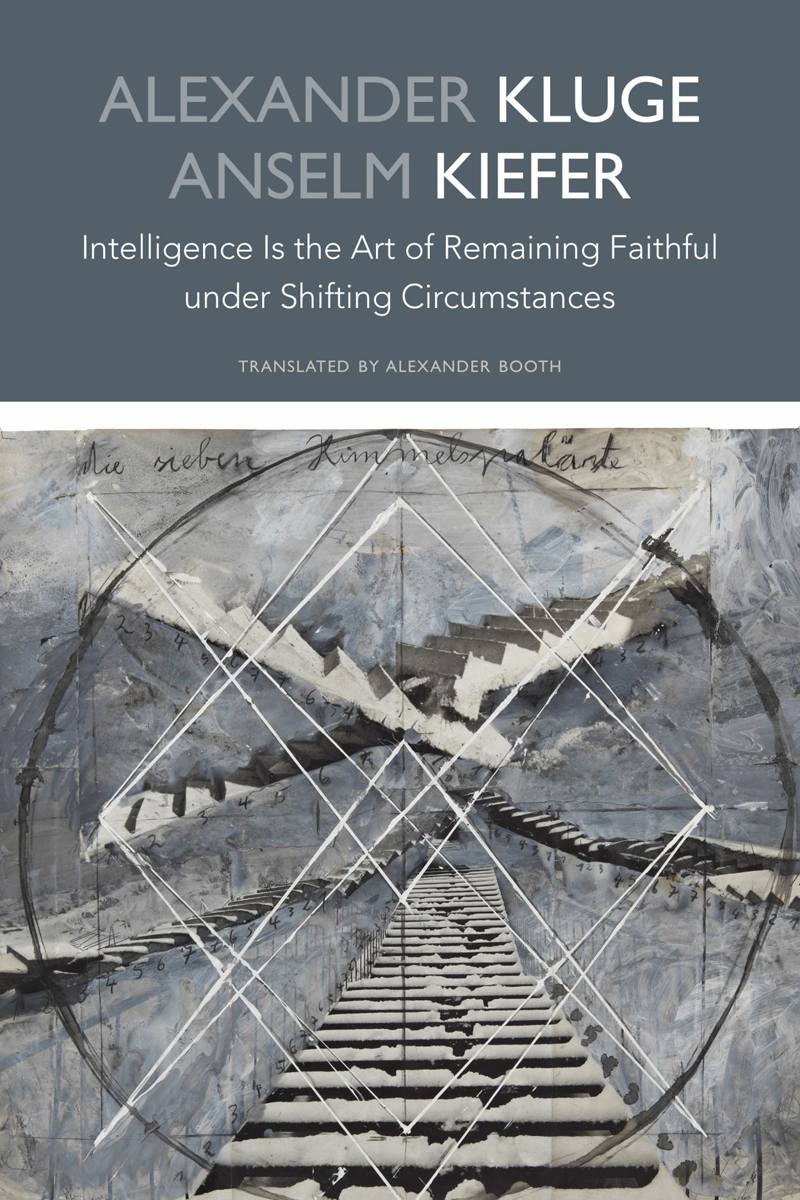
Intelligence is the Art of Remaining Faithful under Shifting Circumstances, by Alexander Kluge and Anselm Kiefer, translated by Alexander Booth, Seagull Books, 223 pages, $25
• • •
There are many Alexander Kluges. All of them grand. The lawyer who worked with Theodor Adorno and described himself as “a faithful servant of the critical theory of the Frankfurt School.” The filmmaker who started out as an assistant to the great Fritz Lang, a chastening experience that informed his decision to sign the Oberhausen Manifesto attacking the flaccidity of postwar German cinema. The author, with Oskar Negt, of vast atlases theorizing history, political theory, and what they called “the underestimated human.” The media architect whose Development Company for Television Program (DCTP), starting in 1987 and for the next three decades, made sure private broadcasters kept weekly slots for independent and experimental productions.
There are other Kluges, too. Less feuilletonic, less “German,” but just as important to salute. The lover of silent movies who collected Mack Sennett’s slapstick comedies. The translator of Winnie ille Pu, a Latin version of Winnie the Pooh (“Cur ursus clamat? / Cur adeo mel amat?”—“Isn’t it funny / How a bear likes honey?”). The philosopher of time—a deep believer in its continuities and concurrences—who, he confessed in a 2013 lecture, still saw himself as a curious six-year-old as well as a Russian grandmother: “Sixteen if not eighty eyes peer out of a single adult human being upon the world.”
Alas, as of last month, there is no Kluge at all. He passed away at the age of ninety-four, within weeks of the death of his friend Jürgen Habermas and just before the publication of Ben Lerner’s Transcription, a novel centered around a nonagenarian German polymath with a gift for delineating not just the possibilities of fiction but also the mysteries of technology and life: “impossibly thin glass filaments underground, underwater, in the lungs, in the cochlea, vibrating when the small waves hit them.” Ichabod! It’s hard right now to open any of his books without a keen, plunging sense of . . . The glory has departed.
At one level, Intelligence Is the Art of Remaining Faithful under Shifting Circumstances, a collaboration with Anselm Kiefer, translated by Alexander Booth, is merely the latest in Kluge’s ongoing book-length dialogues with visual artists, among them Georg Baselitz, Thomas Demand, and Gerhard Richter. But his affinities with Kiefer run especially deep. World War II is a vivid scar in the work of both: Kluge witnessed the near-total destruction by American bombers of his hometown, Halberstadt; Kiefer, born in the basement of a hospital in Donaueschingen, once told an interviewer: “The ruins, the dust. This is where I begin from.” As boys, they were masons: Kluge built tunnels; Kiefer dug garden shelters. Both are children of paper: Kiefer, who often takes near-finished paintings and turns them into books, keeps all thirty-three volumes of Grimms’ dictionary in his studio.
Kluge sees Kiefer as a poeta doctus—a learned poet—describing him too as a “collector, explorer, experimenter.” They talk in July 2023, the day before the painter received the German National Prize, and sections of their conversation are interspersed with color images of installation views and recent pieces such as The House of Whispers—for Paul Celan, Kluge’s responses to various artworks, QR codes to dozens of “microfilms” probing related themes (these are followed by Kiefer’s glosses in red). There are also “stations”—some just a paragraph long, with names such as “Semantic Field Treue (Constancy, Faithfulness) In The Idiotikon, The Dictionary of Swiss German”—that constellate memoir, fiction, mathematics, science fiction.
The spaceways Kluge travels are dizzying. One minute, he’s discussing a sacrificial inspector nine thousand years ago in Uruk who likens a sheep’s liver to the position of the stars; the next, he’s imagining a data capsule “undetectable to the financial auditors of the US Senate” from which life from a destroyed planet could emerge. Always allusions—to Ovid, Kepler, Caspar David Friedrich, Wagner, Brecht. To those he believes, like him, are “oath keepers,” both of the Enlightenment and of Romanticism—Musil, Proust, Nono, Cage, Bob Dylan. To those who refuse the separation of science and poetry. To those alchemists, mystics, and occultists whose heresies extend rather than diminish knowledge. (“It would be arbitrary to say that we cannot know anything about angels just because they very rarely come into laboratories,” he once told an interviewer.)
It’s wonderfully hard for Kluge to dam his thought-rush in the section attending to Kiefer’s Finnegans Wake exhibition at London’s White Cube gallery. Memories of language tumble out—of listening as a boy to his mother and her friend air their concerns at weekly bridge sessions: “[I] haven’t understood a thing in all the muddle of voices. And yet that particular Halberstadt tone consoles me across time, though I cannot say what exactly it conveys.” Glints of freedom: Joyce—like the Gracchus brothers, like Spartacus and Toussaint L’Ouverture, Schwitters too—“accelerated the release of words from their yoke” and “offered the enslaved new fields.” The painting Liffey, named after the Dublin river, bruits momentum, change, a rebellious hydropoetics—“Liquid turns to ice, that is, crystal. The solid and stony can explode into the sky in the form of clouds and rain back down: liquid debris.”
Spellbinding in a different way is an exchange triggered by the sand-and-charcoal-coated photograph Die Trummerfrauen (The Rubble Women). Its title refers to the German women who cleaned bricks from bombed buildings and placed them in neat towers to help with urban reconstruction. They helped reconstruct their broken husbands too, Kluge says. Kiefer recalls going to a station platform to meet an uncle—emaciated, hairless—belatedly returning from the war: “The train was supposed to come through a small tunnel. And, as a kid, I thought that Siberia began right behind it.” Kluge harks back to Penelope not recognizing Odysseus when he lands in Ithaca after twenty years away.
It’s been claimed that Kluge’s work is cold and impersonal. He himself says he writes “antirhetorically.” Yes—but really, no. Intelligence Is the Art—its depths and orbits, elastic latitudes, lived and speculated histories—is supremely thermal. Every page is a construction site where words and images labor together to do justice to the complexity of thoughts being essayed. Rhythm and pulse. Warmth, so much warmth.
The present, Kluge declares, “represses all pasts, occupies (or sells) broad swathes of the future, engages in battles with the subjunctive.” If so, its categorical antidote is this book, his faithful life.
Sukhdev Sandhu directs the Colloquium for Unpopular Culture at New York University. A former Critic of the Year at the British Press Awards, he writes for the Guardian, makes radio documentaries for the BBC, and runs the Texte and Töne publishing imprint.