


 Geeta Dayal
In the Scottish duo’s album Inferno, a kaleidoscopic range builds up a rich and uncanny sense of atmosphere.
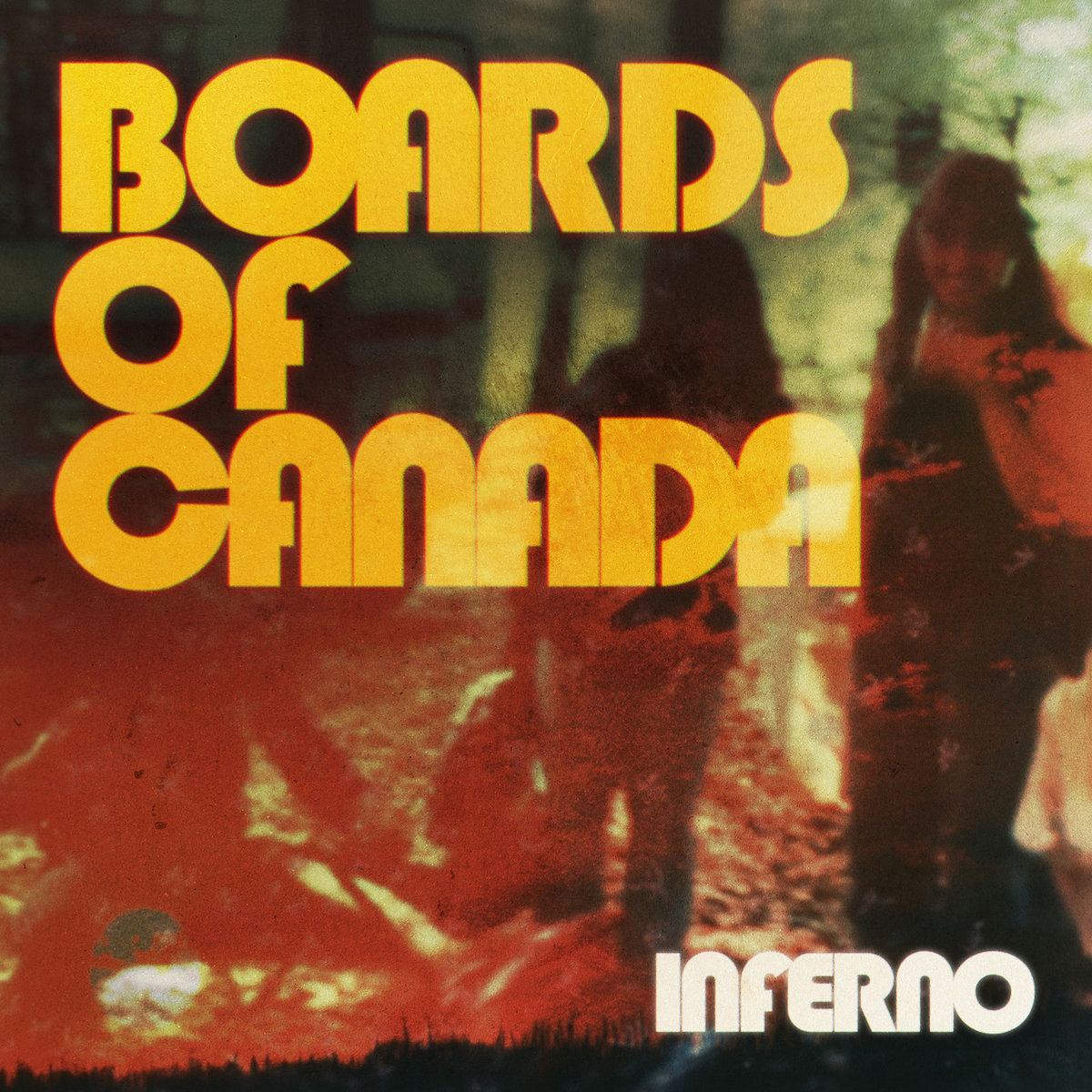
Inferno, by Boards of Canada,
Warp Records
• • •
Few bands are as charged with nostalgia for a past that never quite existed as Boards of Canada. Nearly three decades after their debut album, 1998’s Music Has the Right to Children, the Scottish duo retains a potent mythos. The trippy, haunting vocal samples, the charmingly imperfect quality of their vintage synthesizer sounds, and the faded references to a bygone childhood all add up to a unique and unforgettable style of ambient electronic music. Later trends of “hypnagogic pop” and “library music” have attempted to mine similar psychological and sonic territories, but no one has matched Boards of Canada’s surreal, dreamlike mix of sounds. Their records retain a strange power to this day.
Inferno, their first new full-length release in thirteen years, has a bleak and gloomy aura that gradually softens, becoming lighter and somewhat more vibrant as it progresses. Cryptic references to science and religion fill the eighteen tracks, which have titles like “Hydrogen Helium Lithium Leviathan” and “The Word Becomes Flesh,” and images of crosses can be found in the accompanying videos and artwork. But nothing is overt with Boards of Canada. In interviews, they have said they do not consider themselves to be religious at all. In their music, reality is a vivid, sensory blur that often crosses paths with the imaginary. The kaleidoscopic range of thematic and sonic elements are not there to form any kind of linear narrative but instead build up a rich and uncanny sense of atmosphere.
Inferno opens with an arpeggiated vintage synthesizer motif that feels like the introduction to a 1970s public television special. The track, “Introit,” takes its name from a Christian liturgical term for a recitation at mass. Next, “Prophecy at 1420 MHz” introduces some beats, forming an ominous low undertow. The sonic environment is dark and introspective. A deep robotic voice reminiscent of Darth Vader intones strange pronouncements. Some colorful synth pads attempt to take over, but a slow fade-out causes them to dissolve.
The slightly sinister collage “Father and Son” continues with veiled references to religion and the 1970s. It includes sampled vocals pulled from “The Jesus Trip,” an episode of a 1971 BBC documentary series called Man Alive. The vocals capture a conversation between a son who left his family and his aggrieved father. Boards of Canada use parts of their strained interaction, sampling chopped-up lines like, “I love you, but I love the Lord . . . more than I love any physical being.” The vibe is eerie and intense.
Several tracks are heavy on vocal samples that are longer than what would normally be expected in a Boards of Canada record. In their previous work, brief vocal snippets were common, such as the sound of a child laughing, or someone reciting a long list of numbers, or an odd line sung through a vocoder. On Inferno, samples of a conversation, like on “Father and Son,” feel like too much information. The words might sound a bit woozy and distorted, and sliced up and rearranged, but hearing so much talking breaks the hypnotic spell of the music. Perhaps it is because several of these vocal samples are in heavily American-accented English, and for me, living in the US, it sounds too loud and clear to be truly mysterious. When the songs are not in English, such as a mesmerizing track that samples and loops a chant of the entire Hare Krishna maha-mantra, the enchantment remains.
My favorite tracks on Inferno are the instrumental ones, like the melancholy “Memory Death,” which seems to stop time with its slow pace, hallucinatory pitch-bending, and immersive, cinematic sound design. When I first listened to the song, it brought me right back to the revelation of hearing the group in 1998 for the first time—that wide-eyed sense of wonder, combined with a slightly otherworldly quality.
Other primarily instrumental pieces on the second half of the record also offer that mystical, transporting experience that Boards of Canada does so well. “Into the Magic Land” and “Blood in the Labyrinth” are more guitar-based, echoing back to the style of their 2005 album The Campfire Headphase. Other tracks are more uniquely varied in structure and timbre, like the remarkable “You Retreat in Time and Space.” It begins with the stately purity of a church hymn, and, bit by bit, lowly transforms into a simple melody that sounds like it is being played on a toy music box. It then softly layers that line over a driving rhythm section. The result is deeply wistful and slightly funky all at once—an odd but beautiful balance of conflicting resonances that somehow all work together.
Inferno thrives in those liminal spaces, in tricky and unexpected psychological states. In an interview in Melody Maker in 1978, David Bowie defended the “chilly” ambience of his album Low, arguing that “rather surprising emotions . . . are lurking in one’s head somewhere that are very rarely expressed, possibly because one doesn’t feel there is an occasion to express that kind of emotion.” Boards of Canada crafts a rich interior world to express unusual and complicated thoughts. Confusion about the future and uncertainty about the past can be depicted at the same time. A rush of euphoria can be subtly threaded with a premonition of doom. A joyful laugh can have a profoundly unsettling undercurrent. Pangs of melancholy for a past gone by can sink in heavily and seem completely tangible, even if this history is entirely fictional. In Boards of Canada’s nuanced portrayals, the group effectively taps into our subconscious, short-circuiting the ordinary and superficial and taking a leap into our innermost thoughts.
Geeta Dayal is an arts critic and journalist specializing in twentieth-century music, culture, and technology. She has written extensively for frieze and many other publications, including the Guardian, Wired, the Wire, Bookforum, Slate, the Boston Globe, and Rolling Stone. She is the author of Another Green World (Bloomsbury, 2009), a book on Brian Eno, and is currently at work on a new book on music.