


 Aruna D’Souza
A galvanizing exhibition at PS1 showcases NYC art made by and
for the people.
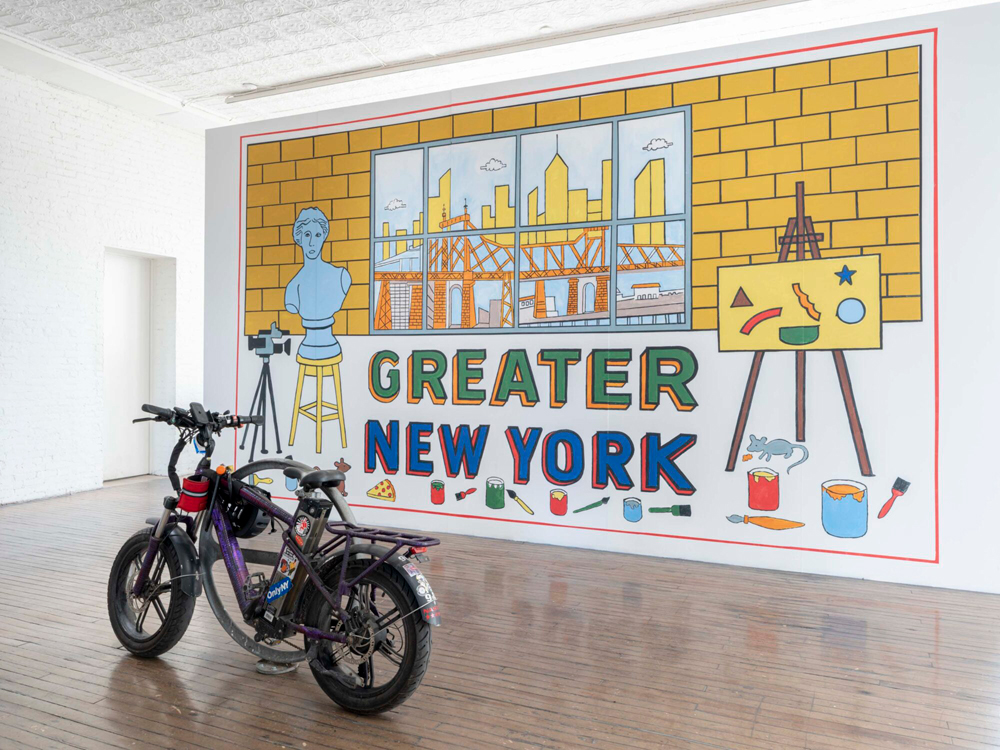
Greater New York, installation view. Courtesy MoMA PS1. Photo: Kris Graves. Pictured, left: fields harrington, Unfree Free Time (Bike Rental), 2026. Right: Cevallos Brothers, Greater New York, 2026.
Greater New York 2026, curated by Jody Graf, Elena Ketelsen González, Kari Rittenbach, Sheldon Gooch, and Andrea Sánchez, led by Connie Butler and Ruba Katrib, MoMA PS1, 22–25 Jackson Avenue, Queens, through August 17, 2026
• • •
After the ticker-tape parade for the Knicks last week, Mayor Zohran Mamdani gave a rousing speech about the team’s championship run, in which they closed a twenty-nine-point lead in the final moments of game four, when everyone, from color commentators to sports-betting markets, had given up on them. “What is New York if not your back up against the wall, a dream that feels just out of reach, a rent payment you don’t know how you will ever make? What is New York if not 99.6 percent of the world stacked against you? And who are New Yorkers if not people who hear those odds and smile?” It was a rhetorical master class—“The Rent Is Too High; Knicks in Five!”—that captured Mamdani’s particular political gift: the ability to look reality head-on without ceding the joy and beauty of striving toward something better.
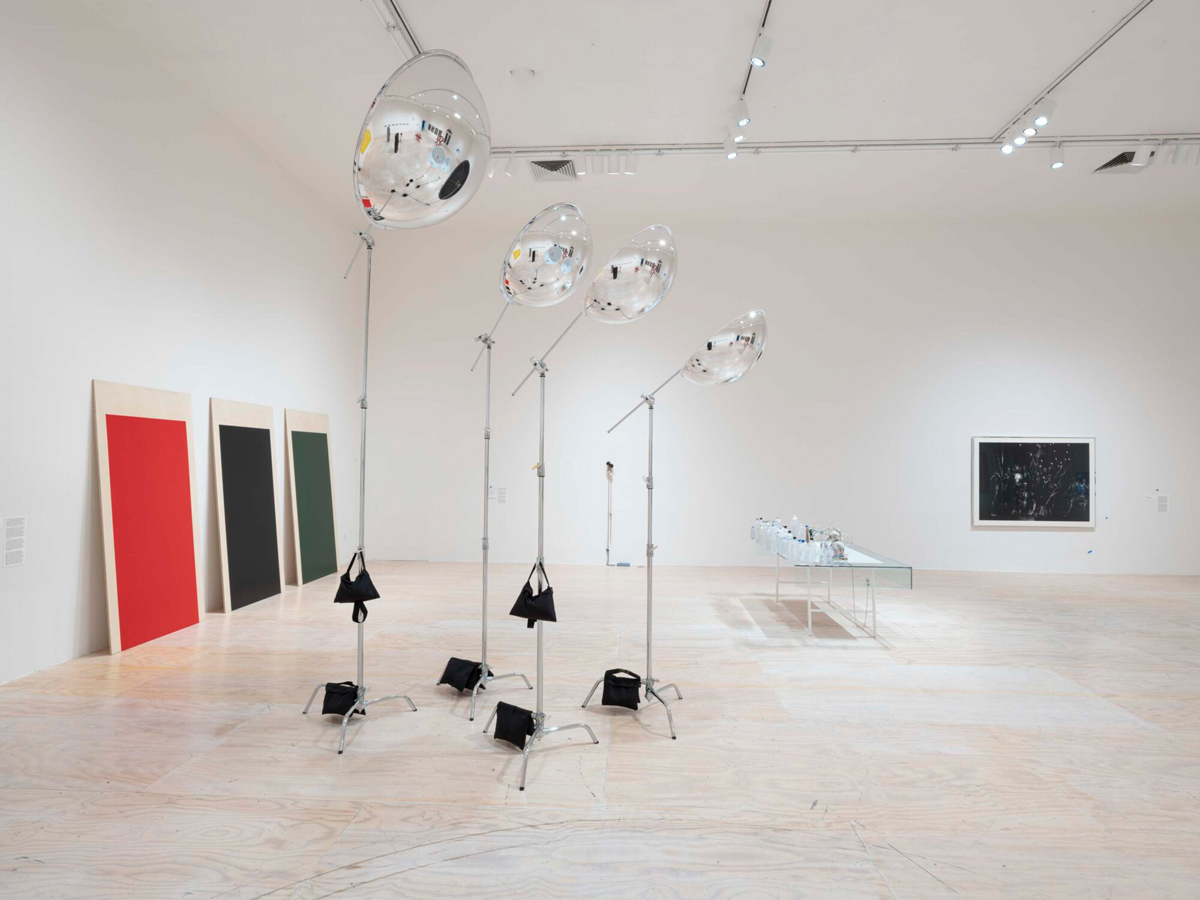
Greater New York, installation view. Courtesy MoMA PS1. Photo: Kris Graves. Pictured, center left foreground: Win McCarthy, Philosophy of the Mind, 2026.
If Mamdani’s address were an art exhibition, it would be Greater New York at MoMA PS1. The fifty-three participating artists and collectives offer up a picture of the city that doesn’t shy away from the hardships we face in our daily lives—sexual violence, police surveillance, at-risk infrastructure, xenophobia, the lawlessness of ICE, climate crisis, precarious labor, and more. While I, for one, am often paralyzed by the weight of all the shit going on around us, these artists are rolling up their sleeves and getting to work.
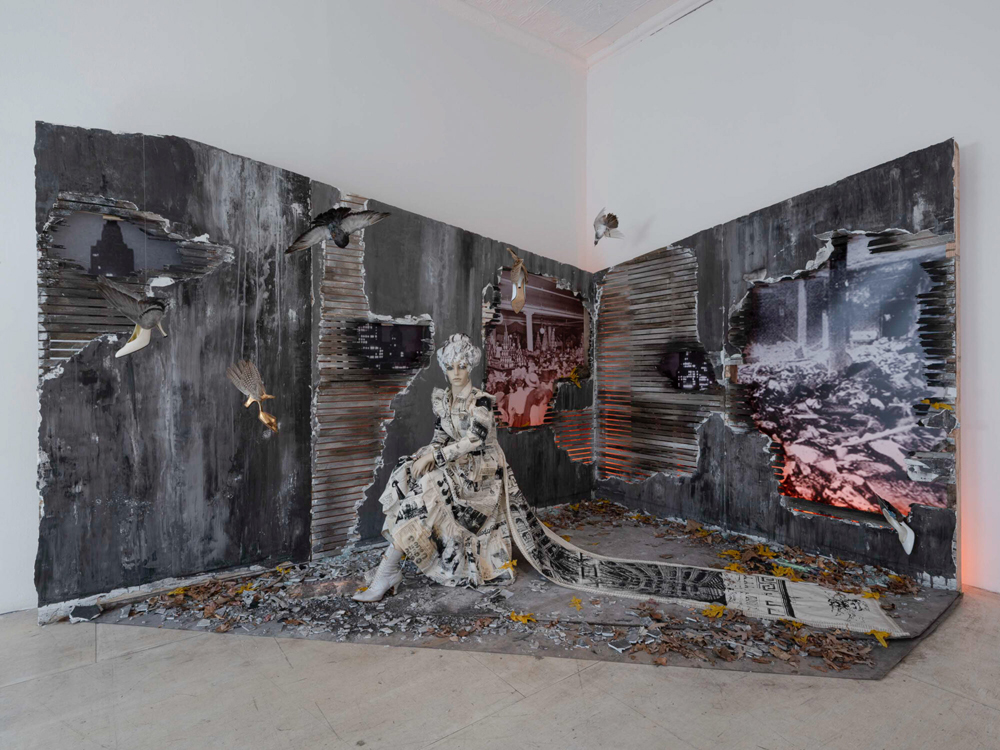
Greater New York, installation view. Courtesy MoMA PS1. Photo: Kris Graves. Pictured: Women’s History Museum, Chez les heureux du monde, 2026.
Some of the strongest contributions deal directly with the question of labor, in fact. One of the first things you see is fields harrington’s Unfree Free Time (Bike Rental) (2026), for which the artist hired out a bike used by Gustavo Ajche, a leader of Los Deliveristas Unidos, the group that secured a $21.44 minimum hourly wage last year. While the bike is on display (and thereby unusable), the museum will pay Ajche that same hourly wage, a simple but elegant gesture of resource redistribution to a gig worker. Chez les heureux du monde (2026), an installation by the Women’s History Museum, consists of a mannequin posing modishly in a set resembling a burned-out tenement, her dress made of fabric printed with newspaper stories about the Triangle Shirtwaist Factory fire and other moments in the history of the rag trade.
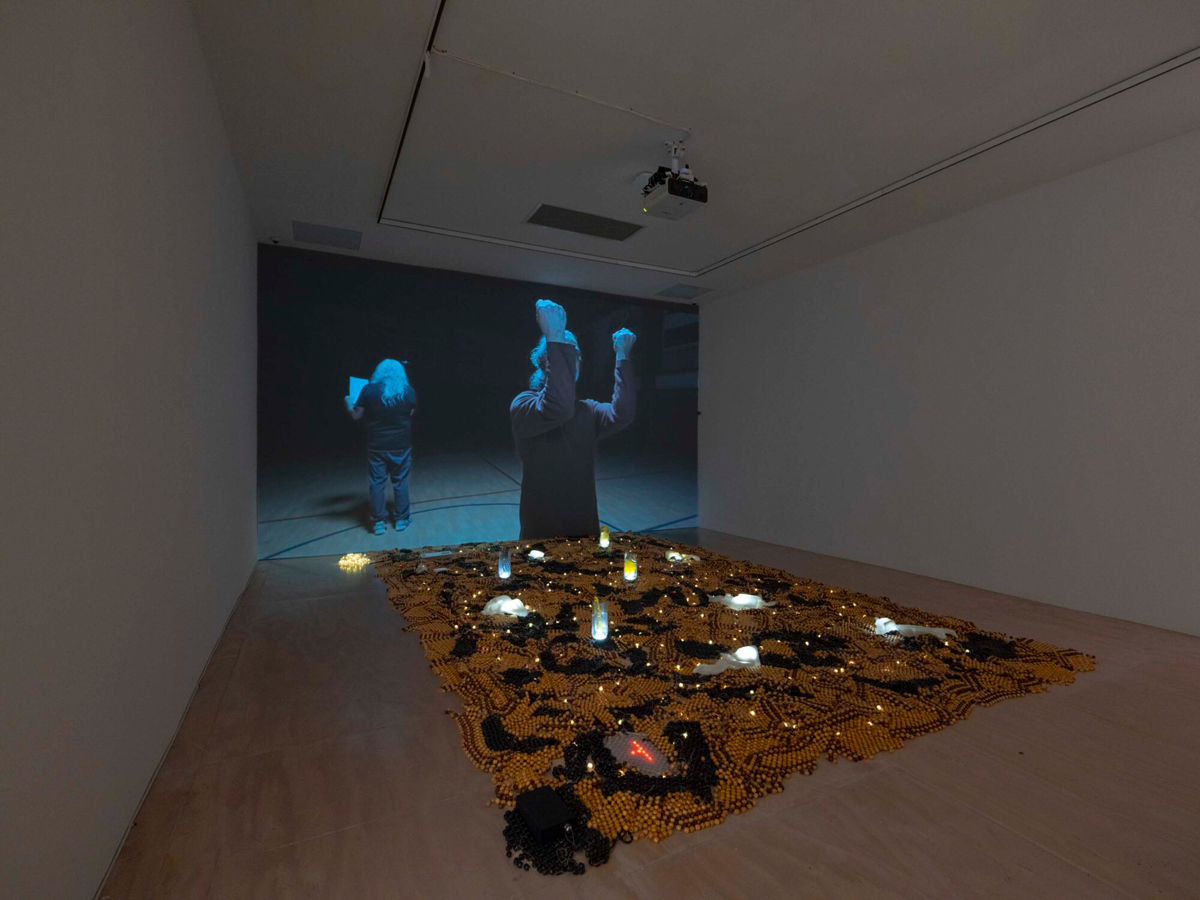
Greater New York, installation view. Courtesy MoMA PS1. Photo: Kris Graves. Pictured: Kenneth Tam, I’M STAYING HOPEFUL AND STRONG (For Bilal and Salah), 2026.
Kenneth Tam’s I’M STAYING HOPEFUL AND STRONG (For Bilal and Salah) (2026) is a moving collaboration with two brothers who were devastated by the collapse of the taxi medallion market, an event that bankrupted immigrant cab drivers, many of whom were South Asian. In a dimly lit room carpeted with a rug composed of wooden-beaded seat covers used by drivers to make their long hours behind the wheel bearable, a projected video shows the brothers moving slowly and meditatively with props (folding chairs, boxes) while they speak both their complaints and their will to rebuild their lives. Tam’s focus on South Asian subjects is particularly gratifying: this edition of Greater New York, like most in the past, almost entirely excludes South Asian artists—only one is represented this year (Vijay Masharani), the same in 2021, none in 2010, though we hit the jackpot with three in 2015—despite taking place in a borough that hosts a huge South Asian diasporic community.
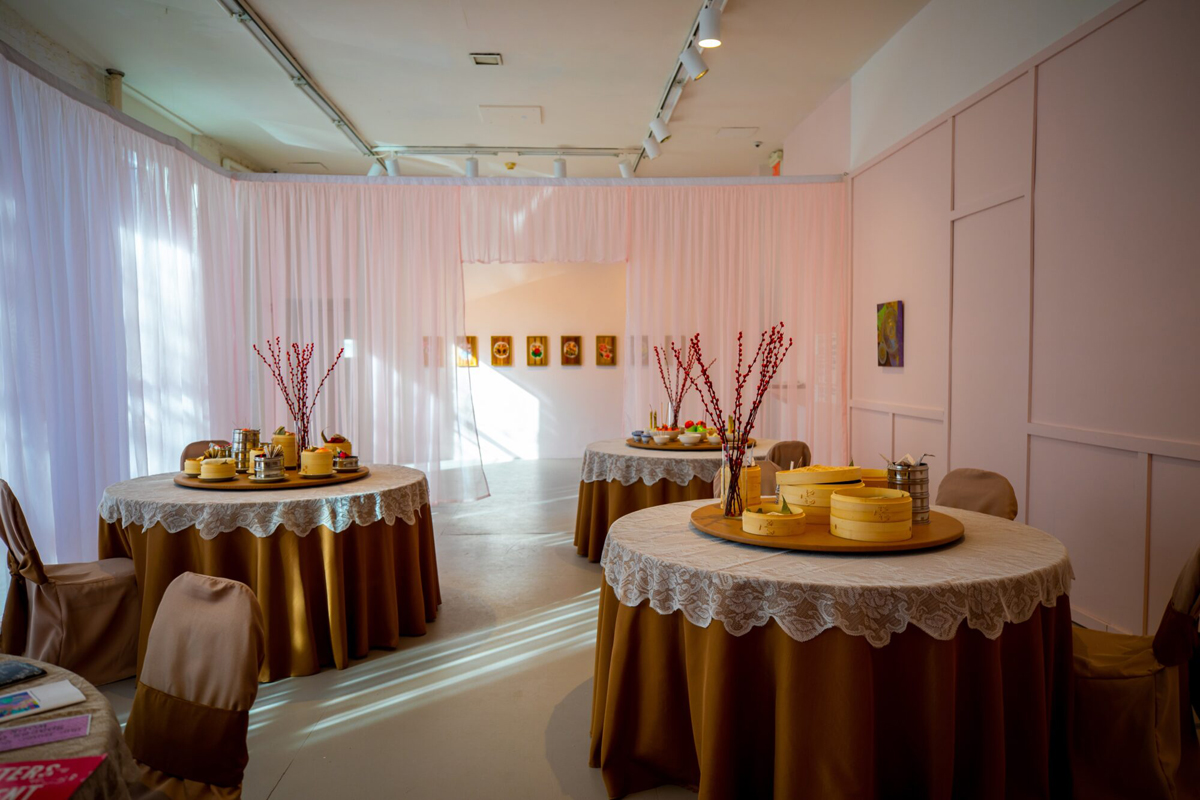
Greater New York, installation view. Courtesy MoMA PS1. Photo: Kris Graves. Pictured: Red Canary Song, Touch the Heart, 2026.
Meanwhile, Red Canary Song, a grassroots collective led by migrant Asian-origin massage- and sex workers, have filled a gallery with objects made by its members, including a series of four Dim Sum Constellations (2026), banquet tables transformed into altars to those of their number who have died in instances of racialized sexual violence, as well as celebrations of the acts of care they are undertaking to keep each other safe. Plastic foodstuffs, incense, and candles occupy one table; pudding-like fake breasts, dollar-bill-stuffed G-strings, condoms, and bottles of Tiger Balm sit in metal and bamboo steamer baskets on another; excerpts from a mapping project initiated by body workers and origami cranes on a third; and books related to the migration histories and political organizing among sex workers on a fourth. This is art as a form of mutual aid, made by and for the people whose concerns it addresses. It is galvanizing.
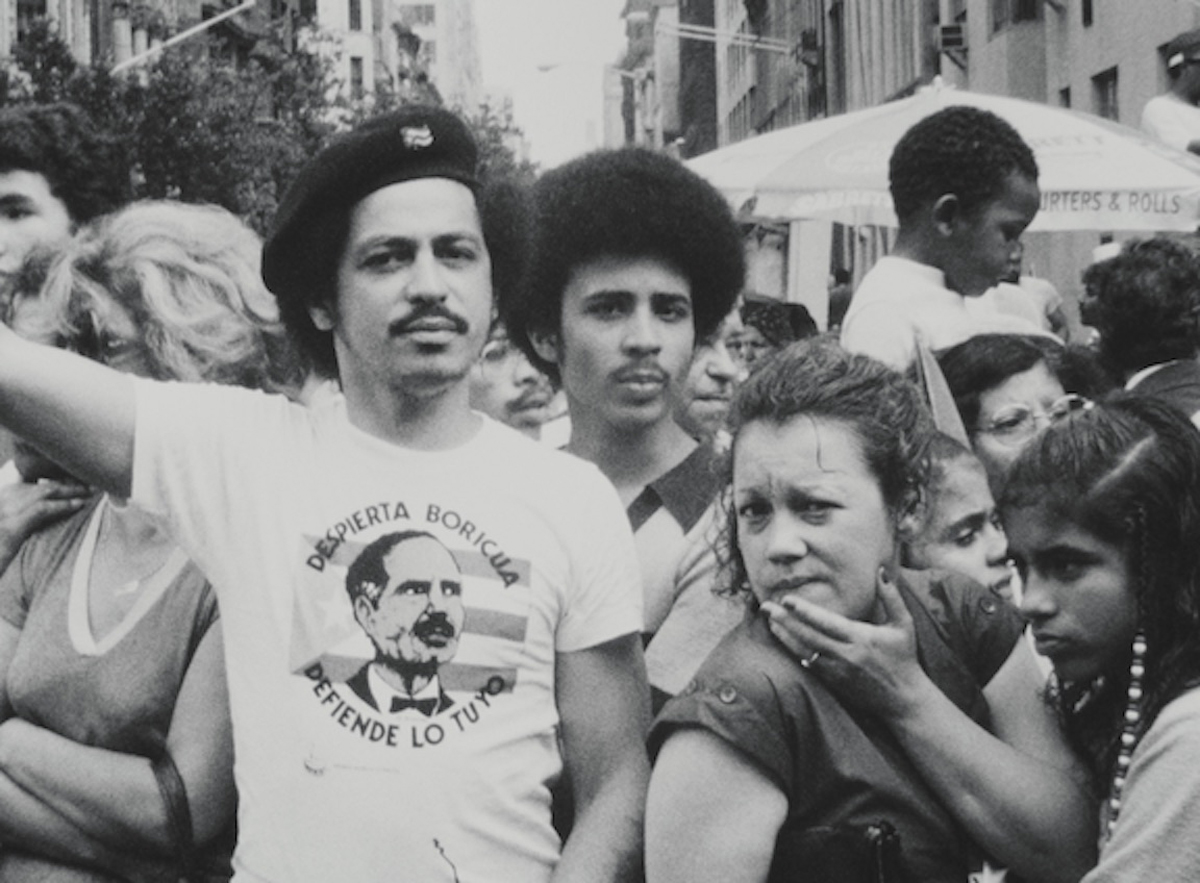
Kameron Neal, Down the Barrel (of a Lens), 2023 (still). Two-channel video installation, 25 minutes 25 seconds. Courtesy the artist.
Surveillance is one of the themes that shows up repeatedly, whether it’s Win McCarthy’s half-dome security mirrors (the kind in subway stations), now mounted on tripods, like the setup for a high-fashion photo shoot (Philosophy of Mind, 2026), or Rachel Handlin’s pictures of Paris as seen through the side mirrors of motor scooters, an instance of the city itself reversing the street photographer’s gaze. But it is Kameron Neal’s Down the Barrel (of a Lens), a two-channel video installation from 2023, that mesmerized me. When he was a public artist in residence at the New York City Department of Records and Information Services, Neal combed through NYPD surveillance footage from 1960 to 1980, taken by police officers armed with cameras, assembling it into twenty-five-minute films projected on opposite walls of the gallery. One shows the surveilled (Vietnam War protesters, striking workers, Black Panthers and Young Lords at demonstrations around the city) clocking that they’re being looked at. The other exposes those doing the watching—or, at least, lays bare their point of view, whether it’s establishing shots of street signs to indicate where the filming is taking place, or even, at times, shots of other police officers as they go about their business. The viewer, placed in the middle of the room, is simultaneously watcher and watched. The effect is at once ominous and lyrical; the archive here is mined for both its information and its strange beauty.
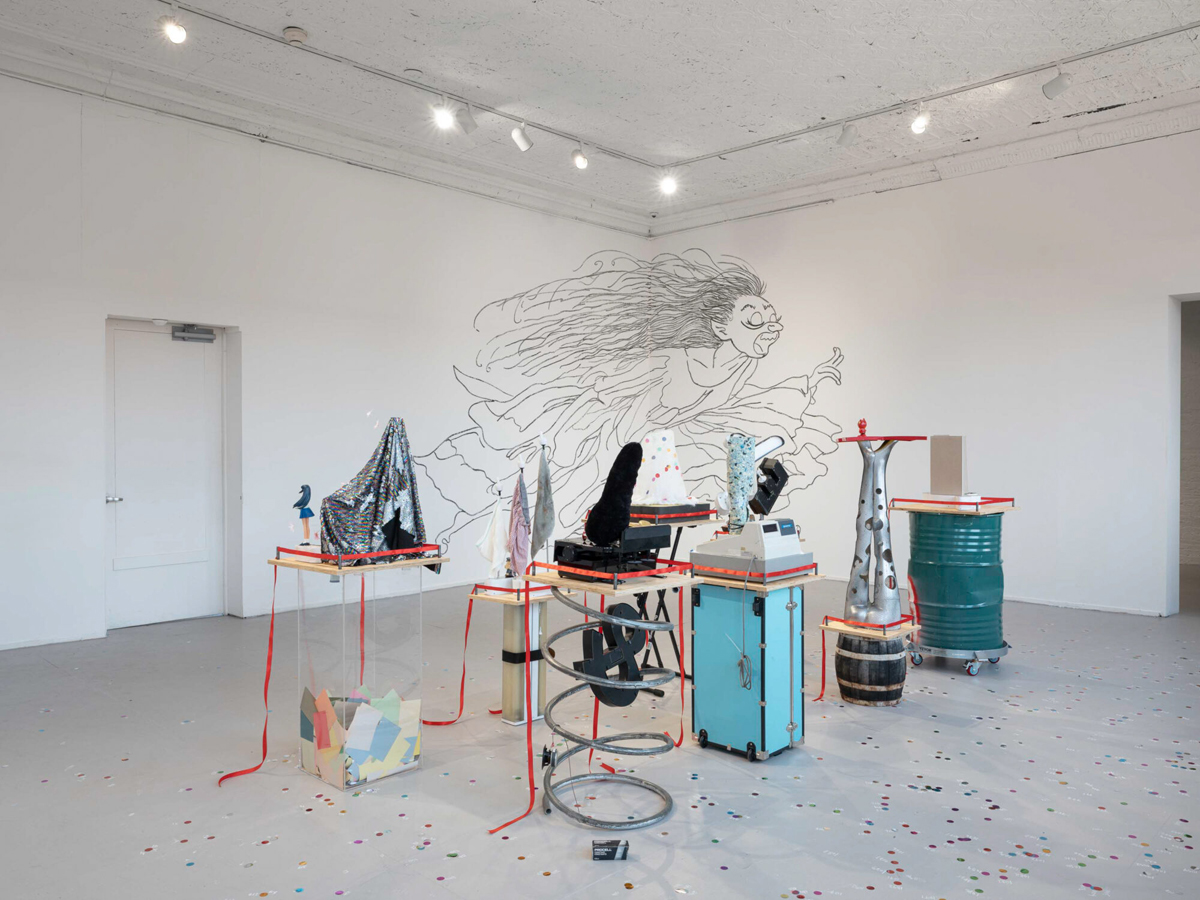
Greater New York, installation view. Courtesy MoMA PS1. Photo: Kris Graves. Pictured: Louis Osmosis, Variations on Public Affairs & Their Subsequent Invigilators, 2025–26.
There is a mood of apocalyptic whimsy emerging among young artists—not gallows humor, but a kind of playfulness that both grapples with and counteracts the dark realities of contemporary life. I’m thinking of works like Marc Kokopeli’s Problem_01, _02, and _03 (2026), which resemble TV consoles, their insides filled with South Park–coded beings dressed as a seventeenth-century Dutch merchant, midtown accountants, a makeshift robot whose costume is constructed out of cardboard. Their eyes, mouths, and eyebrows appear on the liquid-crystal display that fronts each diorama, lending them their delightfully animated expressions as they talk through cycles of economic booms and busts past, present, and future. Or Louis Osmosis’s maquettes for public monuments (Variations on Public Affairs & Their Subsequent Invigilators, 2025–26), each so niche as to address only a handful of people, a salty solution to how fragmented the public has become thanks to our ability to personalize and optimize everything around us to our exact specification.
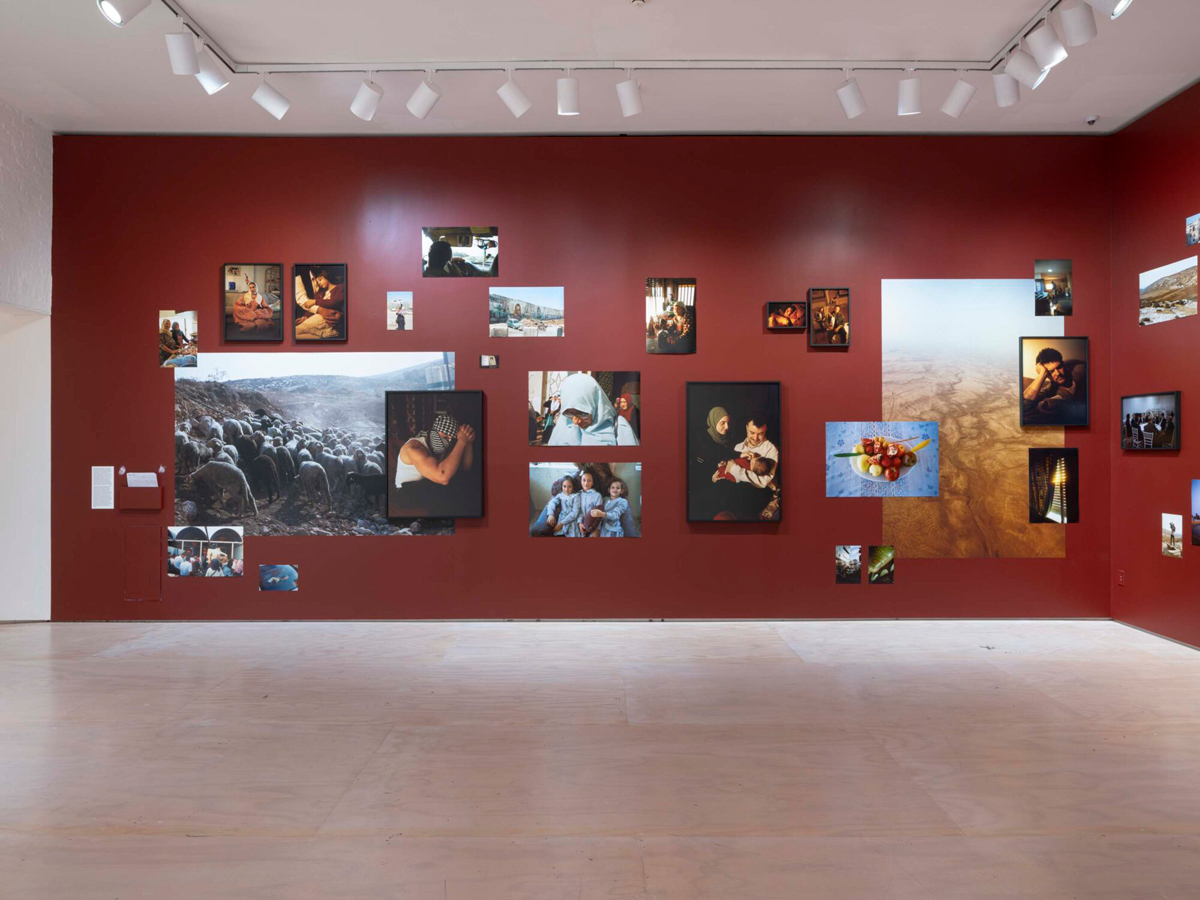
Greater New York, installation view. Courtesy MoMA PS1. Photo: Kris Graves. Pictured: Dean Majd, Photographs from the Birthmark and Separation series, 2018–26.
André Magaña’s 5 OH55FODMBs - A Typical Amount Used for One QSR (2026) is an eerily compelling demonstration of how our technology—in this case, digital advertising displays—is increasingly unsuited to the effects of climate change: five of these damaged panels veer between industrial waste and abstract painting. But if Magaña offers up the beauty hiding in decay, other artists picture resilience, as in the photographic series by Dean Majd of Palestinians in the West Bank and abroad who are surviving genocide; by Farah Al Qasimi of Arab Americans, a community facing unprecedented levels of Islamophobia; and by Cinthya Santos-Briones of the journeys of undocumented immigrants in the age of ICE. And then there are the works of the Cevallos Brothers, Ecuadorian immigrants who for more than fifty years have created hand-painted signage for businesses along Queens’ Roosevelt Avenue. In a city that is changing under the pressure of real-estate speculation and private equity, that is becoming more and more homogeneous despite its diversity along infinite axes, that has become unbearably inhospitable to artists, the Cevallos Brothers are proof that art—glorious art—endures, as long as we’re willing to look for it.
Aruna D’Souza is a writer and critic based in New York. She contributes to the New York Times, 4Columns, and Hyperallergic. Her new book, Imperfect Solidarities, was published by Floating Opera Press in 2024.