


 Brian Dillon
Hélène Cixous weaves intersecting timescales to relay a multigenerational story of flight and fire.
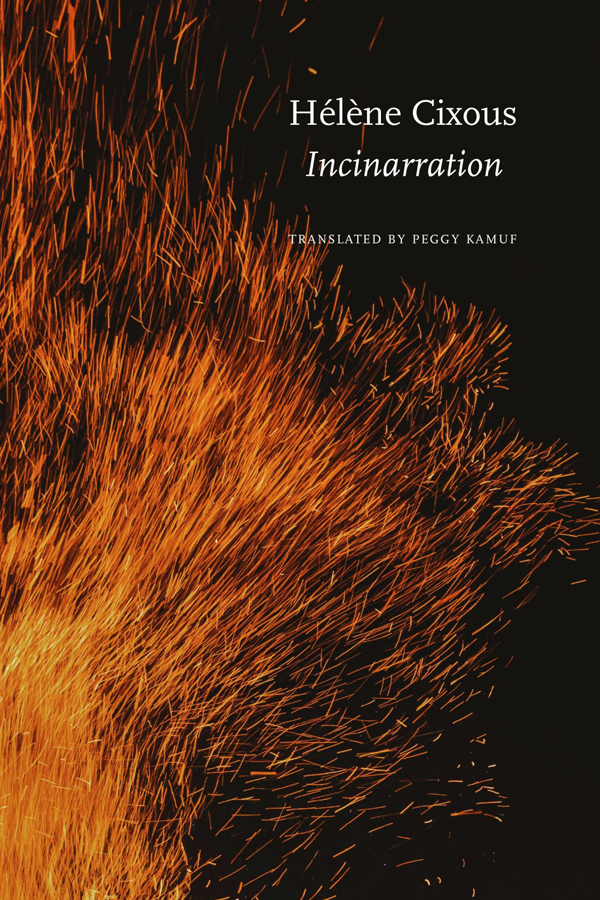
Incinarration: What Do We Carry?, by Hélène Cixous, translated by Peggy Kamuf, Seagull Books, 129 pages, $25
• • •
In the summer of 2022, Europe burned. Calculations vary, but from June to September, successive heat waves may well have caused over sixty thousand “excess deaths.” Even in leafy gray London—where, so damp YouTubers and glowing TikTokers will tell you, the heat hits different and wears you out—temperatures exceeded 40 °C or 104 °F, and a wildfire struck houses in the East End. (I chose this sticky moment to come down with Covid—talk about your dog days.) Across the continent, larger fires raged; in the South and Southwest of France, tens of thousands of people were evacuated from their paths. Among the escapees (with her beloved cats) was the writer Hélène Cixous, who, in her newly translated essay-memoir-fiction-of-sorts, reflects on catastrophe and freedom, hope and denial, a family’s stories about who survived the disaster and who did not. In her late eighties, with over seventy books behind her, Cixous now offers a fractured kind of narrative thinking about states of emergency past and present.
Incinarration was first published, in French, in 2023. (Peggy Kamuf, eminent scholar of French theory and literature, has translated several works by Cixous, and renders without undue intrusion the customary puns and self-awareness of the original.) Here Cixous pursues a subject broached in her book Osnabrück (1999) and addressed again in Well-Kept Ruins (2020): the escape, before the Nazis took power, of her mother, Ève Klein, from Germany to Algeria, and the fate of those Jews in the Lower Saxony town of Osnabrück who did not flee in time. (Another exile began in 1971, when Ève, a midwife, was expelled from independent Algeria.) As in the earlier books, timescales swerve and weave and intersect, so that the moment of her mother’s flight brushes up against wartime in Germany and Algeria, which in turn folds into post-pandemic anxiety and contemporary ecological disaster. In Well-Kept Ruins, Cixous wrote: “I like being in 1648 in October 2019.” Along with flight and fire and the very idea of the book as such, this temporal confusion is a central motif and method in Incinarration. At times the voices also slide across one another, and it may be hard to tell if the speaker is Cixous, her mother, her grandmother, or one of several other relatives.
The family’s story is also that of millions of others, among them refugees who “think only of America, one word haunts their minds driven by hope: Visa! Visa!” As readers of Cixous’s critical and literary works—from her early monograph on James Joyce, through the writings on écriture féminine, to her recently translated novel Angst—might expect, this is a book as much about language as it is about confirmable facts in the history of the writer’s forebears. The words in which antisemitisms of the twentieth century were cast are recalled and studied: “In Algeria when it was France we said Jew in a lowered voice. Jew out loud is an insult. In my memory, Israelite is worse than Jew. It’s Jew with tweezers.” The word “Nazi” is a bitter sound, “sweating, stinking with a non-human acridity, an abscess of language, as for it, it is said, more than once a day, more often than any other word—except mama or papa.” Jewish writers in Germany try to reckon with the violence of language itself. In extremis, during war, words give up, and there is only sound: “the noise takes the form of flying tanks, in a circle, one understands that these armed powers make their way while describing circles, which increases the sensation of terror.” But language is already a weapon of terror, words turned unmeaning and almost physical.
As with previous volumes in Cixous’s autobiographical series, literature is always present in Incinarration. When the flames draw near, she has been reading Daniel Defoe. German Jews, she says, are like “Robinsons . . . who do not want to die before having written their records.” In Defoe’s Journal of the Plague Year—published in 1722, but purporting to detail firsthand a bubonic outbreak in London half a century earlier—she discovers connections with panic in the face of Covid and burning countryside, but also with the anxious Jewish population of Osnabrück in the early 1930s, her grandmother refusing to flee Dresden until Kristallnacht in 1938, and Germans in Dresden as the Allied bombers approached seven years later and set the city ablaze. In all these cases, terror is mixed with disbelief and frail but sometimes stubborn hope. Cixous’s grandmother “wants to make believe that she believes that Hitler is not going to last.” Jewish exiles in Algeria in 1942 “could believe that an existence was granted us, our papers for living on this earth were returned to us, but no not yet.” Eventually, Cixous writes, “Evil makes one believe in evil as in God. You feel targeted.”
The world is on fire, we like to say now, and sometimes we mean precisely climatic disasters of the sort that ignited Europe in 2022 and will ravage much of the planet in decades to come. Just as likely, we intend the ceaseless murder, from earth or air, of civilian populations, a quarter-century now of the latest iteration of imperial war on the Middle East, direct or proxied. Of course, Incinarration predates the most recent assaults on Gaza, Lebanon, and Iran. If you go looking for comments by Cixous about Gaza, you will find only a press conference in 2025, on the occasion of the Formentor Prize, when she said that, in destroying Gaza, Israel also destroyed itself. Impossible, however, not to consider this book an urgent mediation on current violence, actual and verbal, and on the ways that present atrocities mimic, echo, and rebound (for peoples, families, and individuals) on earlier periods of murder and banishment. Like the other great Franco-Jewish-Algerian thinker of her lifetime, Cixous’s close friend Jacques Derrida, her view of things is doubled by colonialism on top of antisemitism. Incinarration feels horribly apropos in the era of drone-war imperialism, and if the book remains quiet about its newest forms, Cixous cannot help giving us a language in which to couch our horror.
Brian Dillon’s memoir Ambivalence: An Education is published by New York Review Books in September. He is working on Charisma, a novel.