


 Sasha Frere-Jones
Francesc Tosquelles is the hero we need right now.
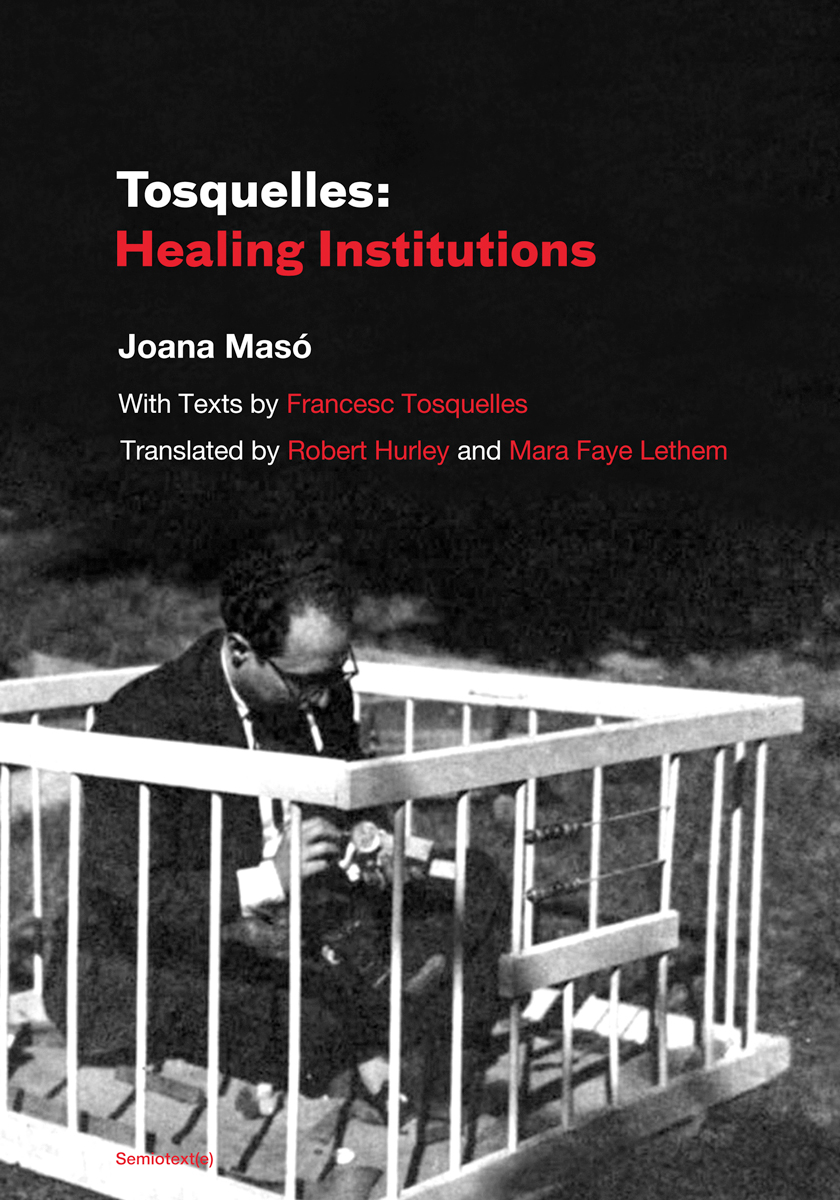
Tosquelles: Healing Institutions, by Joana Masó with texts by Francesc Tosquelles, translated by Robert Hurley and Mara Faye Lethem, Semiotext(e), 397 pages, $24.95
• • •
If I tell you the most important book of the year is by, or at least about, a Catalan psychiatrist who died in 1994, it is both to exploit the demented spritz of promotional language and make clear that Francesc Tosquelles is the hero we need right now. This is not to allege that the anthology Tosquelles: Healing Institutions, edited by Joana Masó and with texts translated by Robert Hurley and Mara Faye Lethem, is a perfect book. But there is no way it could be. Tosquelles was a practitioner, and capturing his liberatory project is not simply a matter of arraying his texts in order. He wrote extensively but worked first and foremost as a clinician, writing conference papers in Catalan, Spanish, and French and publishing in journals. Many of these texts have never been translated into English; his writings are only reaching the world at all because his son, Jacques Tosquellas, began publishing the Archives complètes with Éditions d’une publishing house, run by Sophie Legrain, in 2014.
Peers like Frantz Fanon and Jacques Lacan show up in Healing Institutions, the entire project of resuscitation being as messy and multifarious as a family or a Catalan tertúlia, translated as “debate group,” though there is no exact translation for a word that indicates something more like a standing date with a fixed group of friends (to discuss texts and politics and such).
But none of this is about anything as polite or bounded as “debate.” Tosquelles was in the business of accepting people and reality, insofar as one could, and starting from there. In 1947—as quoted in the only other Anglophone collection of Tosquelles’s writing, 2024’s Psychotherapy and Materialism: Essays by François Tosquelles and Jean Oury, edited Marlon Miguel and Elena Vogman—he posited madness as “a human phenomenon,” which gives the subject “freedom, responsibility, and meaning.” His vision is linked to a historical moment of almost unfathomable change, not unlike our unfathomable moment now. Chaos and effort and failed translations are all central to Tosquelles’s practice, which could be summarized as a radical rewriting of psychiatry that makes care the point of psychiatry rather than some punitive variation of custodial oversight. (One of the custodial practices common when Tosquelles was training in the 1920s was hydrotherapy, including “prolonged baths” of up to twenty-four hours.) In regards to translation, Tosquelles believed that an effective psychiatrist needed to be a foreigner “or pretend to be a foreigner.” Speaking French poorly as a Catalan induced the patient to “take an active position,” suddenly “obliged to translate.”
Looking patients right in the eye is at the core of “institutional psychotherapy,” a term coined in 1952 by psychiatrists Georges Daumézon and Philippe Koechlin, which refers to what Miguel and Vogman describe as “a psychiatric reform and resistance movement.” By bringing the patients directly into the administering and creation of their own care, the “institutional” process was proposed as an antidote to the “establishment.” In an utterly wonderful interview conducted in 1985 by Otium Diagonal, Tosquelles explains the difference between the two: “What psychiatrists did is convert establishments into institutions,” further elaborating that “if you get married and fuck because it’s Friday, that’s not an institution, that’s an établissement.” The institution, in this somewhat counterintuitive formation, is “a permanent state” that goes against the other kind of state, which “is always fascist” and is full of “the people who hinder institutions.” In fact, Tosquelles says, the “function of the state is to impede institutions, even marriage.”
To understand this approach, it helps to remember that in 1931, when the nineteen-year-old Tosquelles had already begun his career as a clinician, the Second Republic was established, as was the independent state of Catalan. The nature of the social unit was being rapidly relitigated and fought (physically) on a weekly basis. World War I had damaged millions of lives and triggered a wave of reforms that can be called, soberly, utopian. In 1935, only four years after the Second Republic was formed, so was Alcoholics Anonymous, the mad healing the mad through talk. And speech was the key. As Tosquelles wrote in 1969, in “What Is To Be Understood by Institutional Psychotherapy?”: “We believe, along with Freud, more radically spelled out by Lacan, that the field of psychotherapy is the field of speech.”
Fleeing Franco by crossing the Pyrenees in early 1939, Tosquelles ended up in the Septfonds refugee camp, where he assembled a psychiatric unit. Psychiatrist Paul Balvet, the director of Saint-Alban-sur-Limagnole, in the département of Lozère in southern France, found Tosquelles through a paper he’d written about “intracranial calcification” (in French, as luck would have it) and had Tosquelles transferred to Saint-Alban. Along with his colleague Lucien Bonnafé, Tosquelles was able to foster a therapeutic approach that was anti-fascist down to its toes. Tristan Tzara spent the summer of 1945 at Saint-Alban, and wrote to Michel Leiris about “a very interesting psychiatrist, a Catalan who would like to restore ‘madness’ to its everyday common meaning—and who arrives at an impressive percentage of cures.”
In 1987, a group of practitioners gathered in Tosquelles’s home in Granges-sur-Lot to discuss “the transformative experiences that had been carried out in French, Italian, and British hospitals.” Of his time at Saint-Alban, and of Bonnafé’s contributions through his fellowship with card-carrying Communists and Surrealists, Tosquelles said,
The surrealists made an experimental movement of madness, something produced by society, showing the deep ties with sex, the drives, the libido. They brought Freudianism to the gates of the city, before it was transformed into a series of gimmicks for selling merchandise. It was the surrealists who experimented with the ways to make someone crazy, long before the illiterate Americans discovered, thanks to the gravity of psychiatry, that the family is fine with driving someone nuts.
It is the blunt manner of Tosquelles, and the sincerity of how he saw the duty of care, that emerges through this quilt of interviews and excerpts and anecdotes and photographs and actual essays. In a health-care structure dominated by distance and deferral, where an Italian American assassin is the truest heir to the works of Saint-Alban, the visions of Tosquelles are only mad to the bureaucrat. One can slip into the sloughs of despond easily, as Zionism dismembers even the idea of care, but Tosquelles would have you form whatever institution you can, using the pressures of the time. As he said at the 1987 gathering, “If it were not, unfortunately, that war produces corpses, you should organize at least one or two wars for every generation; in that situation, one understands things one wouldn’t understand otherwise.” Carrying around Healing Institutions, I feel less scattered and rootless when I open it to read Tosquelles talking about “the source of rhythms” we all carry within us, or the “useless” character of experts. The établissement is not going to go away on its own.
Sasha Frere-Jones is a musician and writer from New York. His memoir, Earlier, was published by Semiotext(e) in 2023. His first book of poems, Pistachios and Frames, will be published by Fonograf Editions in winter 2027.