


 Emily LaBarge
Talking about men, really: the artist’s new works point to corporations, politicians, and their conspiratorial powers.
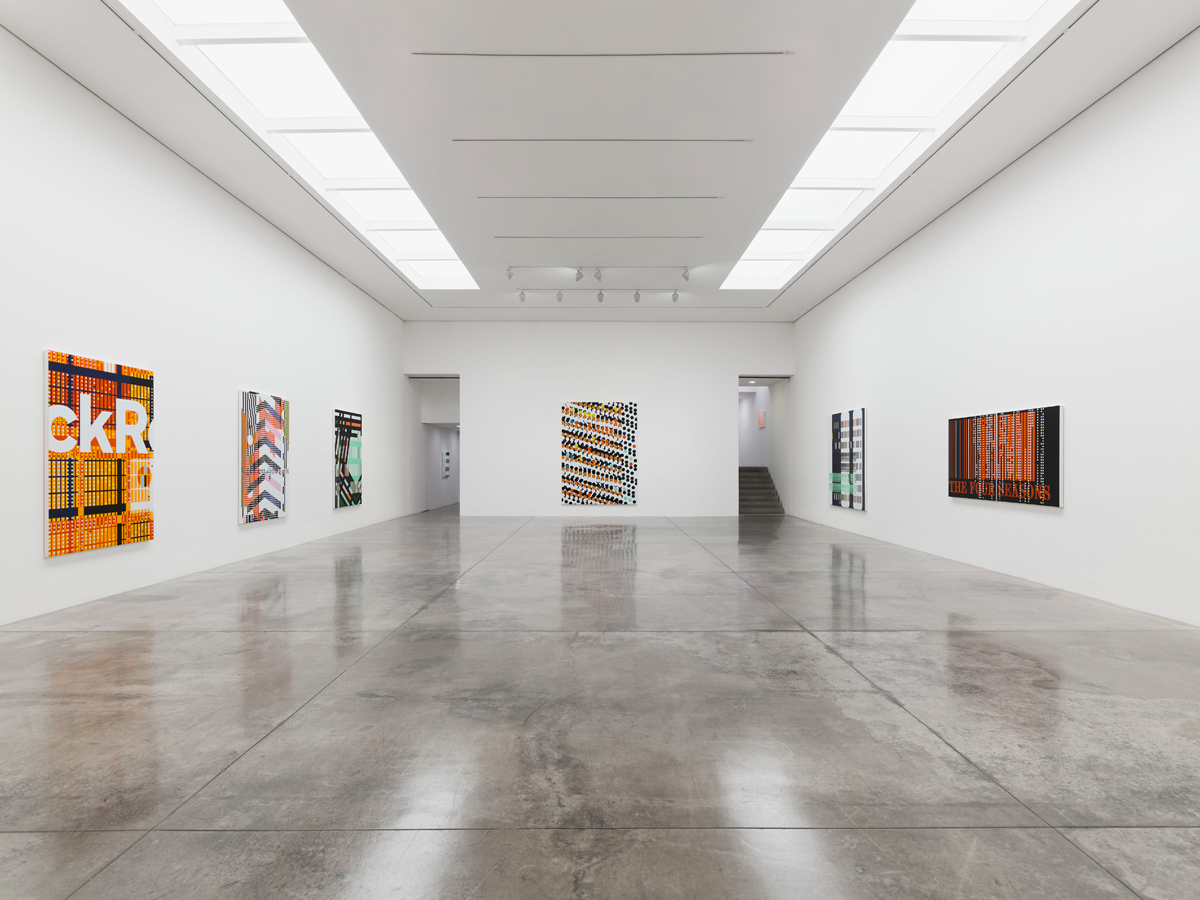
Sarah Morris: Snow Leopards and Skyscrapers, installation view. Courtesy White Cube. Photo: White Cube (Theo Christelis). © Sarah Morris.
Sarah Morris: Snow Leopards and Skyscrapers, White Cube Mason’s Yard, 25-26 Mason’s Yard, London, through May 9, 2026
• • •
To be able to say that one has remained committed, as a lifelong creative endeavor, to gloss is really very chic. Gloss paint that is, but what, truly, is glossier? What is shinier, slicker, more reflective or high-sheen, mirrorlike, able to produce such smooth finish and hard edges, so crisp and precise, so flat—did a machine do it?—so on the surface, so impenetrable?
The medium is the message, in Sarah Morris’s exhibition Snow Leopards and Skyscrapers, but the medium also inverts and subverts, gives the lie of its own associations, which are more than skin-deep. The medium gives a gloss, we might say, as in, “to comment upon, explain, interpret” (transitive verb, ca. 1603), or, earlier, “to make comments or remarks (esp. unfavorable ones) upon a person’s words or actions” (intransitive verb, ca. 1579). A gloss, then, to gloss, though now associated with deliberate deceit or obfuscation, might in fact be an attempt to elucidate what needs further description—to reveal rather than conceal—to attempt to provide a key (as on a map, e.g., dotted line = walking path, or in a Morris painting, e.g., dotted line = unregulated flow of commerce), a glossary of terms to tell you, more precisely, what, in fact, surfaces commonly elude.
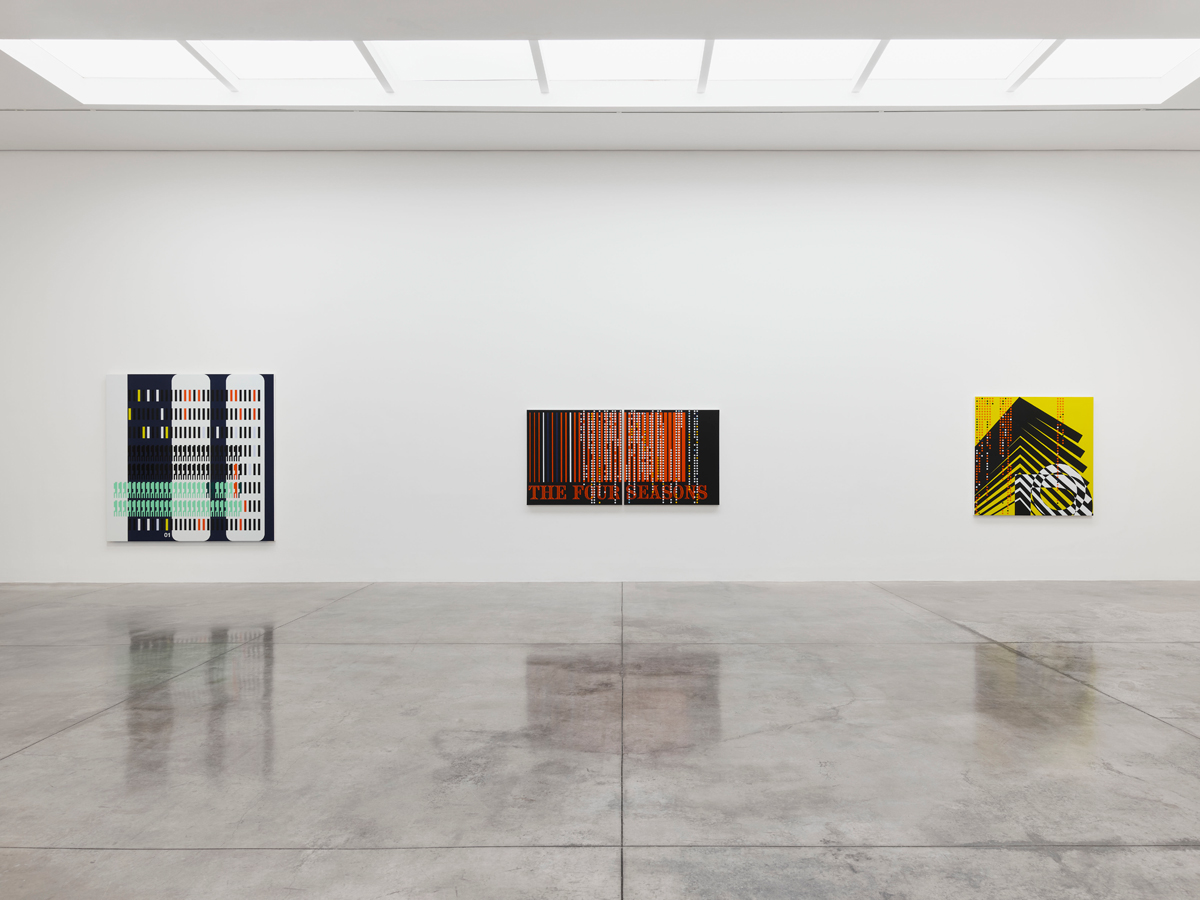
Sarah Morris: Snow Leopards and Skyscrapers, installation view. Courtesy White Cube. Photo: White Cube (Theo Christelis). © Sarah Morris. Pictured, left to right: Cambridge Analytica, 2025; The Four Seasons, 2026; Palantir, 2026.
Can an image—still or moving, painting or film—explain? One would hope not, no matter how didactic our times, nor how many paranoid schematics can be found to link this to that and that to this, a kind of solution for an otherwise overwhelming, and frequently disturbing, world. (I wrote disgusting, first, but the most interesting art, like that of Morris, avoids moralizing.) Can a form be a term, or a term a form? Yes and no. If a word or a phrase is painted, for instance, LIAR, or even a proper name, for instance, Johnson & Johnson or The Four Seasons, it becomes part of, or even forms, an image. And a logo is probably a form and a term all at once. A logo relies on quick apprehension, a monolith as well as a meaning, and this includes its graphic design—a hallmark curlicue script, say, like something reassuring written on pharmacy bottles, or a bold ALL CAPS inline font, like the name of a famous hotel up in neon lights or written across the front of a matchbook.
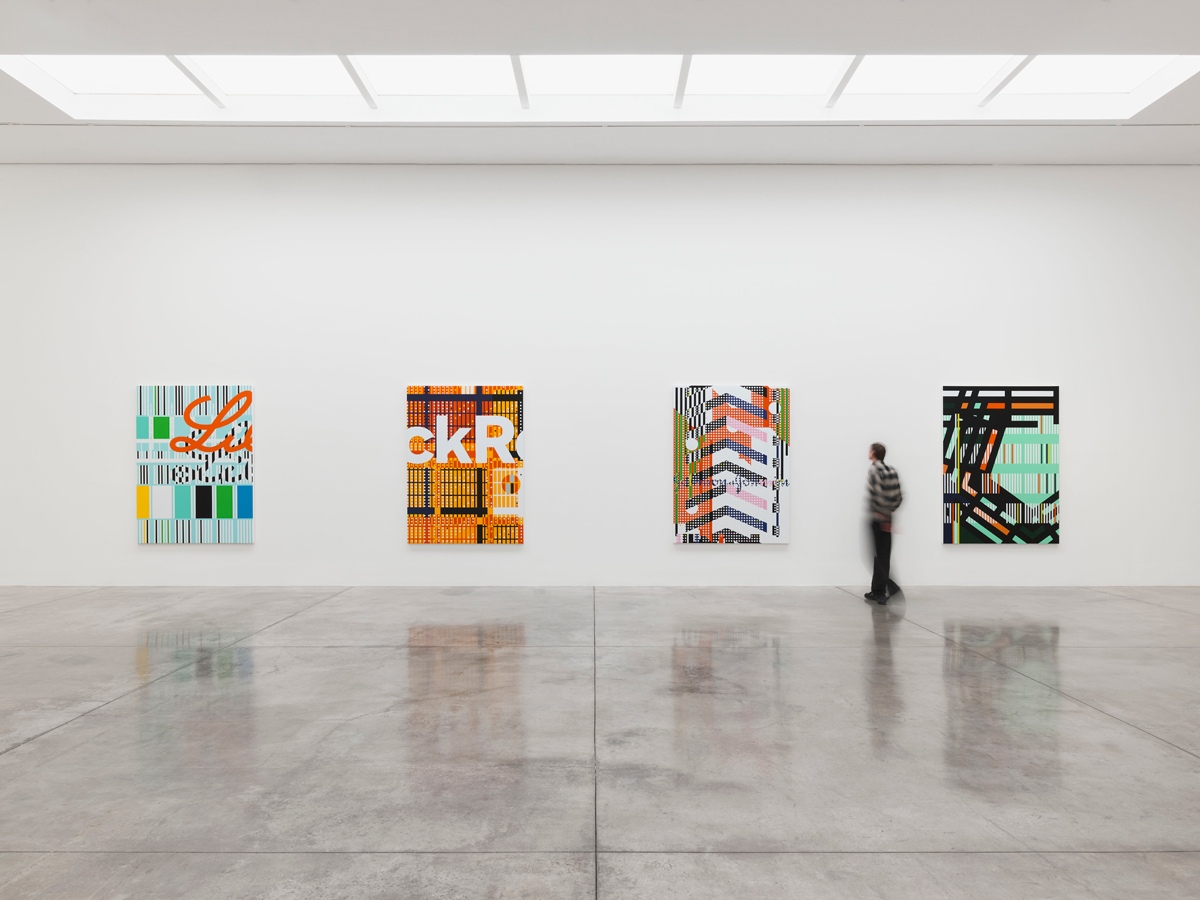
Sarah Morris: Snow Leopards and Skyscrapers, installation view. Courtesy White Cube. Photo: White Cube (Theo Christelis). © Sarah Morris. Pictured, left to right: Lilly, 2025; Blackrock, 2025; Johnson & Johnson, 2025; Department of War, 2025.
A logo does not need words, however, to summon meaning, though we might read it, like a term, as being fathomless, frequently ominous, as most things represented by logos—institutions, corporations, politicians—are. You might easily recognize, for example, a circle with a line at an obtuse angle beneath it, pointing down; or—here’s an easy one—a simple five-sided shape, also known as a pentagon.
The forces behind those establishments, among others, are the subjects of the twelve large (some of them huge) paintings (all 2025) that hang, unbelievably bright, practically raucous and blinking, around the rooms of the two downstairs spaces—one small, one vast—at White Cube’s Mason Yard gallery. Subjects seems the wrong word, but we perhaps lack the correct one for these monsters that occupy the horizon of the twenty-first century, taking up all the air, space, water, energy, light as we sit dazzled and idle. “Let’s call them corporations on some level,” the artist says in a video, of these entities that preoccupy her, make the paintings happen, and also give them their corresponding titles. When Morris says “on some level,” there’s a little flicker of realism in her voice, because we know (though likely not the extent to which, nor how) “corporation” is exceeded by whatever these are, or as she also calls them, “the powers that be, these conspiratorial powers.”
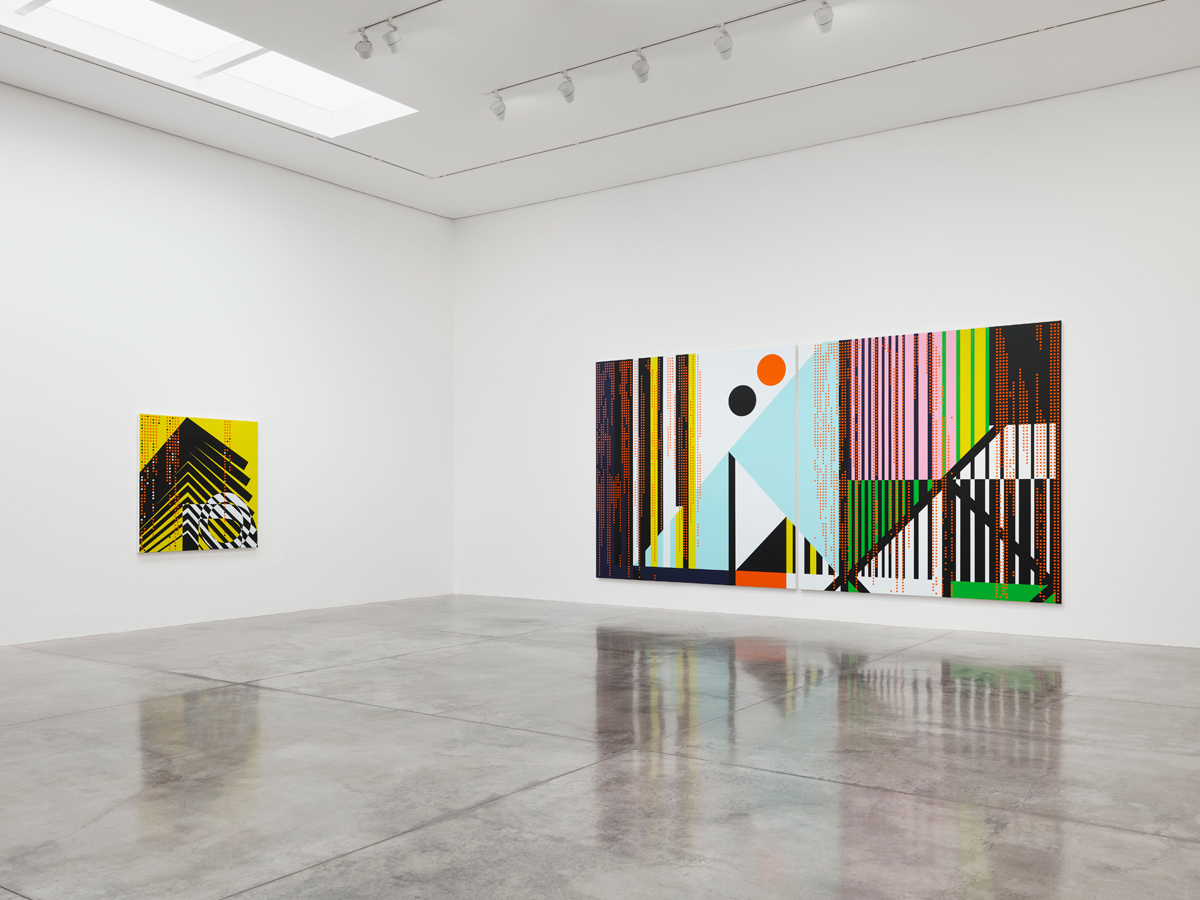
Sarah Morris: Snow Leopards and Skyscrapers, installation view. Courtesy White Cube. Photo: White Cube (Theo Christelis). © Sarah Morris. Pictured, left to right: Palantir, 2026; Bank of China, 2025.
The paintings are executed in the bright, hard-edge, high-contrast style Morris is best known for, and filled with graphic shapes like dots, lines, rectangles, curves, diamonds, triangles, which make repetitive patterns that seem nonetheless disrupted, glitching, dissolving, like a dysfunctional infographic. In Palantir (not a real word, in any case, unless you believe in Middle-earth), the circle and arrow of the company so beloved of the current Trump administration for its ruthless surveillance and data-harvesting appear to have come loose, frozen in a spinning time-lapse and interspersed with Morse code–like strings of dots. In Department of War, slanted grids of black oblongs cut through an aquamarine background—across which stream thin vertical lines in white, orange, red, yellow, blue—so that what ultimately dominates the image is a sort of radiating pentagon, expanding, unstoppable.
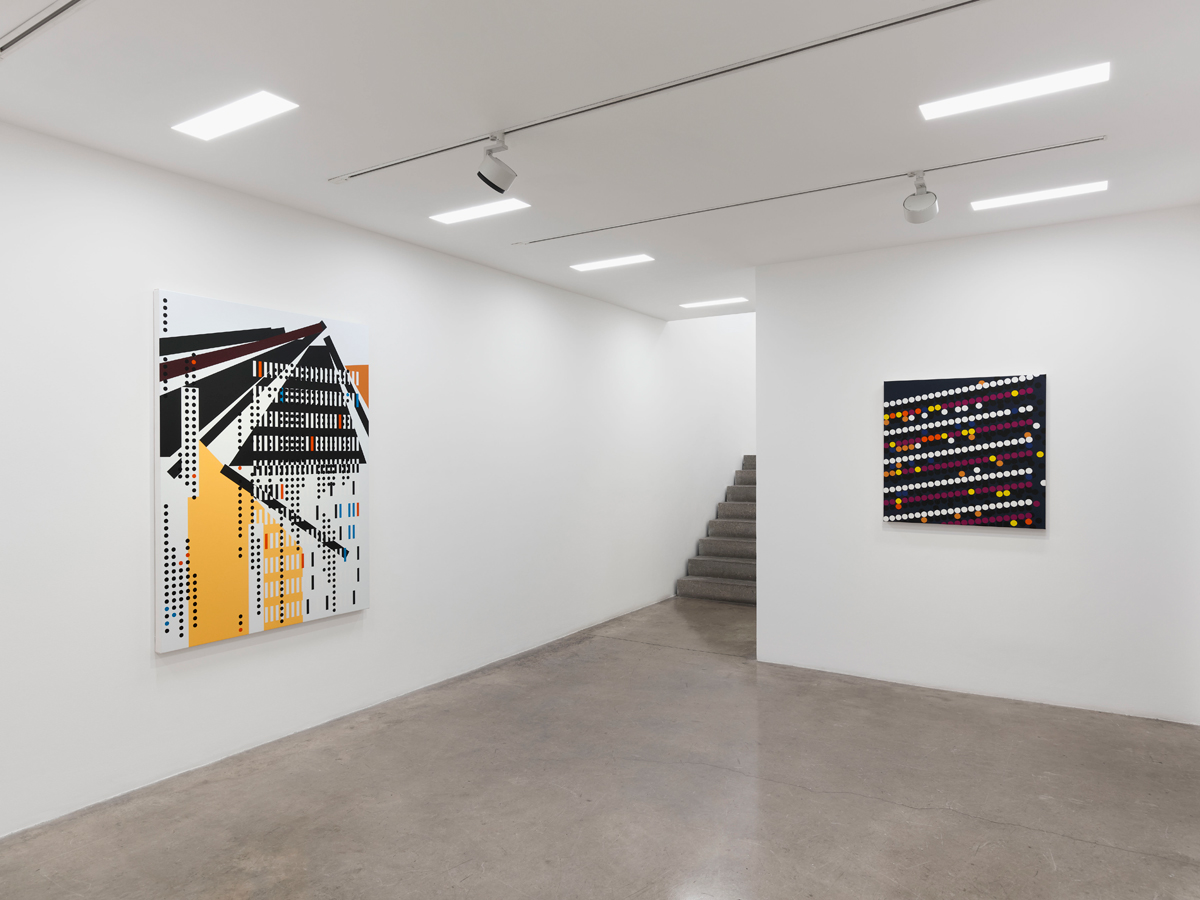
Sarah Morris: Snow Leopards and Skyscrapers, installation view. Courtesy White Cube. Photo: White Cube (Theo Christelis). © Sarah Morris. Pictured, left to right: JP Morgan, 2025; Misregistration #8, 2025.
In these paintings, which ape the abstracted graphics of data and capital flow that so commonly obscure legibility, the painterly technique is precise—raised edges of gloss meeting matte are, up close, exquisite and laborious—but the visual language, orderly at first glance, is like a virus, mutating, unchecked by the four edges of the canvas, spilling off into the void beyond. “We’re talking about men, really,” Morris says of these omnipresent, omnipotent bodies, for lack of a better word. “We’re talking about a group of men, and how they envision society. And I’m not really sure that they view things . . . that there is a social form. . . . What would the social form be right now? . . . How can we make an argument for the idea of a social form that goes beyond these entities and this group of men?”
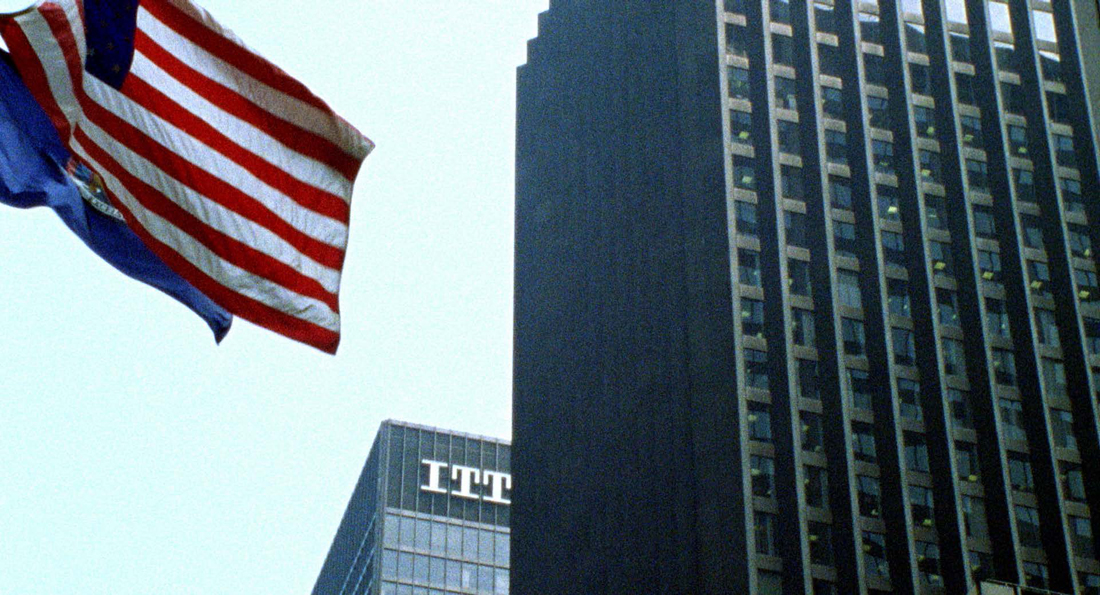
Sarah Morris, Midtown, 1998 (still). © Sarah Morris.
Upstairs, Morris’s most recent film, Chris Rock (2025), alternates with her first, Midtown (1998), in a screening room—forty minutes and then ten minutes. Neither provides a solution to the unanswerable question of this group of men, nor the potential of a new social form as antidote; but each jettisons us into the title of the exhibition in a different way. Snow Leopards and Skyscrapers invokes the writer Peter Matthiessen, whose polymathic activities involved cofounding the Paris Review in part as a cover for his work for the CIA. His 1978 book The Snow Leopard is an account of traveling to the Dolpo region of the Tibetan plateau in the Himalayas on a two-month search for the elusive feline, rarely beheld.
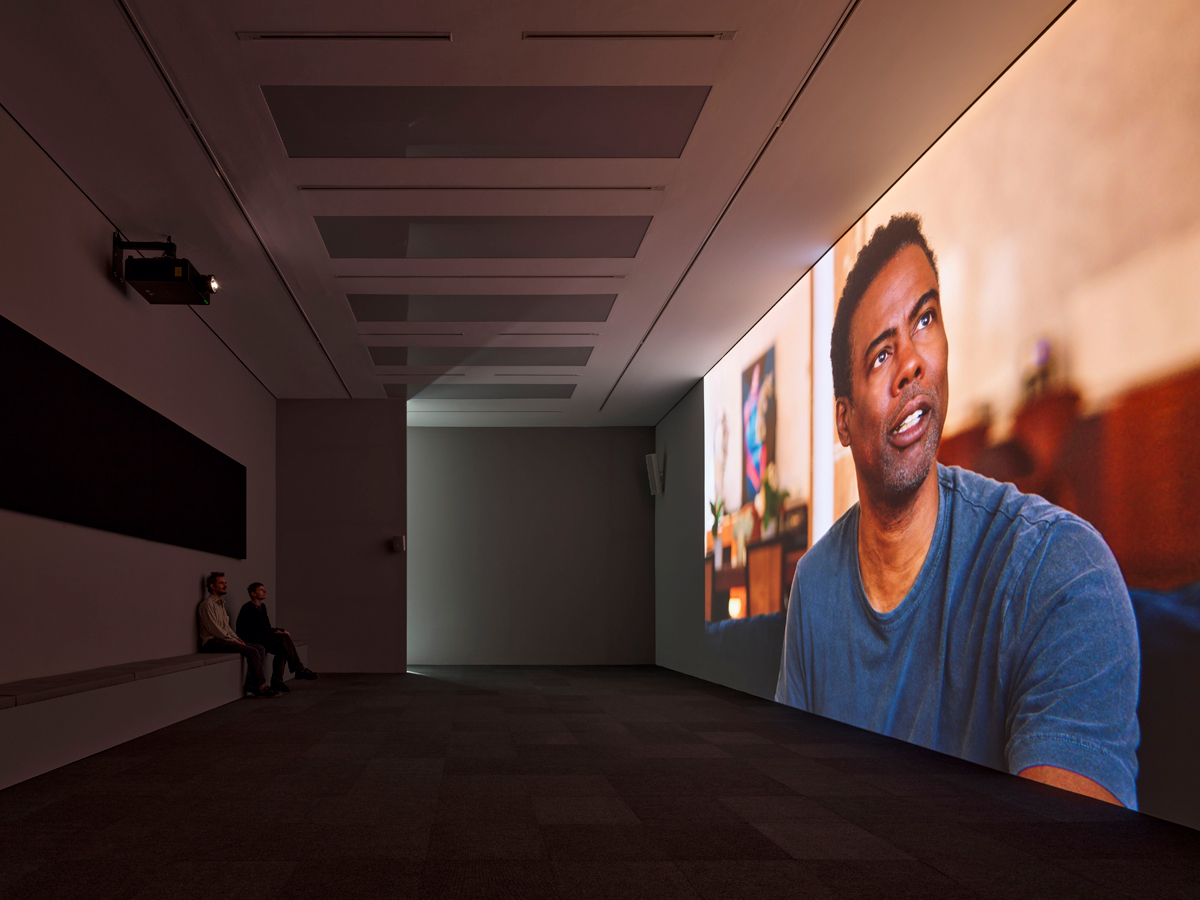
Sarah Morris: Snow Leopards and Skyscrapers, installation view. Courtesy White Cube. Photo: White Cube (Theo Christelis). © Sarah Morris. Pictured: Chris Rock, 2025.
So, what are we looking for here, amid the vertiginous skyscrapers of Midtown, caught in static vignettes between views of the busy streets, people passing, sitting, waiting? Or in the scenes of Rock, who sits and speaks with Morris in a cab on the way to a rehearsal of his upcoming show in Baltimore, or in his apartment in New York? Rock is endlessly watchable as he answers questions about his family, his craft, where the internal voice of the comedian comes from, to whom it is speaking. His grandfather was a preacher who drafted sermons in the cab he drove by day, in which Rock often accompanied him in the front passenger’s seat. “The only protest artists we have right now are comedians,” he says, as they discuss where the inner voice—the impulse to speak—comes from. “Big ego, low self-esteem,” he says, is the way to survive and to make work, only half-joking. We could offer the same about art, of course, of which Morris states, “all great art is a form of trespassing,” comparing it to comedy as fueled by “the desire to talk back.”
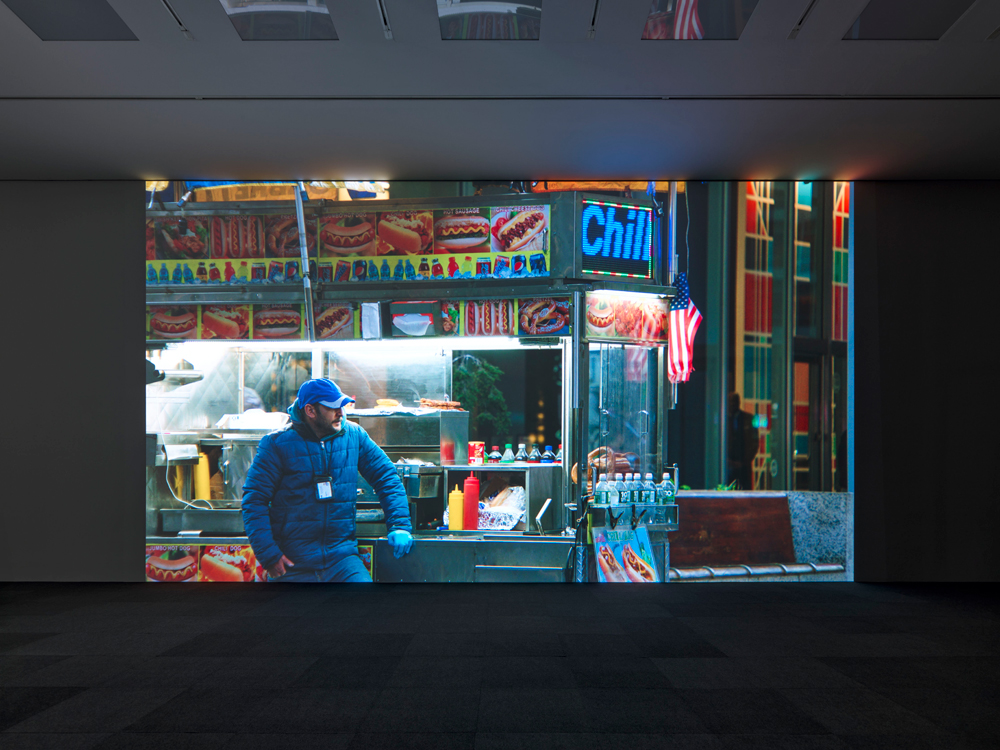
Sarah Morris: Snow Leopards and Skyscrapers, installation view. Courtesy White Cube. Photo: White Cube (Theo Christelis). © Sarah Morris. Pictured: Midtown, 1998.
Matthiessen never did see that snow leopard, but he did make a whole book out of his search, the absence, and everything else it showed to him. That’s life in the big city, the fast lane, whatever you want to call it, and we all have to keep looking.
Emily LaBarge is a Canadian writer based in London. Her work has appeared in Artforum, Bookforum, the London Review of Books, the New York Times, frieze, and the Paris Review, among other publications. Her first book, Dog Days, was published in the UK in 2025 by Peninsula Press, and is forthcoming in the US and Canada, with Transit and Hamish Hamilton, in May 2026.