


 Sasha Frere-Jones
In Ben Lerner’s fourth novel, the dilemma of a broken phone powers a story about consciousness and connection.
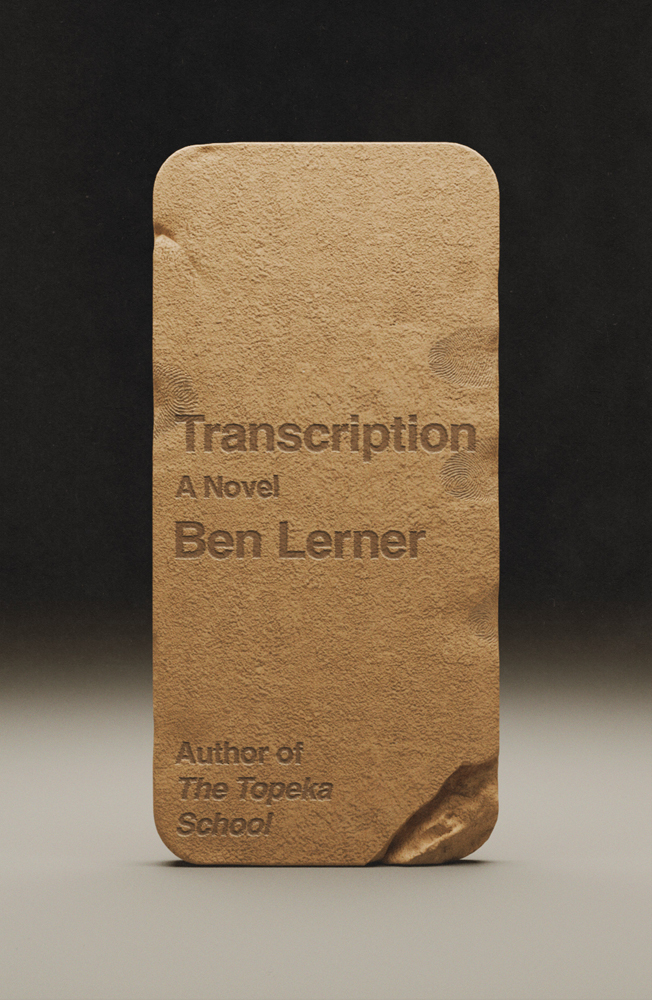
Transcription, by Ben Lerner,
Farrar, Straus and Giroux, 130 pages, $25
• • •
For Ben Lerner, panic obtains. In his first novel, Leaving the Atocha Station (2011), Lerner’s stand-in, Adam Gordon, talks about the “chemical sting” he has known since childhood as the “particular aftertaste of panic.” Walking around Madrid, on a poetry fellowship, the twentysomething Gordon tilts against anxiety with unsupervised blends of “tranqs” and “spliffs” and booze and coffee. In Lerner’s next novel, 10:04 (2014), he voices the slightly older “Ben” narrator and sees anxiety sprout across the social field in response to the Sandy-like storm hitting New York. No longer unique then, his panic is joined by the novelty of astereognosis, an inability “to form a mental image of the overall shape of what I touch.” (There is still walking around and panicking, this time treated with a prescription of “deep, deliberate breaths.”) Adam Gordon returns for The Topeka School (2019), younger than his Atocha version, battling the kaiju of anxiety: migraines, which signify to Gordon as “periodic full-bodied involuntary confessions that he was soft, a poser.” Psychic and physical pain combined—what could be worse?
You’re holding it—the smartphone, an invitation to perform a self-administered assault on the physical (scrolliosis of the thumb) and psychic (Chex Mix of the mind) realms that, like cocaine, is no less addictive for being so clearly an assault. In Transcription, Lerner’s fourth and shortest novel, the phone enters as the agent of panic for the narrator (Lerner’s unnamed avatar), who is trying to interview his aged (ninety) mentor, Thomas, who may be dying (and who may be Alexander Kluge), for a magazine (unnamed), intending to record the talk with his phone.
But before our narrator leaves his hotel in Providence, having achieved nothing more than arriving, he drops his phone into water and then bricks it by restarting it again and again. There is now an immediate problem, of how to record his interview, dwarfed by a larger realization that calls for one of Lerner’s arias of perception, that drone shot rising up to reveal the garden of the brain as a maze. The narrator realizes that he checks his phone “whenever a transition presented itself,” which is a lot in any given day: when leaving one space for another, standing after sitting, walking after not walking, or vice versa.
It gets worse, and without being called a panic, the narrator’s phoneless dissociation becomes another miniature of horror. Wandering around Thomas’s living room (where he sees a stack of Alexander Kluge books, a nice Borgesian detail), he cannot “attend to” the objects he sees. The narrator realizes that “since at least 2008,” the phone has demanded that he swipe and frame and archive and, in return, allowed him to exist Online, as opposed to being in a present that “was too much for me, or too little.” Without a phone, the narrator’s eyes become “saccadic” and his fingers do a “weird Saint Vitus’ dance” at his side. “I wasn’t merely distracted,” Lerner writes, “I was offline, a state of exception.” When the narrator admits that he is “shamefully unresponsive to the old media that surrounded me,” there is the doubled admission that, with a phone, he would have been able to defer the question by taking pictures and deciding later whether or not he had needed to be present. The phone is the experiential grout holding our story together, joining successive thoughts just enough to allay anxiety but then making it such that the experience of the moment never fully coheres, thereby increasing anxiety. Bad medicine.
I love to get into the cushioned golf cart of Lerner’s consciousness and accompany him on one of his careful rides, where he takes care of both of us and sharpens my consciousness. The fact that the only occupation in his books is “walk around and get nervous before giving a big fancy talk” does not bother me, because the grain of his brain stories is so fine and, to this brain, those stories are as universal as any others. In Transcription, the dilemma of the phone—perilous, working or not—powers a story about familial love anchored by Thomas and the narrator’s daughter, Eva, “the two people I loved who didn’t have smartphones, excepting the dead.”
The first and third sections circle Thomas, one narrated by his almost-son, our narrator, the other by his actual son, Max. Thomas is sort of a benevolent academic gargoyle, spinning out bits of thought in a way that would likely charm the listener based on familiarity: “A black box theater. Like the black box of an airplane. That is recovered. Like Schrödinger. The superposition of theaters.” Max is less charmed by his actual father than our narrator, in part because Max’s daughter, Emmie, the West Coast analog to Eva, is struggling to eat. Thomas seems to not understand his granddaughter’s pain, which is par for the course with humans in his orbit. Braced to hear about Kafka and “the history of pre-Christian asceticism” in response to Emmie’s condition, Max snaps at his father in German: “This is not fucking theater, Dad, this isn’t art or literature, Emmie isn’t a character in a fiction, she’s my fucking daughter.” Thomas is not hurt, and this makes it worse somehow.
Do I wish there could be another historical glaze for the American novel other than the Nazi marinade? I sure do. The words Gaza and Palestine appear in this text, so we assume the author has internet access. But Lerner rarely builds a novel from things outside his immediate experience, and this is more than part of the point—describing consciousness is his beat, and his gift. It would be miserly and clumsy to ask Lerner to go for historical sweep or class war. But his narrator could do more inside the act of noticing the privilege of parents stocking their house with candy for the suffering child with her iPad, or the father figure choosing the luxury of his own death. In fact, it is the loving patience with which all these mansplaining blowhards keep trying to reach each other and forgive what sins they can remember, and the care of the parents phoning in from the outside, that makes me want Lerner to breathe deep and talk to me about people who lose everything, who never get to Facetime with a nurse, who never get closure, who never get second and third chances to work it out with someone they’ve had on the scene for an unnaturally long time, who never get to tell us how scared they were, what the panic tasted like.
Sasha Frere-Jones is a musician and writer from New York. His memoir, Earlier, was published by Semiotext(e) in 2023. His first book of poems, Pistachios and Frames, will be published by Fonograf Editions in winter 2027.