


 Melissa Anderson
Steven Soderbergh’s intriguing new drama about the anguish of abandoning one’s art.
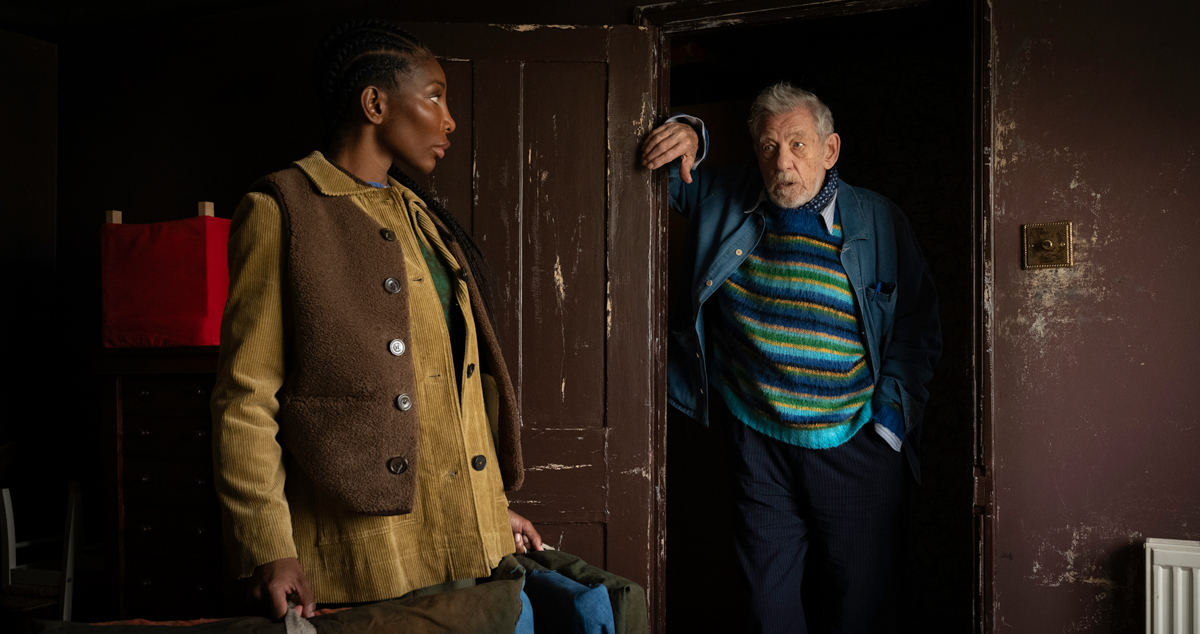
Michaela Coel as Lori Butler and Ian McKellen as Julian Sklar in The Christophers. Courtesy Neon. Photo: Claudette Barius.
The Christophers, directed by Steven Soderbergh, opening in theaters in New York and Los Angeles April 10, 2026 and in
theaters nationwide April 17, 2026
• • •
Wildly prolific, Steven Soderbergh never repeats himself. When working in the same genre, his projects reveal a vast range; the subjects of his biopics, for instance, include personages as diverse as Che Guevara and Liberace. Even the Soderbergh films that might be considered recombinant entities remain wholly distinct, as evident in The Christophers. The third film by the director to be released in fifteen months, it bears elements of its two predecessors, Presence and Black Bag, both of which opened in theaters last year. Like Black Bag, Soderbergh’s latest takes place in London; as with Presence, the most crucial scenes in The Christophers are confined to one large house.
But the new movie (written by Ed Solomon, in his fourth project with Soderbergh) breaks fresh ground, taking off from an intriguing premise: the greedy, talentless adult children of a senescent, once-renowned painter convince an art-school grad and former forger to take a job as their father’s assistant so that she may stealthily “complete” a suite of his notoriously unfinished canvases (which shares the film’s title). The kids are convinced that these works will be discovered after Dad’s imminent death and thus guarantee them untold riches. The Christophers is a small film animated by larger ideas. Several of them (about creation, an artwork’s aura, an artist’s responsibility) are argued over in good faith; a few of them (regarding generation-gap clashes and cancel culture) irk with their hoariness. Yet even the more vexing conversational exchanges still compel, thanks to the taut performances of those engaged in them: Michaela Coel as Lori Butler, the sham adjutant, and Ian McKellen as Julian Sklar, an erstwhile star of British Pop who’s long lost his fizz.
The opening lays out the stark divide between Lori’s aspirations and her reality. First seen on a bench engrossed in sketching a building, she answers a call with the lofty greeting “Butler Art Restoration.” After the brief phone chat concludes, she scurries back a few yards to her much less glamorous gig: dishing out Chinese food from a truck stationed close to the Tower Bridge. A few hours later, she’s in a pub for a sit-down with Julian’s offspring, Barnaby (James Corden) and Sallie (Jessica Gunning), the latter a former classmate of Lori’s and the one who rang her up. At first, Lori balks at the siblings’ ignominious pitch. “His style is unique and quite hard to imitate,” she demurs. Changing tactics, they allude to a past incident (the details of which will be disclosed much later) between Lori and their father: “We know why you hate him. Think of this as a way to get revenge.” She agrees to the scheme.
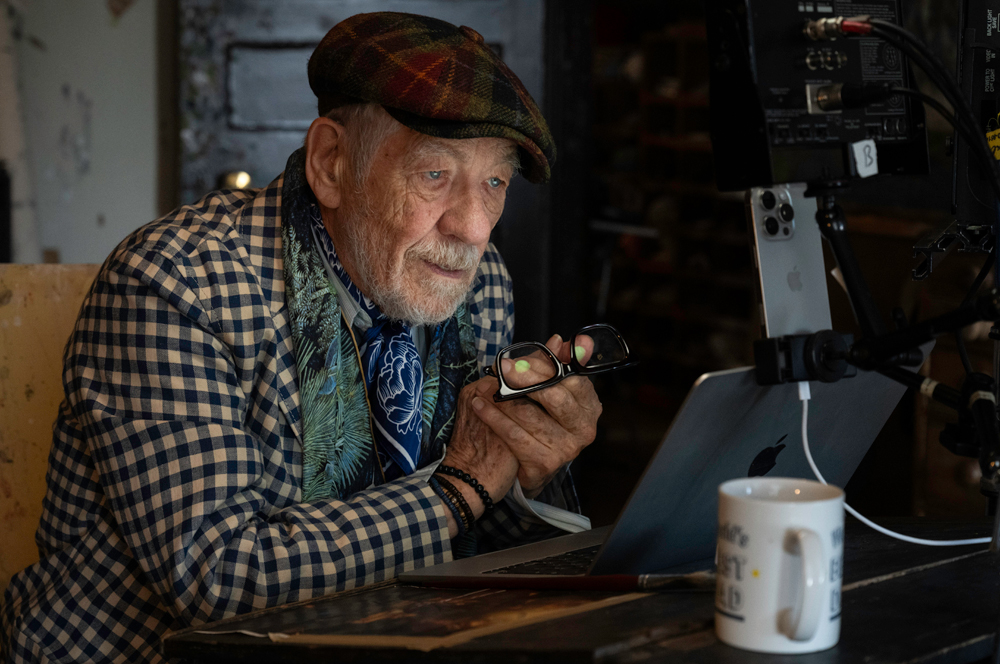
Ian McKellen as Julian Sklar in The Christophers. Courtesy Neon. Photo: Claudette Barius.
Upon arriving at Julian’s chaotic, crammed three-story Georgian town house, Lori sees how far this titan has fallen: he is in the middle of recording a series of Cameo videos, one of his few reliable streams of income. “I’ve done nothing but shit in thirty years, nothing at all in twenty,” he admits as he interviews Lori before officially hiring her, though their ostensible Q and A quickly becomes a logorrheic monologue by the wizened painter. The initial encounter between Julian and Lori establishes the rhythm and pacing of most of their interactions: his torrent of plummily enunciated, quasi-Wildean pique, self-deprecation, self-aggrandizement, and non sequiturs met by her unyielding poise and (usual) taciturnity.
McKellen and Coel are terrific scene partners. As generational paradigms—he an ambassador of the legendary cohort of Shakespearean-trained actors born before WWII, she a millennial avatar famous for creating and starring in the TV shows Chewing Gum and I May Destroy You—they are perfectly matched and balanced. With his Lear-like dudgeon, McKellen clearly relishes the outrageous lines written for him. Coel, a model of Gen Y impatience with geezer entitlement, nicely demonstrates the fortitude required to repel such gale-force verbiage.
Occasionally, the film’s emphasis on the conflicting mores of characters born several decades apart comes across as facile sociology. Harvey Weinstein is invariably mentioned; Julian is aghast at Lori’s insistence that he, as her employer, can never ask about her personal life. But what binds these two contrasting figures—their belief in art’s power, whether they use this word or not—ultimately eclipses what divides them. Even when Julian learns of Lori’s plot—he becomes suspicious when, googling her shortly after their first meeting, he discovers a blistering essay she’d written about him—he can’t quite let her go. And she, despite her scorn for his squandered talent and buffoonish antics, is unable to forget the fact that he was once her lodestar.
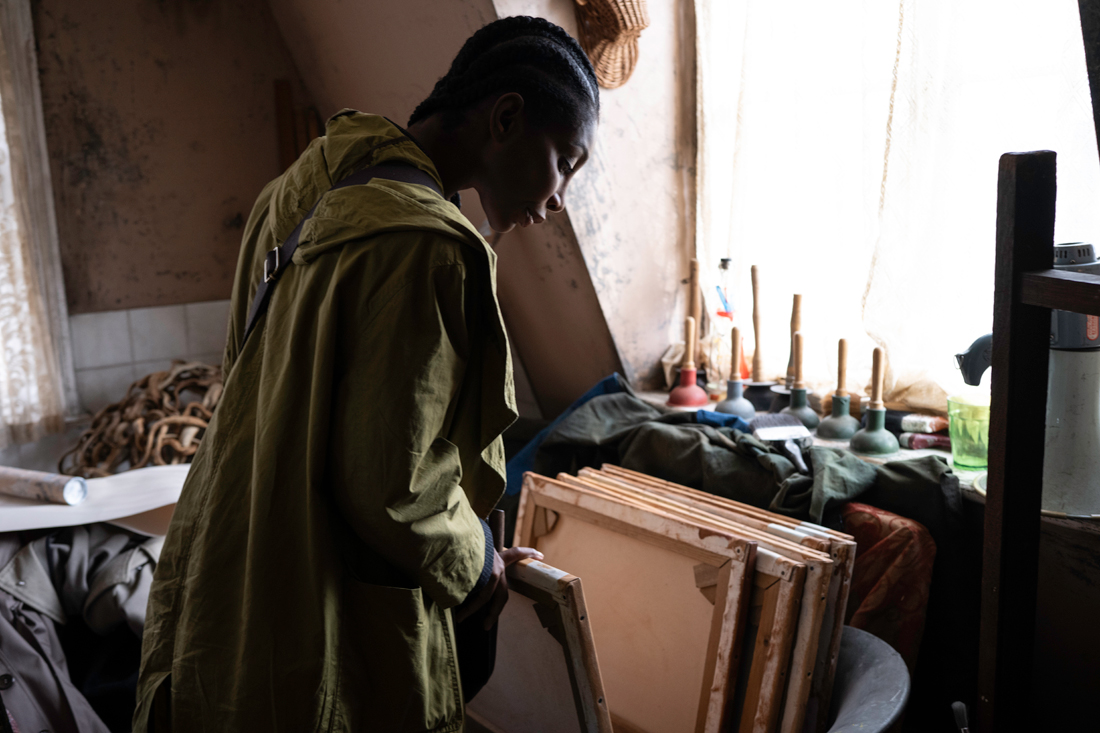
Michaela Coel as Lori Butler in The Christophers. Courtesy Neon. Photo: Claudette Barius.
Which brings us to the canvases that drive the plot. They are partially completed portraits named after one of Julian’s lovers (“I was bisexual, Lori, when it actually cost something to say so,” the old man sniffs). The paintings are an index of the agonizing dissolution of the artist’s relationship with his muse. Julian’s anguish over these incomplete Christophers brought to mind Jack Hazan’s A Bigger Splash, a sublime docufiction from 1974 about David Hockney (born two years before McKellen) in the period immediately following his breakup with boyfriend Peter Schlesinger, the subject of some of artist’s best-known works. To soothe his heartache, Hockney spent long hours in the studio; Hazan’s movie chronicles the creation, destruction, and re-creation of Portrait of an Artist (Pool with Two Figures), the painter’s 1972 homage to the man, then struggling to be recognized for his own talents, who had left him.
The central drama in Hazan’s film concerns the painstaking process of making art. In Soderbergh’s, it revolves around the despair of having abandoned one’s gifts. As Lori and Julian behold the Christophers together, their antagonisms soften, morphing into something like common cause. Without admitting it, he is impressed by her analysis of why he couldn’t finish the canvases, her explication the product of a deep love and knowledge of his oeuvre—and of his sensibility, which not even the most meticulous copier can ever truly capture. In a roundabout way, they will join forces to end Julian’s long dormancy. For her part in this collaboration, Lori commits to resuscitating—an act never to be confused with replicating.
Melissa Anderson is the film editor of 4Columns and the author of a monograph on David Lynch’s Inland Empire from Fireflies Press. A collection of her film criticism, The Hunger, is now available from Film Desk Books.