


 Emily LaBarge
The V&A shines a spotlight on the Italian designer’s wild creations and collaborations with stars, celebrities, and Surrealist artists.
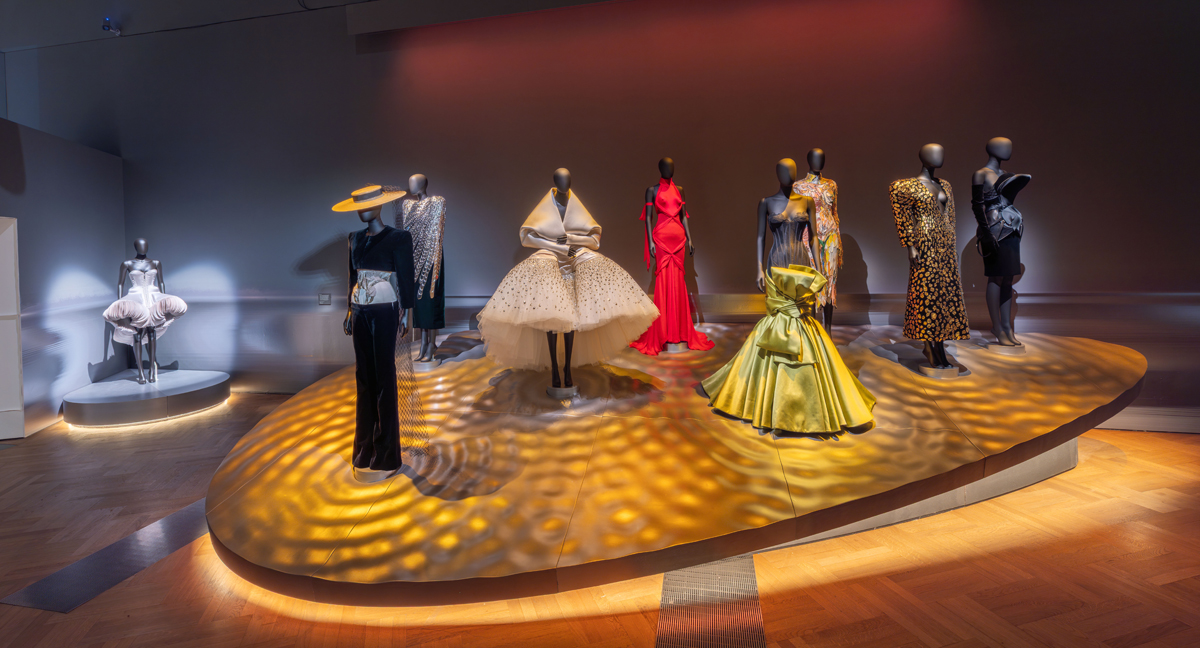
Schiaparelli: Fashion Becomes Art, installation view. Courtesy V&A South Kensington. © Victoria and Albert Museum.
Schiaparelli: Fashion Becomes Art, curated by Sonnet Stanfill, Lydia Caston, and Rosalind McKever, Victoria & Albert Museum, Cromwell Road, London, through November 8, 2026
• • •
A dress that turns the body inside out, skeleton on the exterior—raised and sinuous—instead of hidden deep within. Sweaters with jolly knitted trompe l’oeil bows. Fabric printed with newspaper clippings blaring: “NOUVELLES DE LA MODE,” “OF ALL THINGS,” “Wir lieben schwarz noch immer” (“we still love black”—perennially true). Textiles that appear torn (chiffon déchiré), or like tree bark, or crepe paper, or pleated and crumpled tissue. Capes and dresses, shirts and trousers made of acrylic, cellophane, metal-threaded rayon (“Fildifer”), woven glass-like plastic (“Rhodophane”). A shoe for a hat. Another cap, wide-brimmed and woven, crawling with jeweled insects. A translucent veil embroidered with dark Medusa locks. A choker festooned with large golden pine cones. A pressed powder compact that looks like a rotary phone dial. A perfume bottle that looks like a lit candle in a chamberstick. Things that shimmer, glitter, shine; drape, cascade, flow; cinch, swell, swag, surprise.
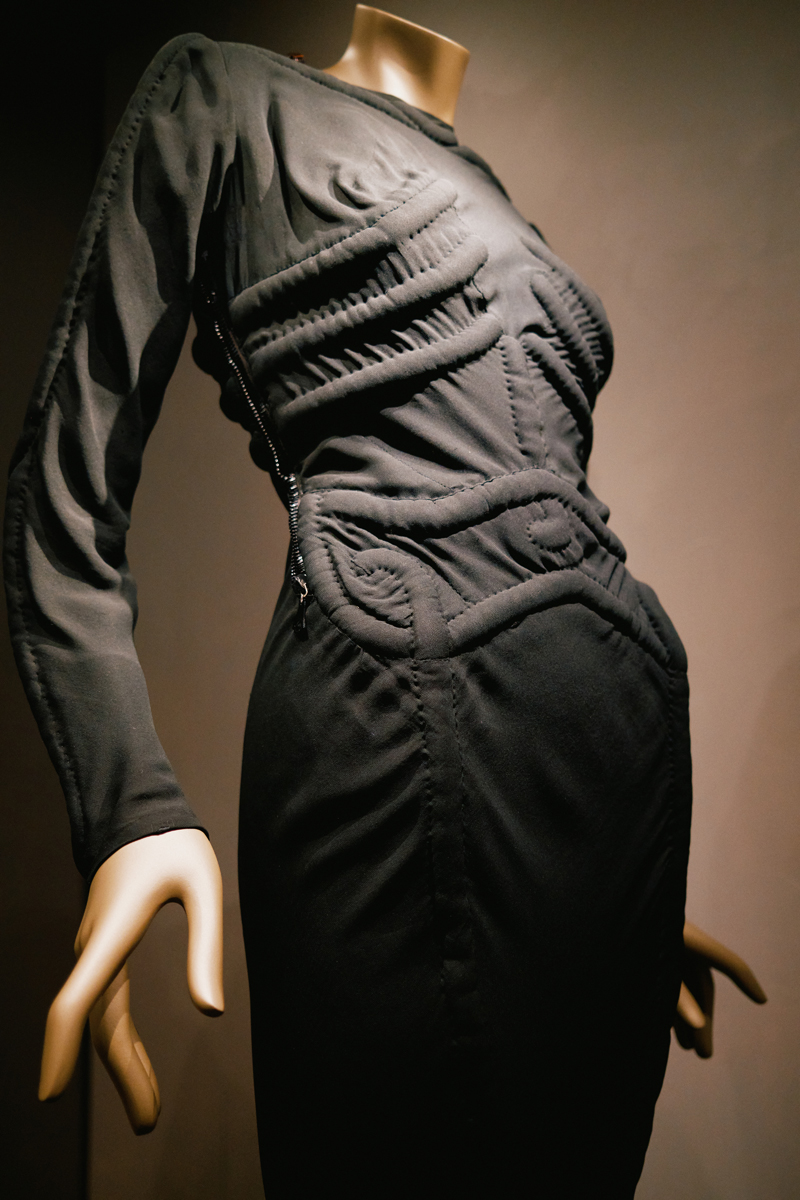
Schiaparelli: Fashion Becomes Art, installation view. Courtesy V&A South Kensington. © Jamie Stoker. Pictured: Skeleton Dress, designed with Salvador Dalí, 1938.
“I like to amuse myself through some of my creations,” Elsa Schiaparelli told the Daily Mirror in 1937, aged forty-seven, which seems fair enough. “If I didn’t, I should die,” she continued, upping the ante and elucidating, with characteristic pith and flair, how much fashion meant to her beyond (as she would later say in her 1954 autobiography, Shocking Life) “the crude and boring reality of merely making a dress to sell.” The Italian designer, who lived and worked variously across Paris (the true international home of couture, she would always argue, and where she died in 1973), London (where she had a salon from 1933 to 1939), and New York (which gave her safe harbor for the war years, during which she worked as a nurse aide), was speaking to the British tabloid for an article entitled “The Glad Hatter”—a hint at Schiaparelli’s wild creations for topping off women’s ensembles.
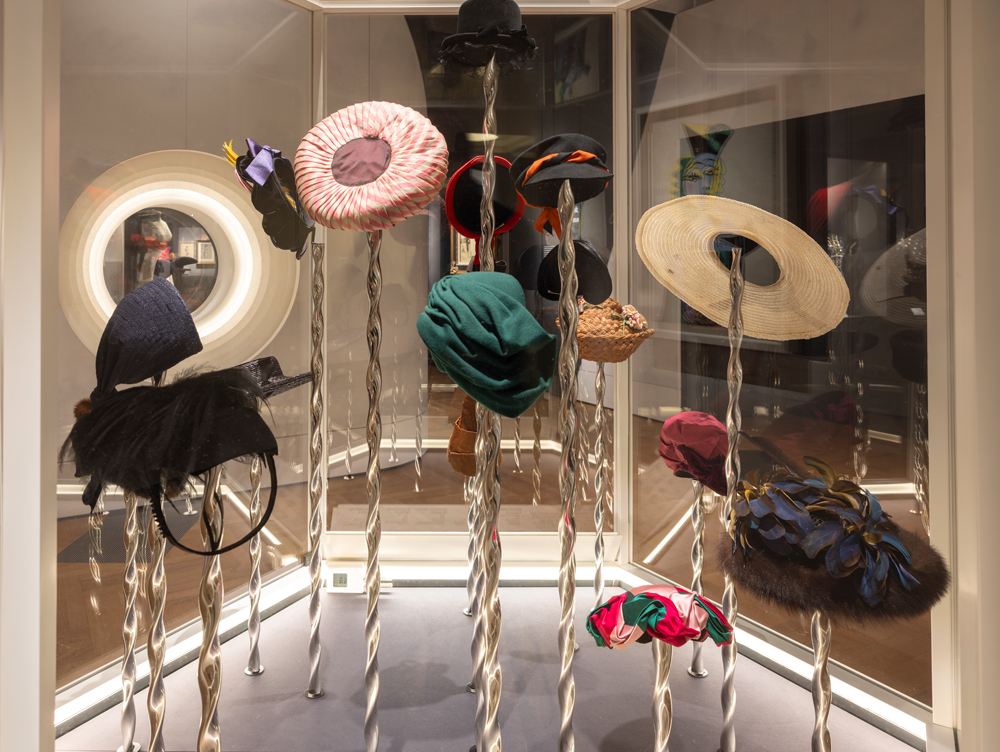
Schiaparelli: Fashion Becomes Art, installation view. Courtesy V&A South Kensington. Photo: Peter Kelleher.
At the center of the V&A’s Schiaparelli: Fashion Becomes Art—a vast and elegantly staged exhibition that spans the designer’s work from 1927 to 1954 (as well as the brand’s recent resurgence under its current creative director, Daniel Roseberry)—sits a kind of prismatic glass crucible in which a selection of hats (shall we say sixteen? I was dazzled, then dizzy, going round and round) perch atop silver poles twisted like ribbons, or the poles that hold animals, up and down, on a merry-go-round. But “hats,” too, seems wrong: they are more like—exhalations, dreams, fantasies, thought bubbles. They are sleek, funny, raucous, beautiful; resembling nests, muttonchops, birdcages, circus tents; crafted from wool, cotton, silk, taffeta, straw, velvet, lace, felt.
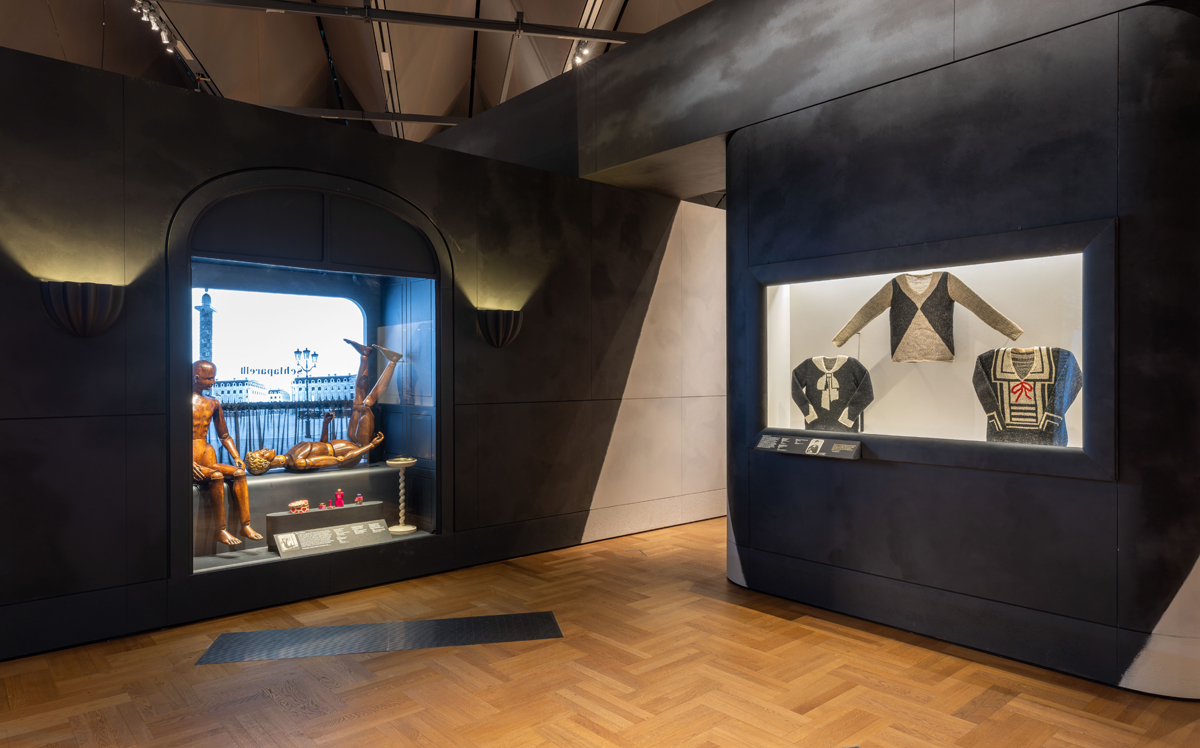
Schiaparelli: Fashion Becomes Art, installation view. Courtesy V&A South Kensington. © Victoria and Albert Museum.
The word “eccentric” was often used to describe Schiaparelli in her time, but now it seems dated, self-serious, gendered (see, kooky, offbeat, and similar, which no one much seems to say about gents). She was funny and fun—standing just five feet tall, often in cropped trousers or boyish suits of her own making—and, in her work, every detail of a woman’s ensemble was ripe for expression and innovation: “the spirit of infectious good humor can be created even through women’s hats.” Or even through—gloves (pink, yellow, purple, striped, ruffled, beaded), hair combs (with flying gold wings), brooches (birds, locks, eyes, keys, feathers, leaves), buttons (suns, ducks, butterflies, peanuts, flowers, swirls, abstractions), purses (like giant baubles or verdant extractions), zippers (big, bold, bright).
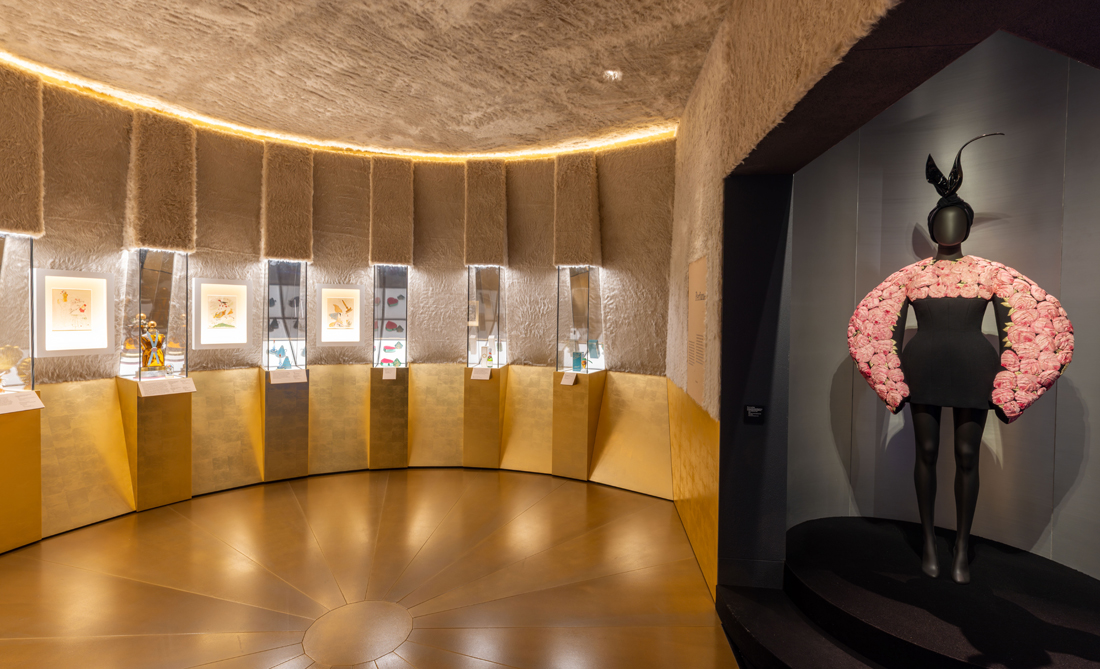
Schiaparelli: Fashion Becomes Art, installation view. Courtesy V&A South Kensington. © Victoria and Albert Museum.
The exhibition—which is theatrically presented with luxe details including fur-lined rooms, phalanxes of mannequins in whirling spotlights, delicate installations for small bijoux, and mirrored enclaves for especially elaborate garments—calls these concerted flairs, these evens, “finishing touches.” The spaces devoted to them come midway through the chronologically plotted show, acting almost as a hinge between displays focused on particular collections (her wartime tweed suits with large “cash and carry” pockets that obviate the use of a purse are a highlight) and, following, Schiaparelli’s collaborations with certain society ladies, stars of the silver screen, photographers, and—most important—Surrealist artists of the contemporary avant-garde.
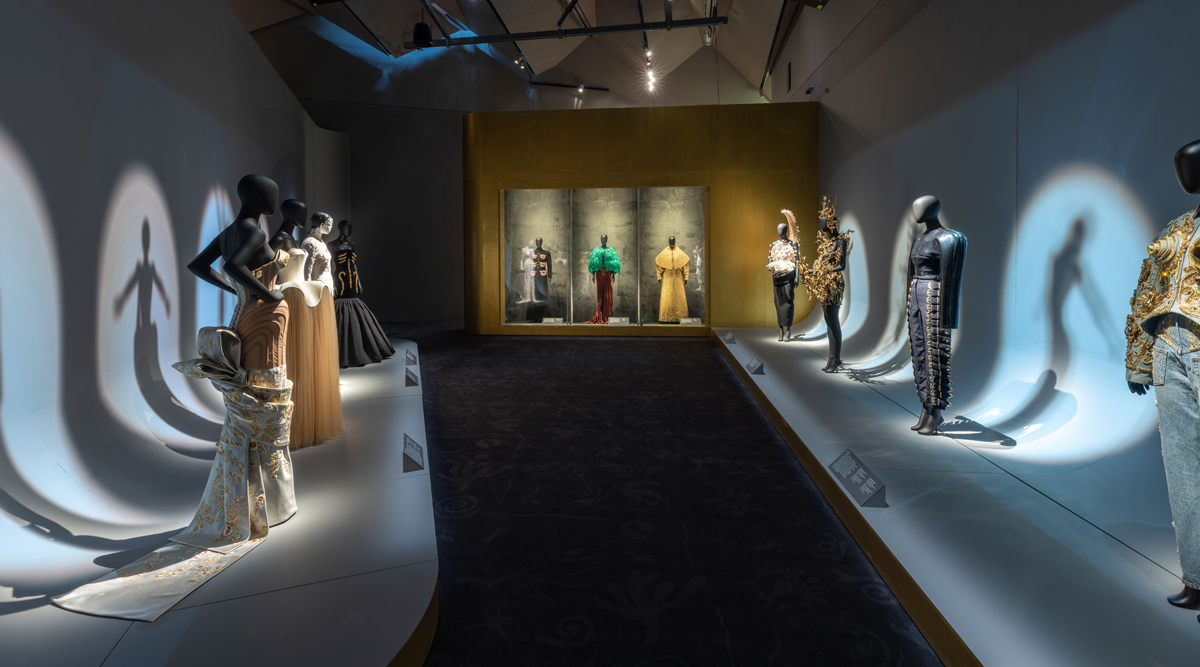
Schiaparelli: Fashion Becomes Art, installation view. Courtesy V&A South Kensington. © Victoria and Albert Museum.
A story repeats throughout, a kind of apocryphal tale, maybe, but also an example of how signs and symbols, themes and motifs, travel across disciplines (and, in some cases, epochs) to take on new life. When Schiaparelli was young—just little Elsa, born to an aristocratic and artistically inclined Roman family—she planted, she often claimed, seeds in her nostrils and mouth so as to become more beautiful. Cue fantastical images of Ovidian transformation à la Chloris abducted by Zephyrus, the god of wind, who turns her into Flora, the goddess of spring, blooming plants and all their colors, a scene memorialized in Botticelli’s ca. 1477–82 Primavera, a painting tumbling with flowers of all variety.
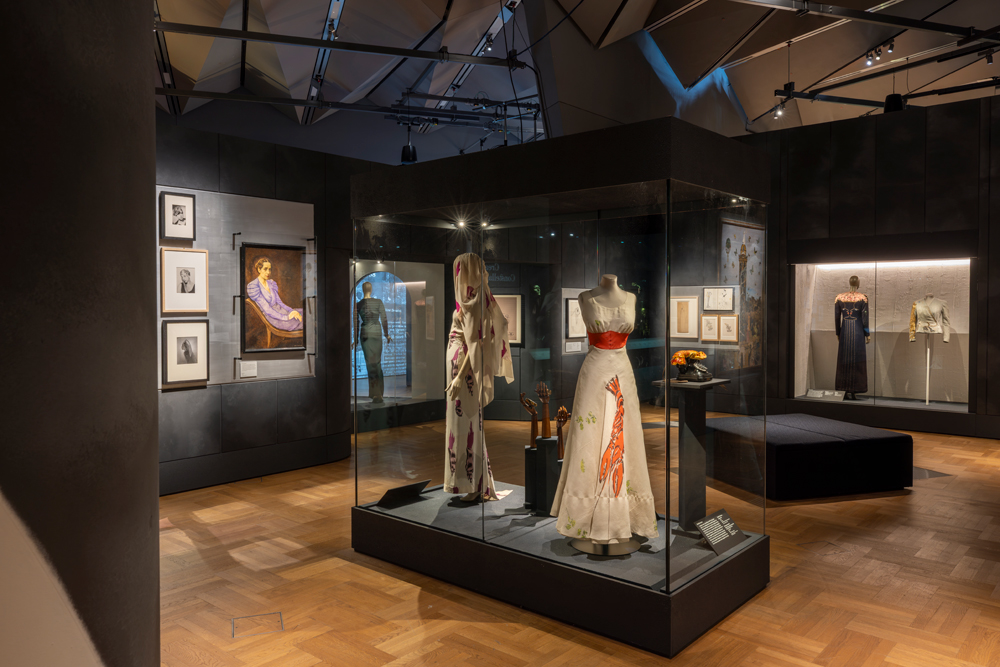
Schiaparelli: Fashion Becomes Art, installation view. Courtesy V&A South Kensington. © Victoria and Albert Museum. Pictured, center vitrine: Tears dress with veil, designed with Salvador Dalí, 1938; Lobster Dress, designed with Salvador Dalí, 1937.
A 1936 canvas by Salvador Dalí, one of Schiaparelli’s constant collaborators, shows a woman standing next to a cypress tree on the outskirts of a dry city that dissolves into hazy swathes of desert and sky to her left. Where her face should be is a tight mask of blossoms pink, ochre, coral. Necrophiliac Spring, it is called (is it the spring, or the one who longs for it, who so loves the dead?); it belonged to Schiaparelli and hangs here amid work she made with Dalí—a dress painted with a lobster, another made of fabric that evokes torn flesh. Nearby, a photograph of the British artist Sheila Legge standing in London’s Trafalgar Square during the 1936 International Surrealist Exhibition—clad in a bridal gown with long black gloves, her head is entirely obscured by a brimming bouquet.
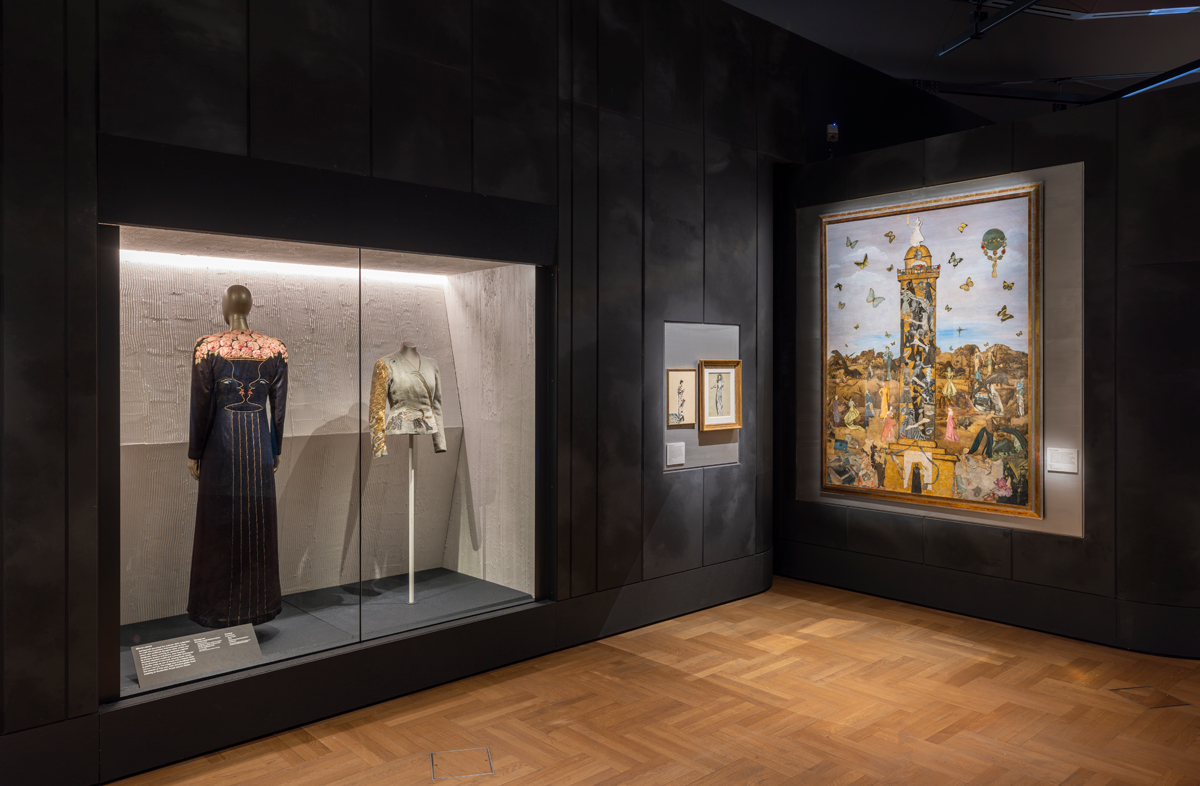
Schiaparelli: Fashion Becomes Art, installation view. Courtesy V&A South Kensington. © Victoria and Albert Museum. Pictured, far left: Evening coat, designed with Jean Cocteau, 1937.
In yet another room, the flowering continues with one of Schiap’s (as she was affectionately called) best-known garments: an evening coat designed with Jean Cocteau. Two faces—gold-outlined, blue eyes, ruby lips—are embroidered on its long, black back, pursing their mouths for a kiss, their profiles also forming (that classic illusion) a goblet. Above, the shoulders of the silk jersey coat are covered with folded pink florets of appliquéd silk, whose leaves shine in gold and green metal and silk thread. They are static, but appear to cascade, their darker pink centers like tongues or secrets never to be told. As with so many works in the exhibition, one holds one’s breath in surprise and admiration. There’s a delight in beholding each small, very handmade decision—from buttons to epaulettes, seams to zippers, waists to hems—as there is in describing them in the round, imagining seeing them worn, or even wearing them oneself. As the saying goes, in fashion, as in art (they are not, in fact, separable when done well), god really is in the details. (Though Cocteau described her as having “the air of a young demon,” bewitching those who entered her store and sending them out into the world remade.) Angel or demon, to make it count, make it fun, make it last, make it strange—to make work that holds enduring appeal—is, ever, to make it Schiap.
Emily LaBarge is a Canadian writer based in London. Her work has appeared in Artforum, Bookforum, the London Review of Books, the New York Times, frieze, and the Paris Review, among other publications. Her first book, Dog Days, was published in the UK in 2025 by Peninsula Press, and in the US and Canada, with Transit and Hamish Hamilton, in May 2026.