


 Nathan Lee
Aestheticized violence and fussy formalism in Lav Diaz’s new film.
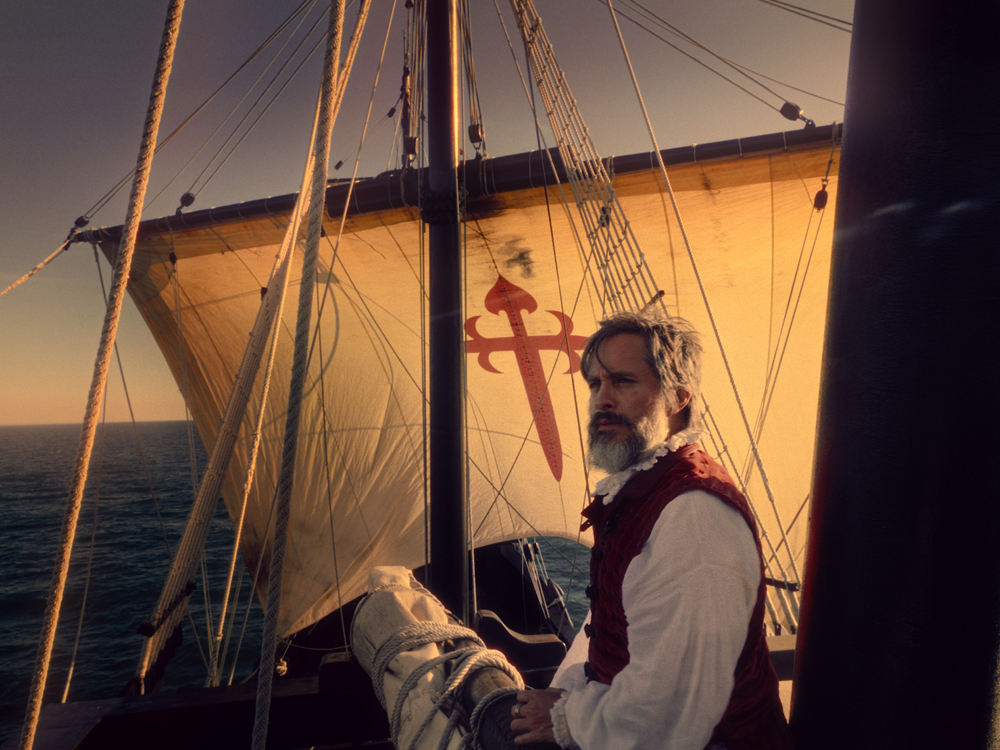
Gael García Bernal as Ferdinand Magellan in Magellan. Courtesy Janus Films.
Magellan, written and directed by Lav Diaz,
now playing in select theaters
• • •
A great deal of wailing and lamentation erupts in Magellan, the new film by Filipino director Lav Diaz. Detailing imperial conquests undertaken from 1511 to 1521, the movie is less concerned with the exploits of famed Portuguese explorer Ferdinand Magellan (Gael García Bernal) than the effects of colonial exploitation. Hence the many scenes of Indigenous people gnashing their teeth, beseeching their gods, raising their arms to a merciless sky as the project of empire overtakes them. By the third or fourth presentation of such agonies, I started composing a variation on the performative spectator meme: “Watching Magellan and shaking my head the whole time to let everyone know I denounce colonialism.”
The movie opens with a vision of Edenic harmony. A resplendent Eve, sinless and nude, gathers water in an emerald landscape of abundance and plenty. Something catches her attention out of frame and she hurries to her village bearing news: “I saw a white man.” Her people repeatedly intone a mantra (Magellan is fond of repetition): “The promise of the gods of our ancestors is upon us!” Signs and wonders? This prelude climaxes with an impassioned ritual of—yes—wailing and lamentation, casting in question, ever so briefly, whether the advent of this pagan pledge is a blessing or curse. Abuse of power comes as no surprise, per the evergreen aphorism of Jenny Holzer, and one needn’t wait for the ensuing white devilry to foresee that no paradise this schematic can be anything but lost.
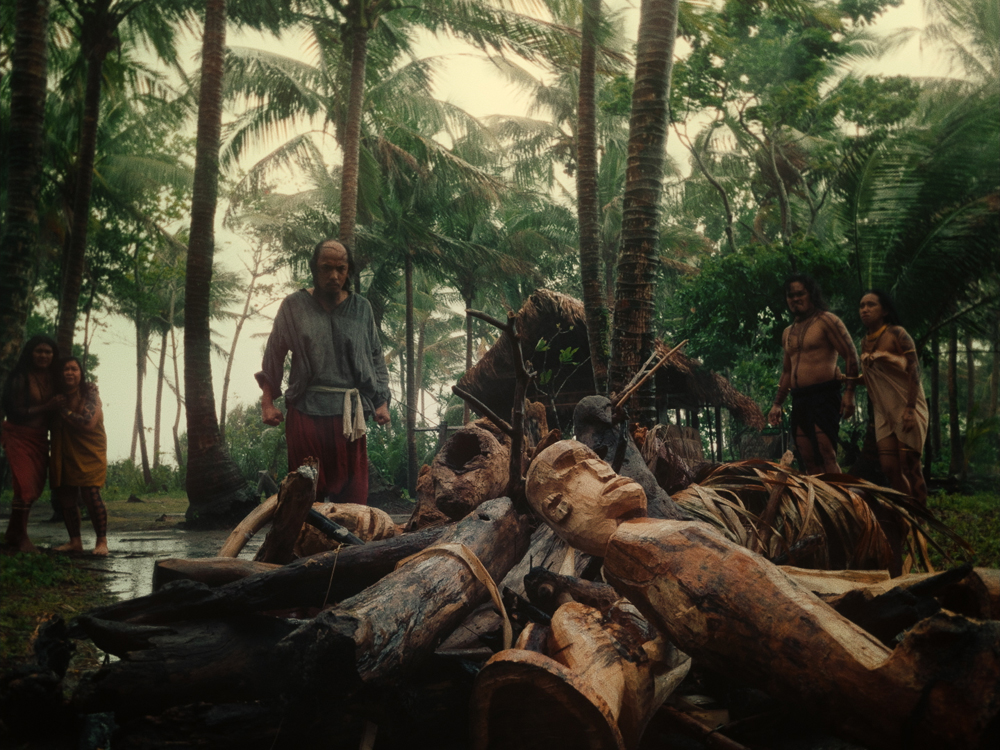
Still from Magellan. Courtesy Janus Films.
The narrative proper begins with the first in a series of title cards designating time and place: 1511, Malacca. Students of history will recall the difficulties Magellan, under the command of Governor Afonso de Albuquerque (Roger Alan Koza), endured in conquering this region of the Malay Peninsula. Viewers of Magellan piece the story together through Diaz’s general method: a magic lantern–like succession of tableaux that aim for emblematic force. Lifeless bodies, both European and Native, arranged on a shoreline with the finesse of a studied nature morte. Languid glide over fog-shrouded river, camera fixed at the prow of a boat penetrating the landscape, the sinister momentum of invasion. Corpses and more corpses, voyages at twilight, imperial machinations, genocide and uprising—the whole of it studiously displayed, everything in its right place.
Acts of violence in Magellan take place almost entirely off-screen. One might generously call this strategy Bressonian for its displacing of normative continuity with associative abstraction. To this viewer, the motif of Indigenous massacre in neatly designed frames more readily aligns with that most enervating cliché of serial-killer procedurals: the sculptural display of mutilated women by the maniac-as–installation artist. The villains of Magellan are scarcely less subtle. After Malacca has been vanquished, a booze-sloshed Governor Albuquerque monologues on their mandate to “suffocate the world” by dominating further reaches of the map, thwarting the commercial ambitions of rival European powers, undermining Islam, and ushering the end of days through the Second Coming of Christ. Before he can quite conclude this bloviating précis of imperial ideology, Alfonso flops over in an alcoholic stupor, a touch of drollery that underlines both the folly of empire and the film’s pervasive obviousness.
Magellan sails on. 1513: the famed explorer meets his future wife, Beatriz (Ângela Azevedo), and plots a new route to the Spice Islands. 1518: the expedition is formalized and Mrs. Magellan is with child. 1519–1520: voyages across the Atlantic and Pacific oceans, replete with mutinous subplots, hallucinatory visions of Beatriz, and—spicier than the Spice Islands—a pair of lusty sailors punished for crimes against the Lord. Decolonize butt stuff!
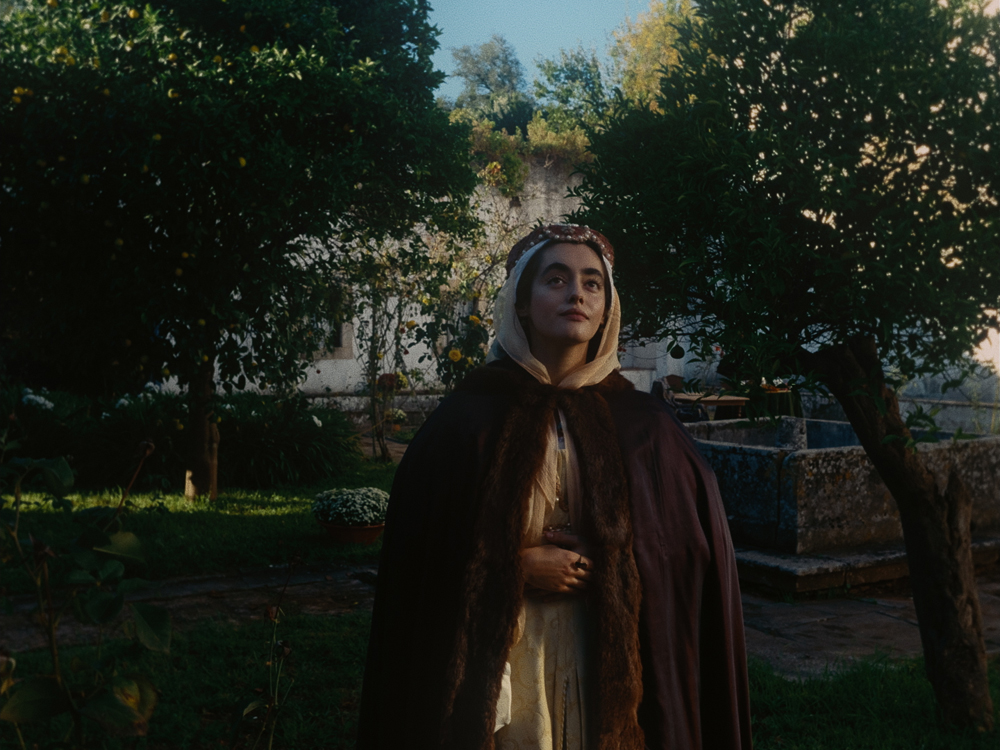
Ângela Azevedo as Beatriz Magellan in Magellan. Courtesy Janus Films.
The movie reaches its geographic and narrative conclusion with the 1521 occupation of Cebu, an island province of the Philippines, where Native resistance put an end to Magellan. Bernal arrives at his own decisive moment. Having capably held the screen in a film that emphasizes image over character, style over substance, the actor is afforded an extended episode to dramatize Magellan’s final days. It’s not much, but it’s something. More, at least, than the fleeting moments devoted to his marriage. Beatriz’s few appearances, in the flesh or as ghostly visitation at sea, suggest a key dimension of this saga has been curiously truncated. For Diaz, whose films often extend to six hours or more, abuse of runtime comes as no surprise: he is reportedly at work on a nine-hour companion film devoted entirely to Beatriz’s perspective.
Sparse and didactic, distanced yet blunt, Magellan is a film of appreciable visual finesse but few compelling ideas. It’s clear why Diaz would be interested in dethroning an epochal European figure with intimate ties to his country. His best-known film, the slow-burn crime drama Norte, the End of History (2013), cast a steely eye on various aspects of Filipino modernity, with notable emphasis on its Christian culture, a direct legacy of its colonization by Western powers. It makes sense, moreover, that after forging a career from demanding micro-budget films little seen outside the international festival circuit, Diaz might have a go at plying his technique on a grander scale with a movie star along for the ride. Less discernible is what investment the viewer is being asked to make.
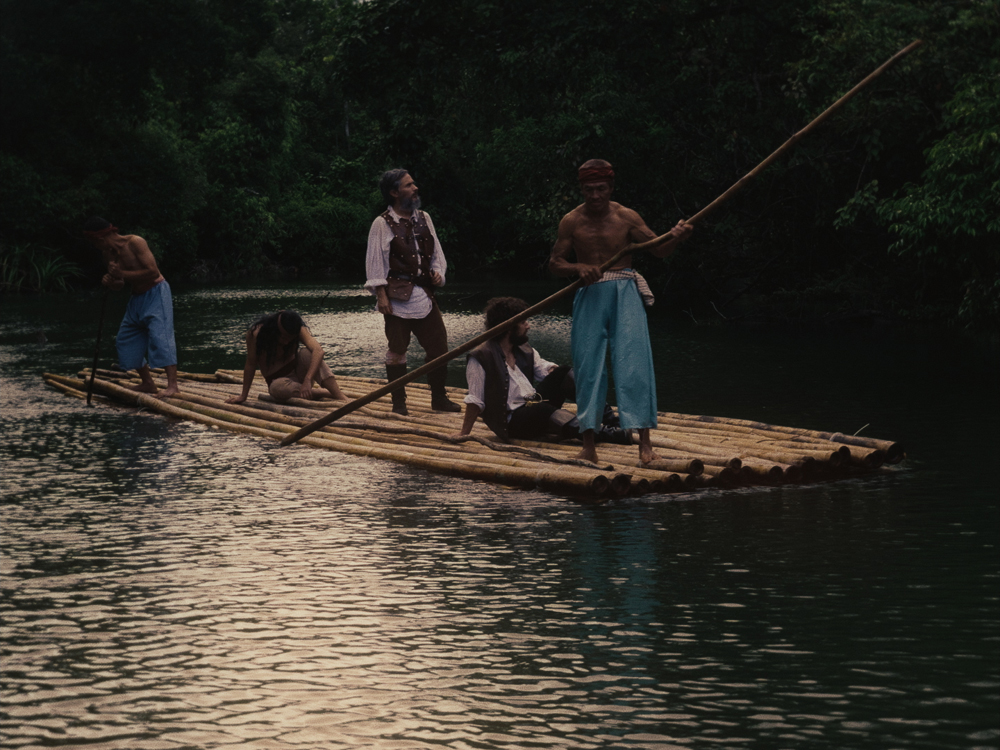
Gael García Bernal as Ferdinand Magellan (center left, standing) in Magellan. Courtesy Janus Films.
Despite its lavish costuming, credible period design, and vivid location shooting in Portugal, Spain, and the Philippines, Magellan is unconcerned with the usual trappings of the biopic, epic, or history lesson. What it offers instead is a routinized exercise in “slow cinema” supported by a sub-Wikipedia armature of historical data. Much of this is nice to look at. Diaz shares the cinematography credit with Artur Tort, a skilled DP notable for his work with Spanish auteur Albert Serra, who coproduced Magellan. Tort’s elegant conjuring of moody vibes elevated Pacifiction (2022), Serra’s contemporary take on colonial dissolution in French Polynesia—a movie that, like Magellan, compensates for its meager substance with pictorial razzmatazz.
All looking is a form of thinking, but some thoughts are better than others. Whatever else is on his mind, Diaz revives—without examining—the long-standing question of aestheticized violence. If depiction does not equal endorsement, neither does restaging atrocity constitute critique. The fussy formalism of Magellan made me want to jump ship.
Nathan Lee is an assistant professor of film at Hollins University and a widely published critic.