


 Sukhdev Sandhu
Queen of rags, queen of nothing: Birgitta Trotzig’s magnificent, terrifying 1964 novella depicts poverty as an existential condition.
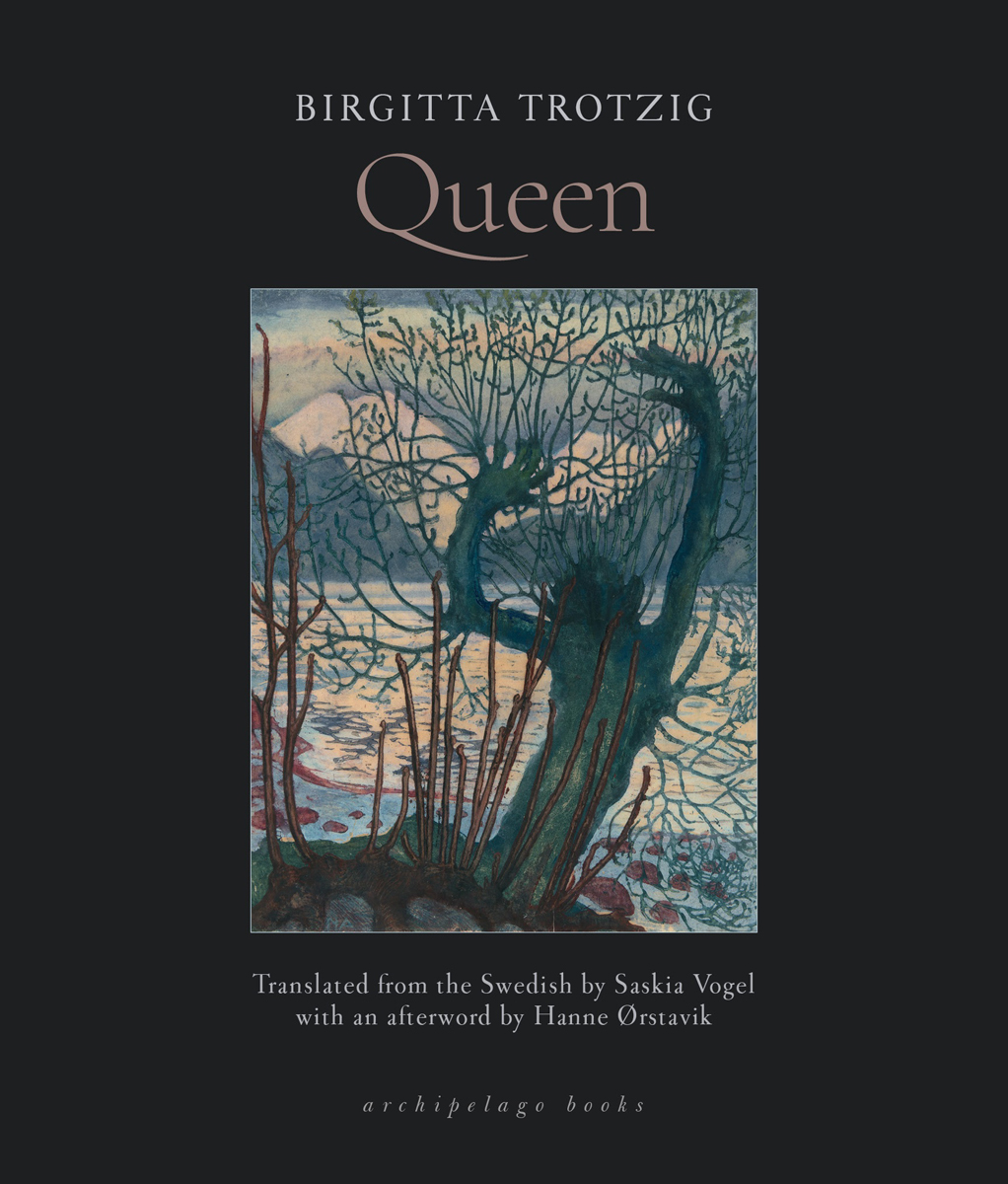
Queen, by Birgitta Trotzig, translated by Saskia Vogel,
Archipelago Books, 157 pages, $19
• • •
Like many writers, Birgitta Trotzig had her own pantheon. Dostoevsky, Simone Weil, Nelly Sachs, St. John of the Cross—all, in their different ways, helped her to develop what she called her “poetics of the margins.” Kafka, too: “We need books that affect us like a disaster,” he wrote in a 1904 letter to his friend Oskar Pollak. Books that “hurt us badly like the death of someone that we hold dearer than ourselves, as if we were driven out in forests away from all human beings, like a suicide.” After finishing Swedish-born Trotzig’s Queen, published in 1964 but only now translated (by Saskia Vogel) into English, I felt, if not quite dead, certainly embolized. Doctor: the MRI!
The novella takes place in the back of beyond. Or, rather—in Bäck, a small village in southern Sweden, whose inhabitants eke out poor, niggardly lives laboring, sometimes vainly, to coax crops from its hostile earth. Here, by the Baltic, the gray gray sea, on land that is muddy and often waterlogged, reeking, under skies whose white light is “as mute as the blind milk of membrane around an extinguished eye,” there lies at the coastal edge an isolated farmhouse. A century ago it had flourished, a fortress in a landscape of indigents and beggary. Now it’s decaying, a fallen citadel.
The place is just about held together by the slog of an unmarried woman in her fifties called Judit Lindgren. She tends there to her mother and father, both of whom—because of age, illness, the gray gray sea—are wilting. She looks out for her younger brother Albert, who has a “thoroughly common intelligence,” suffers headaches and rarely speaks, is strong but cries a lot. Locals defer to her adamantine personality, her tough-as-boots mien. A local clergyman calls her “the Queen.” But, says the narrator, she’s the “queen of rags, of sagging moldering roofs, of nothing.”
Even as a teenager, she despises alms. She wants to be free of sentiment, to become as cold as Bäck in winter, to become geological. In one remarkable passage, she tries to suppress tears, but “stifled [her weeping] bores itself ever deeper downward, inward, vanishing undermost in the deadest layer of earth underneath hidden crumblings, through stone chips down in the desiccated rock-hard packed stratum of the ground.” In another, she fears the “oozing dissolving sea of poverty, once a foot slips in you’re done for, in less than the blink of the eye it will have sucked you down and sucked the clothes from your body.”
Trotzig’s Sweden isn’t a land of planning and progress, of welfare and women’s rights. It’s excruciated, a desert, a medieval wilderness. Bare life. Everywhere the smell of dung. Women caked in mud. Children with “gray scabby faces.” Poor people as “starved cats” with “repugnant quivering” mouths. Gashed language for a gashed world. A woman’s eyes are likened to “an animal in distress, a cow who’d broken its forelegs in a pit.” Even Albert—sweet Albert, the village idiot, the elective mute—turns to his sister, “blind and soft like a calf to the cow.”
Part of what makes Trotzig so discomfiting to read is her lack of interest in writing about poverty in terms of economics or politics. For her, poverty is closer to an existential condition. A curse. Perhaps a destiny. The Queen has another brother—Viktor, much younger—who is often beaten by their father (“a good and patient man, if melancholic”); afterward, as if epigenetically, the boy, “still red and quaking with tears would go out to punish something he could control—he tore a leaf to pieces, he mashed a worm with a rock: there! and there!”
Viktor grows up a tearaway. He drinks. He gets local women up the duff. Yet the Queen, for all her hardness, can’t quite banish him from her affections. In his errancy, his carnality, does he represent a carefree freedom she has tried so hard to smother in herself? Eventually, like so many Swedes in that period, he disappears—to the New World, to be resurrected. Except he isn’t. In and around New York, he piecemeals a life working at demolition companies, as a milkman, a trucker. He drinks, sleeps around, is homeless.
Trotzig writes magnificently, monstrously about Viktor in New York. Barely a human, he’s part of a “mighty sea of people”—a “great heaving wash of human mass”—who churn through the city. He’s a shipwreck—“root fibers turned to slime, drifting lifeless into the dark.” The book’s most astounding scene, as indelible and terrifying a vision of malevolent modernity as anything in a Fritz Lang film or a Sebastião Salgado photograph, pictures him lining up in front of a factory at dawn. The queue of would-be day laborers swells and swells; they lunge forward— overheated, desperate, twisted, yelping, a “river of the unemployed.”
And yet, having convinced us this is hell, that these immigrants and ragged toilers are foredoomed, something happens to Viktor. Someone happens. A chink of light. A mote of grace. This is a novel where, early on, the narrator wonders, “The fate of the word is to drown, is it not?” A novel where the Queen, then barely an adolescent, apprehends that “there was nothing to look forward to. All that was left for her was to plummet, fall back—part ways and die. Part, subside, and then die.” And yet and yet and yet. There are cracks and crinkles. Characters escape, if only for a while, a while that is both strange and cruel, the noose of predestinarianism.
Queen, early on, poses a question: “Wintertime the sea speaks, what does a person have to add to that?” It’s a challenge that Trotzig embraces, brewing a language at once sonorously laconic, a primal scream of stone and fire and water, and liable to erupt into surreal catechisms, fanged noumena, Tiresian curses. Hers is a twilight world. No resolutions, no reparations. Humanity as a plundered vessel. “I write to awaken and disturb,” she later claimed. And how.
Sukhdev Sandhu directs the Colloquium for Unpopular Culture at New York University. A former Critic of the Year at the British Press Awards, he writes for the Guardian, makes radio documentaries for the BBC, and runs the Texte and Töne publishing imprint.