


 Ania Szremski
The critics aren’t all right: this year’s survey is a sharply political and totally sincere iteration.
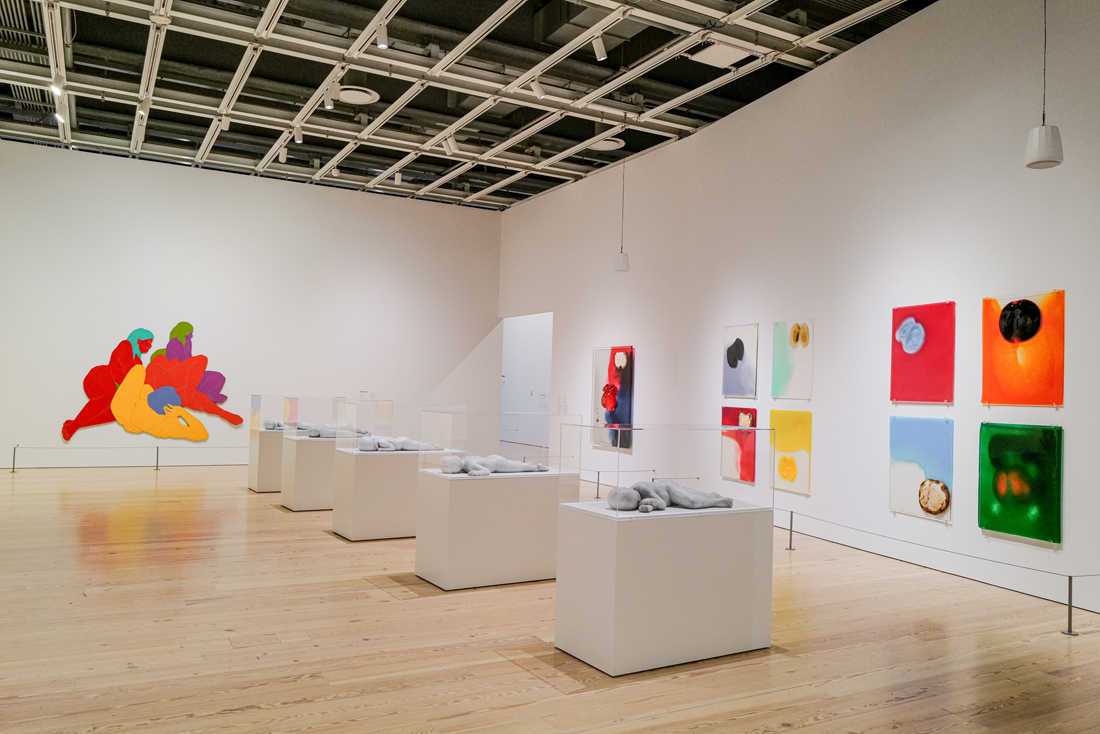
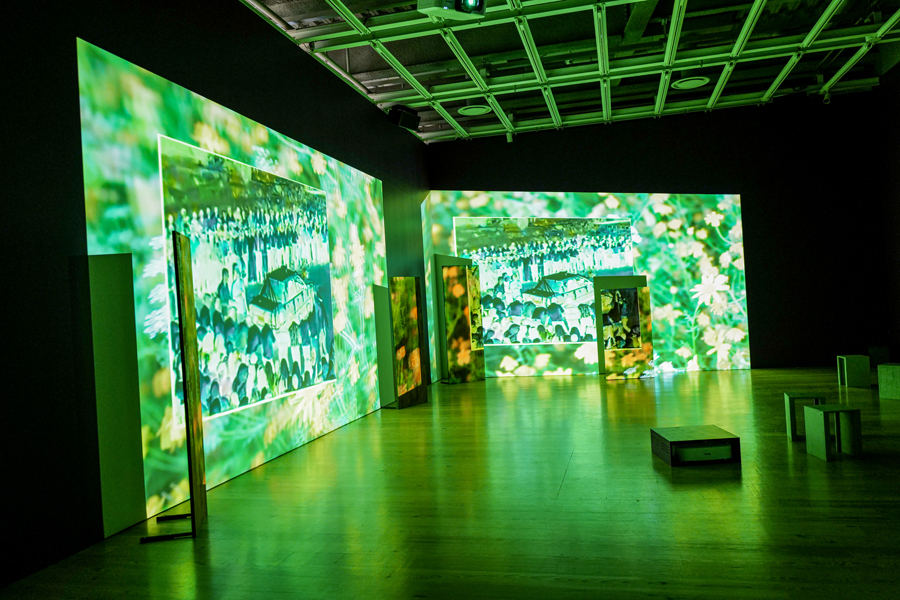
Whitney Biennial 2026, installation view. Courtesy Whitney Museum of American Art. Photo: Jason Lowrie / BFA.com. © BFA. Pictured, far left on right wall: Nour Mobarak, Reproductive Logistics 4, 2026. Center and right, on right wall: Nour Mobarak, Recto Verso series, 2024–25.
Whitney Biennial 2026, curated by Marcela Guerrero and Drew Sawyer with Beatriz Cifuentes and Carina Martinez, Whitney Museum of American Art, 99 Gansevoort Street, New York City,
through August 23, 2026
• • •
This eighty-second edition of the Whitney Biennial, curated by Marcela Guerrero and Drew Sawyer (with Beatriz Cifuentes and Carina Martinez), has so far provoked two waves of critical response. The first, gut-check wave was mostly positive, if tinged with some concerns about the work being “weird” and not political enough. The second-wave critics were, as these things are wont to go, out for blood, with more pointed accusations of political passivity (even self-censorship) or, in the case of Hilton Als for the New Yorker, a reactionary, conservative, and somewhat head-scratching charge that the kids don’t know their art history, don’t even know themselves, and are mindlessly and ruthlessly ripping off their (better, to Als’s vantage) forebears for personal profit.
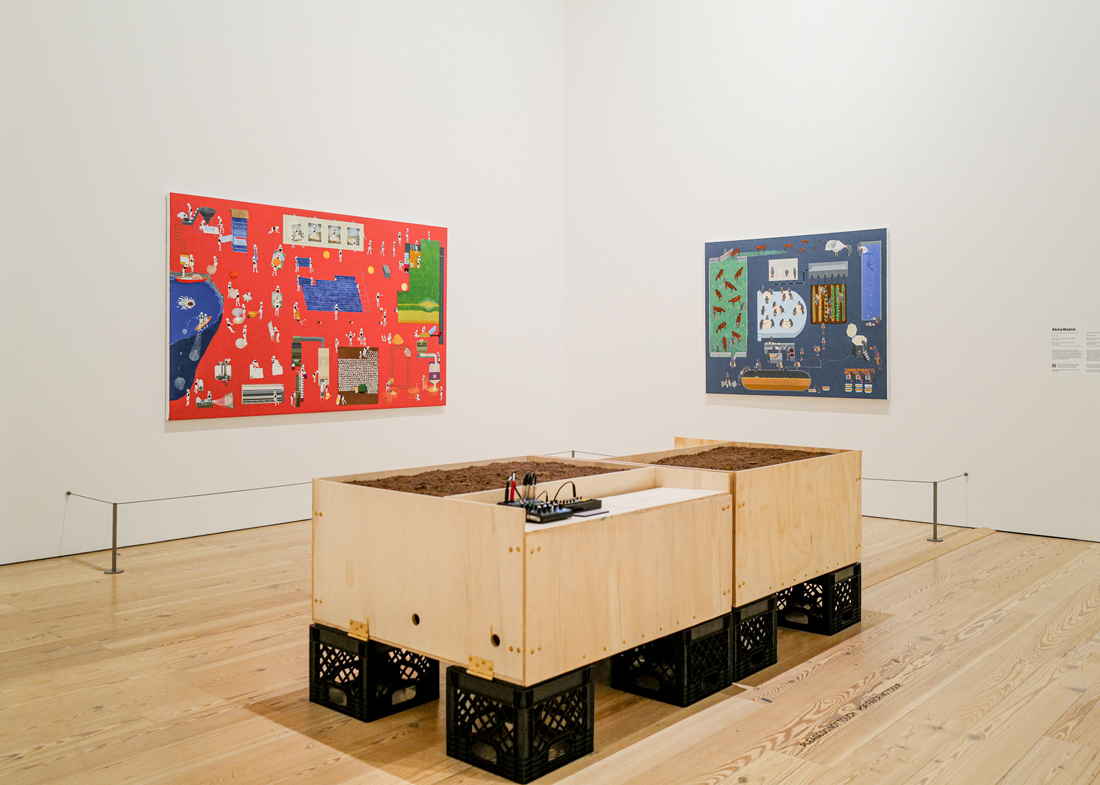
Whitney Biennial 2026, installation view. Courtesy Whitney Museum of American Art. Photo: Jason Lowrie/BFA.com. © BFA. Pictured, left wall: Akira Ikezoe, Robot Stories Around Solar Panels, 2025. Right wall: Akira Ikezoe, Mole Stories Around Methane Gas, 2025.
The privilege of writing about this exhibition after most everyone else has published on it is that you get to read what the other critics thought; the curse is that you feel you must read what the other critics thought; the blessing is that you get to say, the other critics are wrong! I found the 2026 iteration, which includes fifty-six artists and collectives not just from the territorial US but also, crucially, from its imperialist sphere (Afghanistan, Iraq, Vietnam), to be sharply political, limned with powerful moments, sometimes emotionally crushing—and totally sincere, without a sellout rip-off in sight.
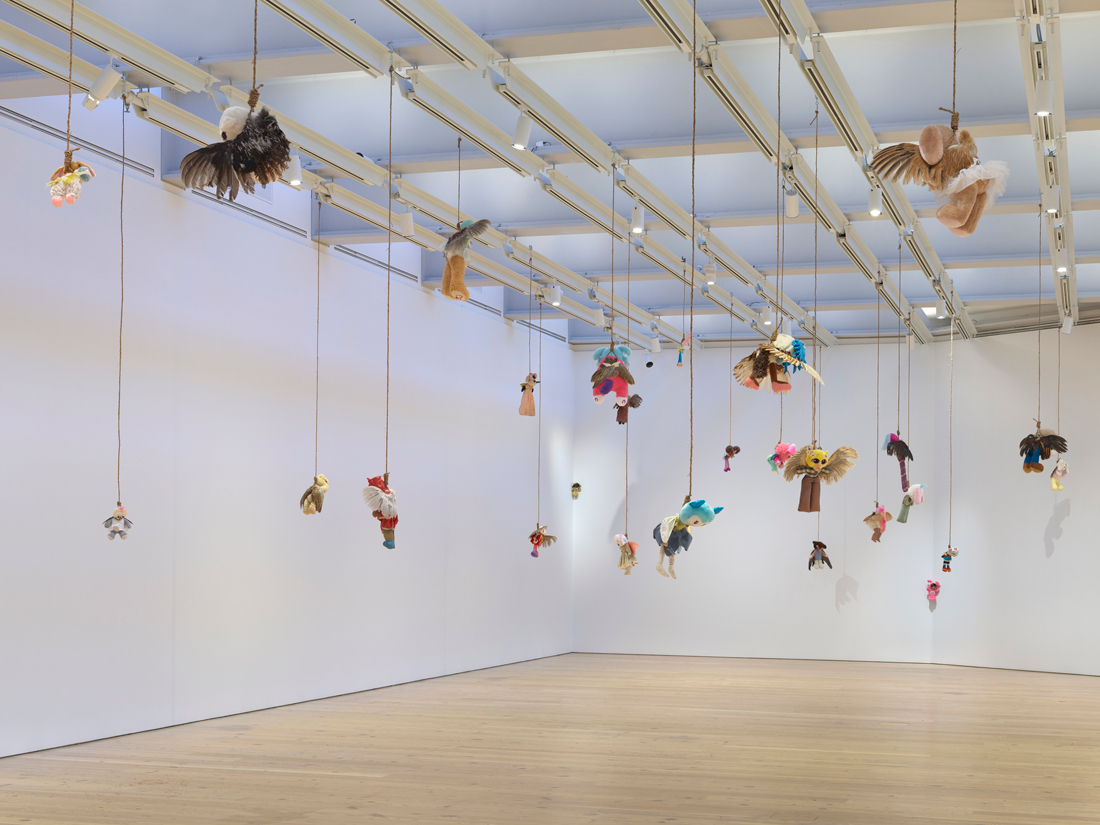
Whitney Biennial 2026, installation view. Courtesy Whitney Museum of American Art. Photo: Ron Amstutz. Pictured: Precious Okoyomon, Everything wants to kill you and you should be afraid, 2026.
The exhibition is laid out across four floors, and follows a heaven-to-hell logic, with Precious Okoyomon’s Everything wants to kill you and you should be afraid (2026), one of the strongest works here, on the eighth floor: a demented “heaven” in which the angels of the airy, light-filled gallery are fifty-five stuffies Frankensteined with sewed-on taxidermy wings, dangling in nooses suspended from the ceiling. Navigating through the show downward, you’ll end up in Zach Blas’s terrifying AI-generated video installation CULTUS (2023) on the ground floor, retina-burning red lights and churning percussion and Satan-esque voice-over screening in a blackened room, squarely placing us in Lucifer’s flames with Blas’s vision of tech domination. Okoyomon’s installation, in particular—which also includes six blackface dolls from the 1930s and ’40s clad in plush bunny suits—sets the tone for the peculiar strain of “weird” so many critics have responded to, which finds echoes through the more terrestrial domains of the fifth and sixth floors; a deranged cuteness that may conceal the acute political nature of these works. It’s a sort of neo–New Sincerity; something like what feminist theorists and artists Elena Castro Córdoba and Laura Tabarés have termed “elvish ugliness,” a queer aesthetic drawing from visions of an unsafe childhood that dresses up trenchant sociopolitical questions in fur and stickers and sparkles and intimations of creeping death.
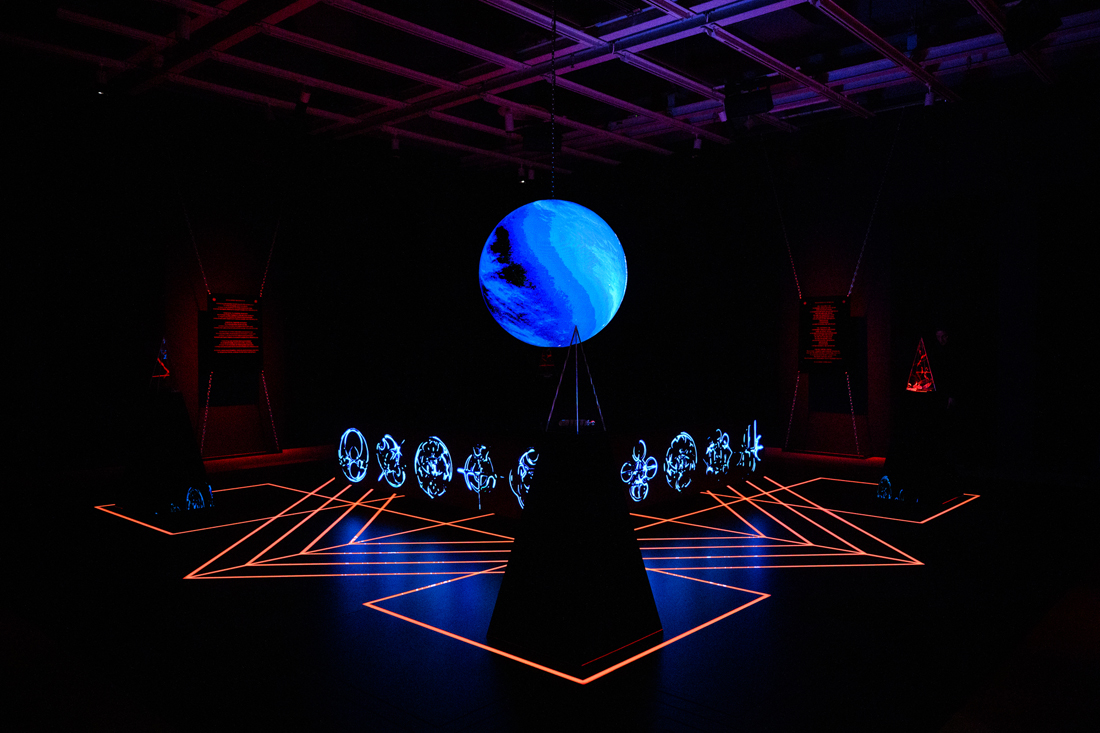
Whitney Biennial 2026, installation view. Courtesy Whitney Museum of American Art. Photo: Darian DiCanno / BFA.com. © BFA. Pictured: Zach Blas, CULTUS, 2023.
We see this on the sixth floor, with an installation by the Brooklyn collective CFGNY (comprised of Daniel Chew, Ten Izu, Kirsten Kilponen, and Tin Nguyen) titled Continuous Fractures Generating New Yields (2025), in which a plywood gazebo shelters strange, threateningly organic plaster casts based on the negative space between “Made in China” objects found at dollar stores and a monstrous and adorable worm-tailed stuffy with uneven glass eyes and furry tentacles. And, on the fifth, in LA-based Young Joon Kwak’s Divine Dance of Soft Revolt (Anna, Travis, Me) (2024), an enormous resin chandelier of a cut-up body whose component parts were cast from their queer and trans friends and covered in silver glitter.
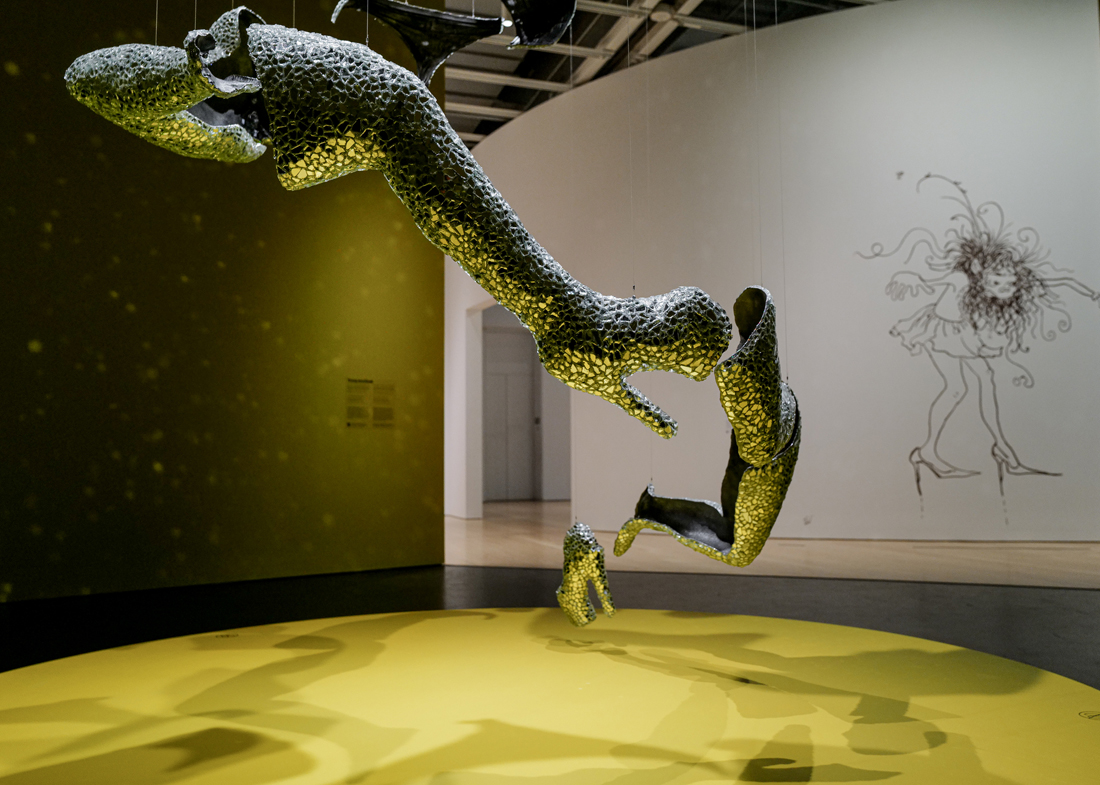
Whitney Biennial 2026, installation view. Courtesy Whitney Museum of American Art. Photo: Darian DiCanno / BFA.com. © BFA. Pictured, suspended in foreground: Young Joon Kwak, Divine Dance of Soft Revolt (Anna, Travis, Me), 2024. Far right, on back wall: Taína H. Cruz, A Wall That Plays Along, 2026.
Or, on the same floor, New Haven–based artist Taína H. Cruz’s enormous Moomin-esque tempera-paint drawing (conceived specifically for one of the exhibition’s curved walls) of a hysterically coiffed feminine figure in dripping heels (A Wall That Plays Along, 2026), accompanied by a suite of works including an elusive and tender painting of a Black girl and her dog (This Counts, 2026), which the object label says are informed by the fear Cruz experienced while growing up in NYC. Or again, most ebulliently, in the Honolulu collective kekahi wahi’s 2023/26 20-minute workout [WIP], codirected with Bradley Capello, a hallucinatory and hyperkinetic video that hearkens to internet-art aesthetics with its screen-pinks and clip-art decoupages that decorate footage of hot young people working out (and vogueing, and exotically dancing) in front of the Captain Cook memorial on the Kealakekua Bay. None of these works are too timid to engage political questions—though some of them evince a very justified terror of the world itself. But maybe they’re less legible to viewers of a certain generation and education, raised on drier aesthetics of Conceptualism and Institutional Critique.
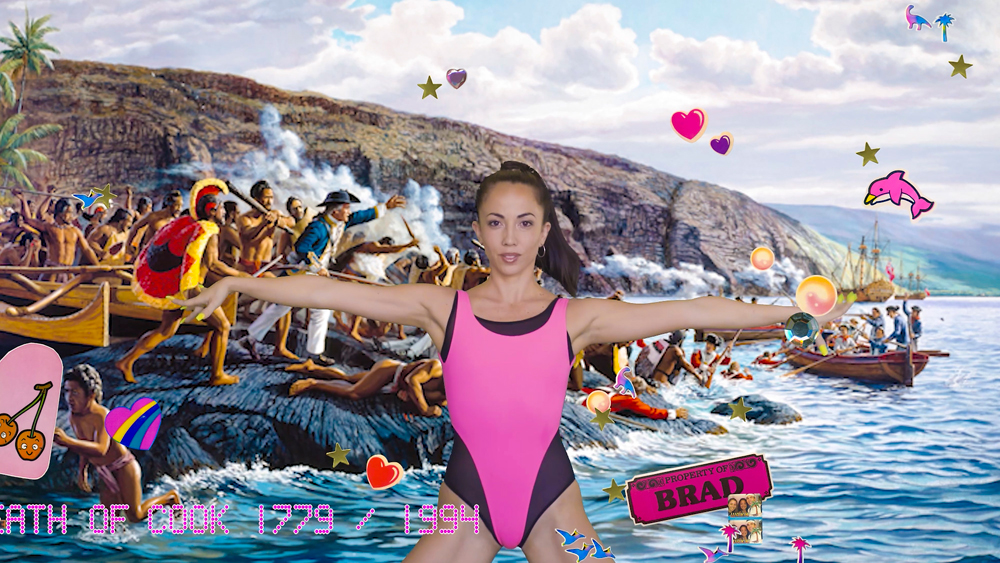
kekahi wahi (Sancia Miala Shiba Nash and Drew K. Broderick) and Bradley Capello, 20-minute workout [WIP], 2023/2026 (still). Courtesy the artists. © kekahi wahi.
On the fifth and sixth floors, we also find plainer, but just as effective, works to do with systems and infrastructure: Akira Ikezoe’s wonderful circuit-board/cartoon-mash-up paintings; David L. Johnson’s series of signs regulating codes of conduct in privately owned public spaces, which hold a special accretive power; Emilio Martínez Poppe’s moving installation placing interviews with employees at Philadelphia governmental agencies against photos taken from their office windows. Theaters of war: Mao Ishikawa’s beautiful 1970s gelatin silver prints of Black US Army soldiers living at a base in Okinawa; Aziz Hazara’s compelling prints based on data extracted from night-vision goggles abandoned by US forces in Afghanistan; Ali Eyal’s painting and sketches of a remembered childhood trip to an amusement park in Baghdad just before the 2003 US invasion.
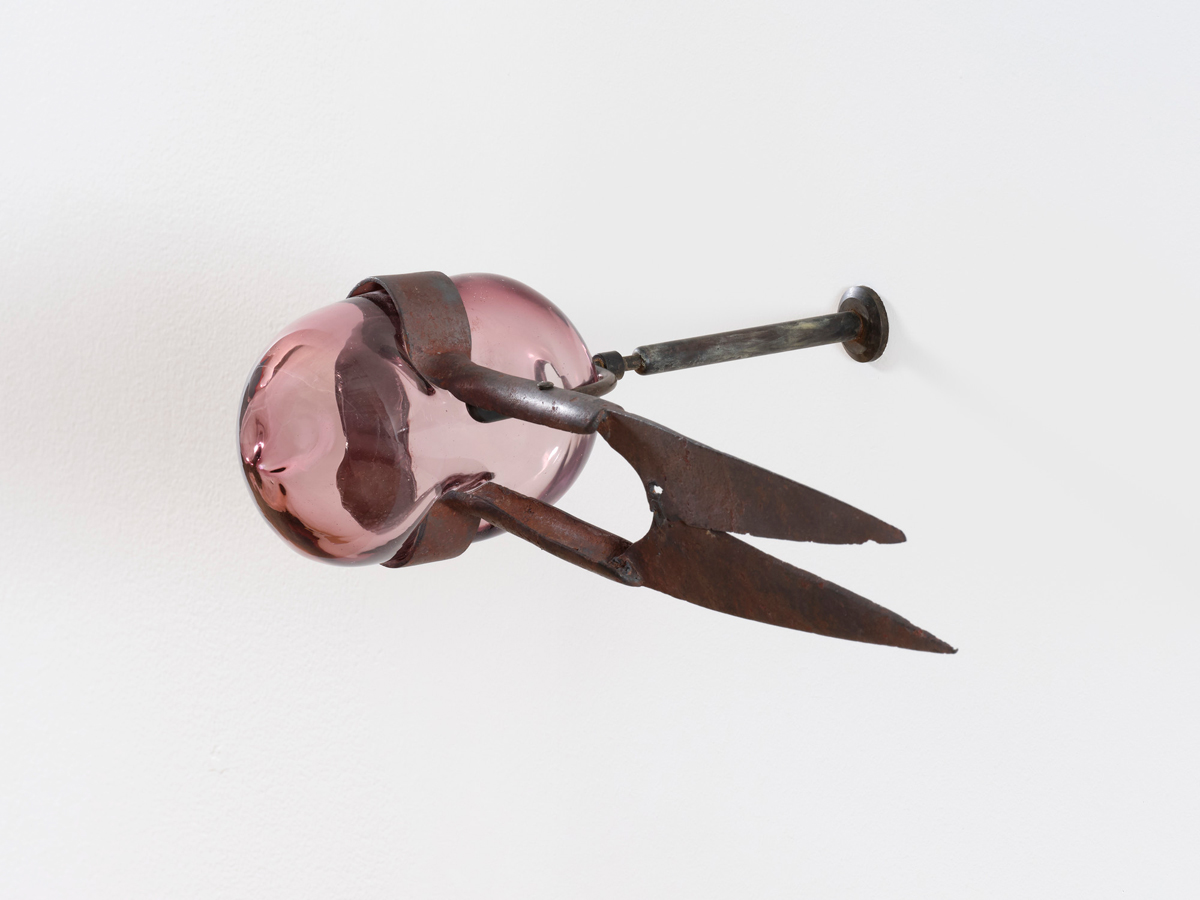
Sula Bermudez-Silverman, blister iii, 2025. Handblown glass, iron sheep shears, steel. Courtesy the artist and Hoffman Donahue. Photo: Paul Salveson.
And human bodies, investigated in many different ways, especially beautifully in Nour Mobarak’s succulent resin-and-mushroom panels and soundtrack based on her own pregnant body. And, in proximity to such explorations, the human’s relationship to nonhuman animals and the natural world: see Sula Bermudez-Silverman’s lovely yet menacing handblown-glass insertions into animal traps and training apparatuses and Oswaldo Maciá’s affecting Requiem for the Insects installation.
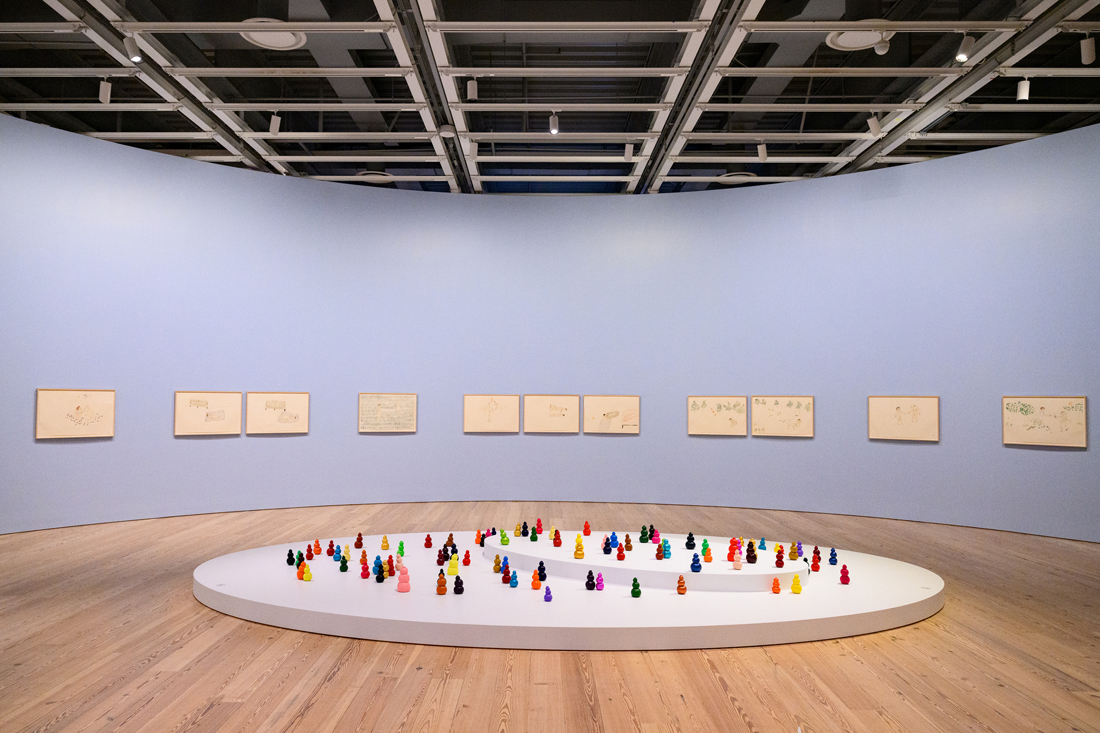
Whitney Biennial 2026, installation view. Courtesy Whitney Museum of American Art. Photo: Darian DiCanno / BFA.com. © BFA. Pictured: works by Emilie Louise Gossiaux, all 2025.
This brings me to my two favorite moments in the whole biennial—those pieces that I found emotionally crushing. The first continues in this theme of the human’s relationship to the nonhuman animal, and it’s also the first artwork you encounter on the fifth floor. It’s an installation of drawings and sculptures by Emilie Louise Gossiaux, made in memory of (and, she says, in collaboration with) her guide dog, London, who died last September. On a pedestal on the floor are one hundred ceramic replicas of London’s favorite chew toy. Surrounding this are eleven smallish framed drawings depicting woman and dog snuggling, cavorting, their bodies commingling. The drawings are naïve in style, their lines incidental, and they poignantly capture the soul connection between a human and the canine who makes her life possible. This is not weird neo–New Sincerity, but really sincere sincerity.
Whitney Biennial 2026, installation view. Courtesy Whitney Museum of American Art. Photo: Jason Lowrie / BFA.com. © BFA. Pictured: Basel Abbas and Ruanne Abou-Rahme, Until we became fire and fire us, 2023–ongoing.
The second is a very different kind of work. This is Palestinian duo Basel Abbas and Ruanne Abou-Rahme’s three-channel sound-and-video installation Until we became fire and fire us (2023–ongoing); it’s something visually cooler and more sophisticated, maybe, than Gossiaux’s memorial, but it’s also a visceral punch in the gut. Given the uproar around the single tiny reference to Palestine in the 2024 Whitney Biennial, I’m not sure why some critics bemoaning the apolitical nature of this one have ignored this piece in particular (maybe it wasn’t given its full due in the way it was tucked into a side viewing room?). The narrator of the video is on a journey to find ten of the lost five hundred villages destroyed in historic Palestine, which her father says she’ll be able to recognize by the presence of cactuses, an ineradicable plant. There is poetry about human becoming cactus, human digging into the land and becoming the land, this land that was taken and destroyed, under which lie so many bodies. There is dancing, in grief and joy, and singing about death. But also, the invocation, “THOSE WHO CHANT / DO NOT DIE.” This is a work that is totally political, totally breathtaking—and totally sincere.
Ania Szremski is the senior editor of 4Columns.